ARISSat-1/KEDR is now ready for deployment Today.

ARISSat-1/KEDR deployment on August 3

ARISSat-1/KEDR is now ready for deployment from the International Space Station during EVA 29 today, August 3.

NASA TV will cover the EVA live starting at 1400 GMT, August 3.
1430: Hatch Open
1446: Egress ARISSat-1/KEDR and secure to airlock ladder
1452: Remove solar panel covers
1507: Translate to deploy site, activate PWR, TIMER1 and TIMER2 switches, verify LEDs on, and deploy
(Internet streaming:http://www.nasa.gov/multimedia/nasatv/index.html)

Read the NASA Press Release about EVA-29 and ARISSat-1/KEDR at: http://tinyurl.com/3hdn5k4 (nasa.gov)


AMSAT-UK Photo Gallery

Upload your 2011 Colloquium Photo’s to the AMSAT-UK photo gallery.
http://t.co/BW8s9JL

Radio-to-Soundcard interface to receive satellite SSTV

The ARISSat-1/KEDR team have released this information about receiving the satellite:

The FM downlink on 145.950 MHz will be audible on all common 2 meter amateur radio receivers with no modification needed to your equipment.

A CW/SSB receiver will also receive the CW beacons on 145.919 MHz or 145.939 MHz and the signals on the linear transponder passband between 145.922 to 145.938 MHz.

To take advantage of the full bandwidth of the downlink for SSTV, CW Decoding, BPSK Decoding you’ll need to add a few things:

+ You’ll need an audio patch cable from your receiver to your computer soundcard audio input. If you are already on the air with other amateur radio soundcard applications then you are ready with the hardware to receive, decode, and display the SSTV, BPSK-1000 or BPSK-400 downlinks.

+ You’ll need SSTV software (refer to the SSTV news item)

+ You’ll need the ARISSatTLM software to decode the BPSK telemetry. (refer to the ARISSatTLM news item)

The key difference is that the SSTV signal is transmitted on the
FM downlink on 145.950 MHz. The BPSK-1000 downlink is transmitted in SSB mode on 145.920 MHz. Depending on your equipment you may need to fabricate an audio patch to the computer soundcard input from both your 2 meter FM radio and 2 meter SSB radio.

An initial “RECEIVE ONLY” configuration is easily done consisting of an audio patch cable between your radio and the soundcard. The ARISSat-1/KEDR team testing the software noted that a minimal set up consisting of an audio cable from the speaker or headphone output from the radio to the line (or mic) input on your PC sound card was successful. If your rig has a ‘Line Out’ audio connection this can be run to the soundcard ‘Line In’ connection.

Many amateur radio “digital modes” articles, web pages, and books also discuss the more complex requirements to interface your transmitter to the soundcard and to control the push-to-talk functions. This is NOT required for you to successfully receive, decode, and display the signals you receive from ARISSat-1/ KEDR. To join into the all the fun your “RECEIVE ONLY” configuration will just need the audio cable!
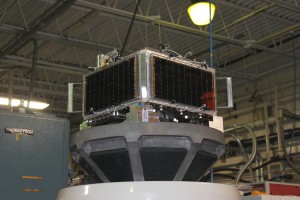
ARISSat-1 signals heard!

ARISSat-1 signals heard!

ARISSat-1

ARISSat-1

On Saturday ARISSat-1 was activated from onboard the Internatonal Space Station and its signals have been heard using just a handheld.

On the AMSAT bulletin board Gould WA4SXM writes:

Johan, ZS1I in South Africa reports hearing the ARISSat-1/Kedr SSTV signal using a handheld and a rubber duck antenna.

Sergey Samburov reports the 2m (145.950 Mhz) and the repeated 70 cm (437.55 MHz) signals active.

Please report signals heard, location and equipment tojulytest@arissat1.org.


AMSAT-UK Photo gallery

If you had the pleasure of attending the Colloquium today, don’t forget you can upload your photo’s to the AMSAT-UK photo gallery found here http://www.uk.amsat.org/Gallery3/index.php/

Just make a album and upload as many photo’s as you like!

Don’t forget to register!


73

Rob M0TFO

Don’t forget to watch live tomorrow –here

Live Webcast of Colloquium

The AMSAT-UK International Space Colloquium takes place at the Holiday Inn, Guildford, GU2 7XZ, this weekend, July 30-31. BATC and AMSAT-UK volunteers will be streaming video of the event live, enabling it to be seen around the world.

Clearly a webcast cannot match actually being there, with the opportunity to chat to satellite builders and inspect space hardware, but if you can’t get to Guildford then the webcast provides the next best thing.

Watch live at http://www.batc.tv/ch_live.php?ch=3 (view stream AMSAT 2011)

There’s also a Chat facility available that can be used to ask the presenters questions, set your  chat ID by entering: /nick “your callsign”

The schedule, times in BST (GMT+1), is at
http://tinyurl.com/2011ColloquiumSchedule