AMSAT Files FCC Comments on Proposed 2.4 and 5.8 GHz Satellite Use

FCC SealOn November 9, AMSAT filed comments with the Federal Communications Commission (FCC) on a proposal to let unlicensed devices communicate directly with satellites in two bands shared with the amateur and amateur-satellite services. AMSAT asked the Commission to keep the new satellite uplinks out of the 2400-2450 MHz amateur-satellite segment and not to add a satellite downlink allocation in the 2.4 GHz band.

The Notice of Proposed Rulemaking (NPRM), “Unleashing Unlicensed Spectrum for Direct-to-Device” (ET Docket No. 26-169, FCC 26-51), was adopted August 6 and released August 7. It would allow devices certified under Part 15 of the FCC’s rules, such as Wi-Fi and Bluetooth equipment, to transmit to authorized satellites in the 2400-2483.5 MHz and 5725-5850 MHz bands. A new footnote to the Table of Frequency Allocations, NG36, would permit mobile-satellite service uplinks in both bands on an unprotected, non-interference basis. Devices would remain within the existing Part 15 limits of up to 4 watts EIRP, although the FCC asks whether different limits are warranted for satellite links. The 902-928 MHz band, included in the draft released in July, was dropped before adoption.

The NPRM proposes no rules for satellite downlinks, but it asks whether they should be permitted at 5725-5850 MHz and whether a downlink allocation should be added at 2400-2483.5 MHz. It also proposes to confirm that Part 15 devices may be used inside spacecraft, seeks comment on their use during spacewalks and for links between spacecraft, and asks whether limits are needed on unintended radio emissions from satellite electronics.

In the United States, the amateur service is primary at 2400-2417 MHz and secondary at 2417-2450 MHz and across 5725-5850 MHz. The amateur-satellite service may operate at 2400-2450 MHz in both directions on a non-interference basis and has a secondary downlink allocation at 5830-5850 MHz.

In its 20-page filing, AMSAT said it does not oppose innovation in direct-to-device connectivity, but noted that the 2400-2450 MHz segment has hosted amateur satellite links for decades, from the S-band downlinks of AO-40 and AO-51 to the 2400-2410 MHz uplink of the QO-100 geostationary transponder. It described the 5830-5850 MHz segment as an important option for higher-rate microwave downlinks. The comments explain that amateur satellite links are often weak-signal links with margins that may be only a few decibels.

Terrestrial Part 15 emissions generally arrive from directions that a ground station’s antenna attenuates while tracking a satellite, but a co-frequency satellite in or near the antenna’s main beam may be received at high gain. For a reference ground station with a 60 cm dish, AMSAT’s technical appendix finds a difference of about 35 dB between the signal level an illustrative consumer downlink would need and the level that would protect the amateur receiver. AMSAT called this a serious warning about compatibility at 2400-2450 MHz rather than a complete sharing study, and said the whole 2400-2483.5 MHz band should be excluded from any downlink framework absent a convincing demonstration of compatibility.

On the uplink side, AMSAT noted that links to orbit could favor outdoor, skyward transmissions, while many Wi-Fi and Bluetooth links today operate indoors or below maximum power. Its bounding calculations show that a single device at the maximum permitted power spectral density could approach the interference allowance of a narrowband transponder channel on a low Earth orbit amateur satellite passing overhead, and that roughly 10 to 30 co-channel devices transmitting skyward at full power at once could raise the satellite receiver’s noise floor by about 3 dB in 1 MHz. Calling these figures stress tests rather than forecasts, AMSAT asked the Commission to require realistic aggregate interference studies that treat amateur satellite receivers as victims.

Among other things, AMSAT asked the Commission to:

• Add no satellite downlink allocation at 2400-2483.5 MHz, and issue a further notice with specific rule text and technical analysis before adopting downlink rules in any band.
• Exclude the 5830-5850 MHz amateur-satellite downlink segment from any 5725-5850 MHz downlink framework, or protect it with limits based on the needs of amateur ground stations.
• Allow no increase in Part 15 power, antenna gain, or emission limits for transmissions to satellites, and cap direct-to-device earth stations at 36 dBm (4 watts) EIRP.
• Revise footnote NG36 to bar operations under it from causing harmful interference to, or claiming protection from, the amateur and amateur-satellite services; to include those technical limits; and to confine the 2.4 GHz uplink allocation to 2450-2483.5 MHz, where there is no amateur allocation.
• Require an individual license or U.S. market access grant for every satellite operating under the new framework, a public point of contact for interference reports, prompt investigation and mitigation of harmful interference, and a public database of authorized operations.
• Apply radiated emission limits at least as strict as the Part 15 Class B limits, as an initial benchmark, to unintended emissions from spacecraft in bands used by the amateur-satellite and passive services, measured before launch, with stricter narrowband or aggregate limits where needed.
• On the last point, AMSAT noted that the reported unintended emissions, at 40-70 MHz and 110-188 MHz, overlap the 50-54 MHz amateur band and the 144-146 MHz amateur-satellite band, including the 145.8-146.0 MHz segment that carries ARISS downlinks and the downlinks of amateur and university satellites. Its analysis found that a Class B-level limit offers substantial protection against a single spacecraft’s emissions but cannot by itself guarantee protection against narrowband emissions from large constellations.

AMSAT supported confirming that Part 15 devices may be used inside spacecraft, citing the long-standing use of crew Wi-Fi and Bluetooth devices aboard the International Space Station alongside ARISS. It urged greater caution about spacewalk and spacecraft-to-spacecraft use of 2400-2450 MHz, where no hull shields amateur satellites sharing the band.

***For More Information***

The FCC NPRM (FCC 26-51) is available at: https://docs.fcc.gov/public/attachments/FCC-26-51A1.pdf

AMSAT’s comments are available at: https://www.fcc.gov/ecfs/document/26110084235/1

Reply comments are due December 7, 2026, and may be filed at https://www.fcc.gov/ecfs/

Source AMSAT News Service (ANS) https://mailman.amsat.org/hyperkitty/list/ans@amsat.org/thread/UDSS7CEAZYFTPBPOT2INZ3COVHPWJLKD/
Astronaut to use Amateur Radio to Talk to UK Students

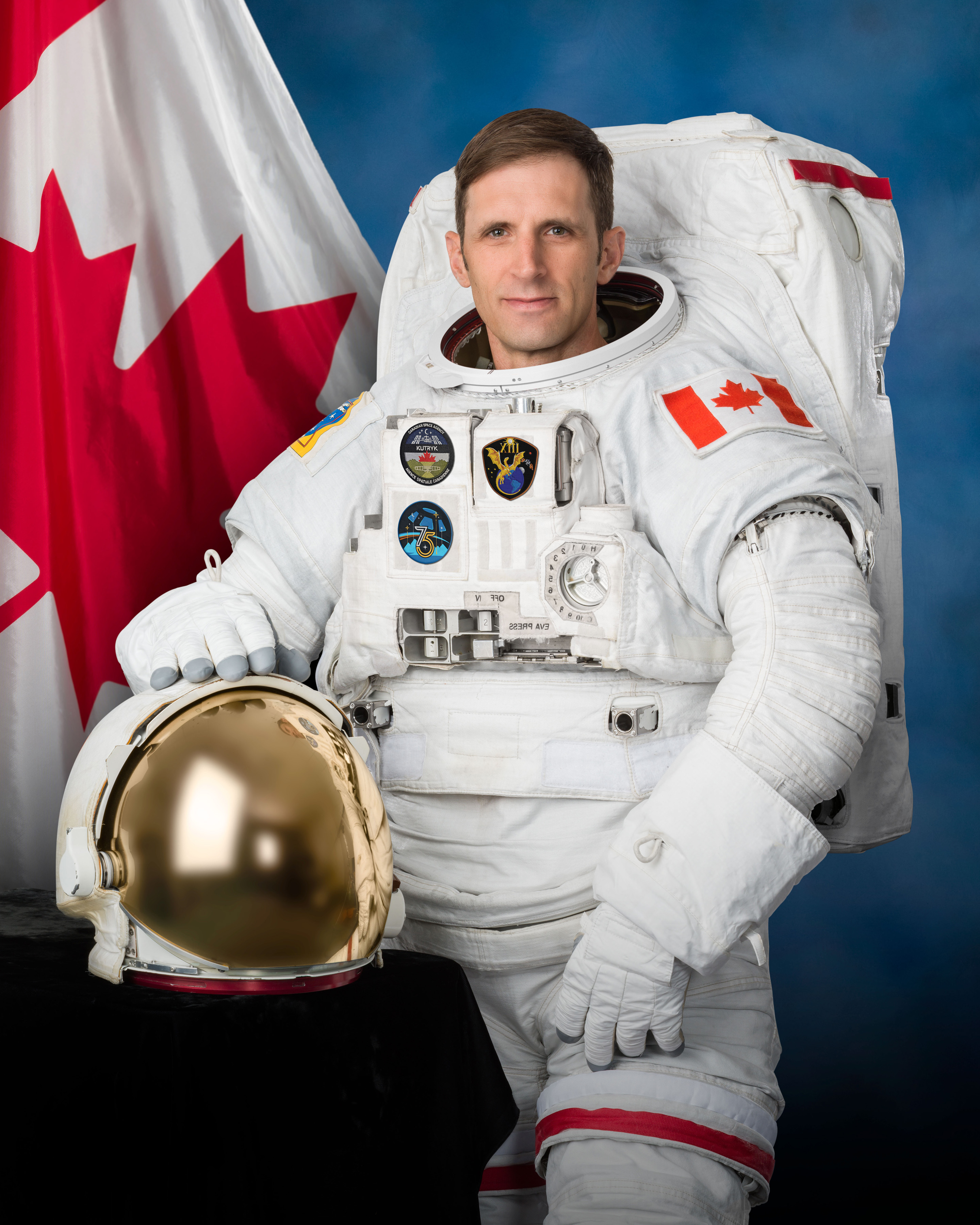
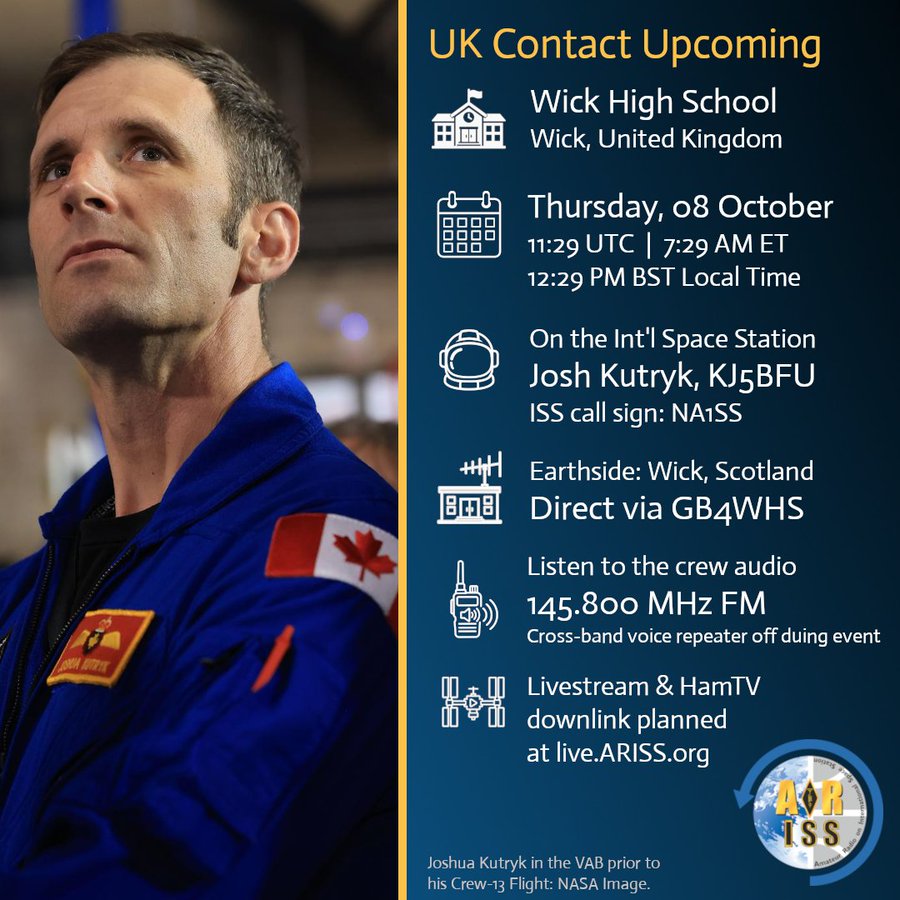
Wick High School ARISS Contact DetailsRescheduled Date: Students at Wick High School in Caithness will use amateur radio to ask astronaut Joshua Kutryk KJ5BFU questions about space.

The ARISS contact, using the call signs NA1SS on the International Space Station and GB4WHS at the school, will take place on Thursday, October 8, 2026, at 12:29 PM BST (11:29 GMT). You can listen in to the ISS downlink on 145.800 MHz (plus/minus 3 kHz Doppler shift) FM.

The event will be streamed live at https://live.ariss.org/

The space and ground teams will attempt to use the HamTV transmitter during this contact to send live Digital Amateur TV pictures of the astronaut on a frequency of 2395 MHz.

The HamTV downlink will be streamed at https://live.ariss.org/hamtv/

Wick High School is a comprehensive secondary school with 725 students aged 11-18. The school has 9 feeder primaries with around 800 children aged 5-11. The Caithness community is in the very far north of mainland Scotland. The area has a large employment focus on engineering, nuclear and renewable energy, with many of our students looking to careers in these industries. The High School encourages and supports pathways into these industries through our excellent Technologies departments.

The Wick High School Radio Club, GMØWHS, plays an important role in this programme by introducing students to amateur radio, satellite communications and wireless technology. Through practical activities, pupils develop technical knowledge alongside teamwork, problem-solving and communication skills while gaining an insight into careers in engineering, aerospace and technology, all while studying for their industry-recognised Foundation licence qualification.

For many young people living in this remote part of Scotland, opportunities to engage directly with the space sector are limited. A live conversation with an astronaut aboard the International Space Station would provide an unforgettable educational experience, raising aspirations and inspiring the next generation of scientists, engineers and explorers.

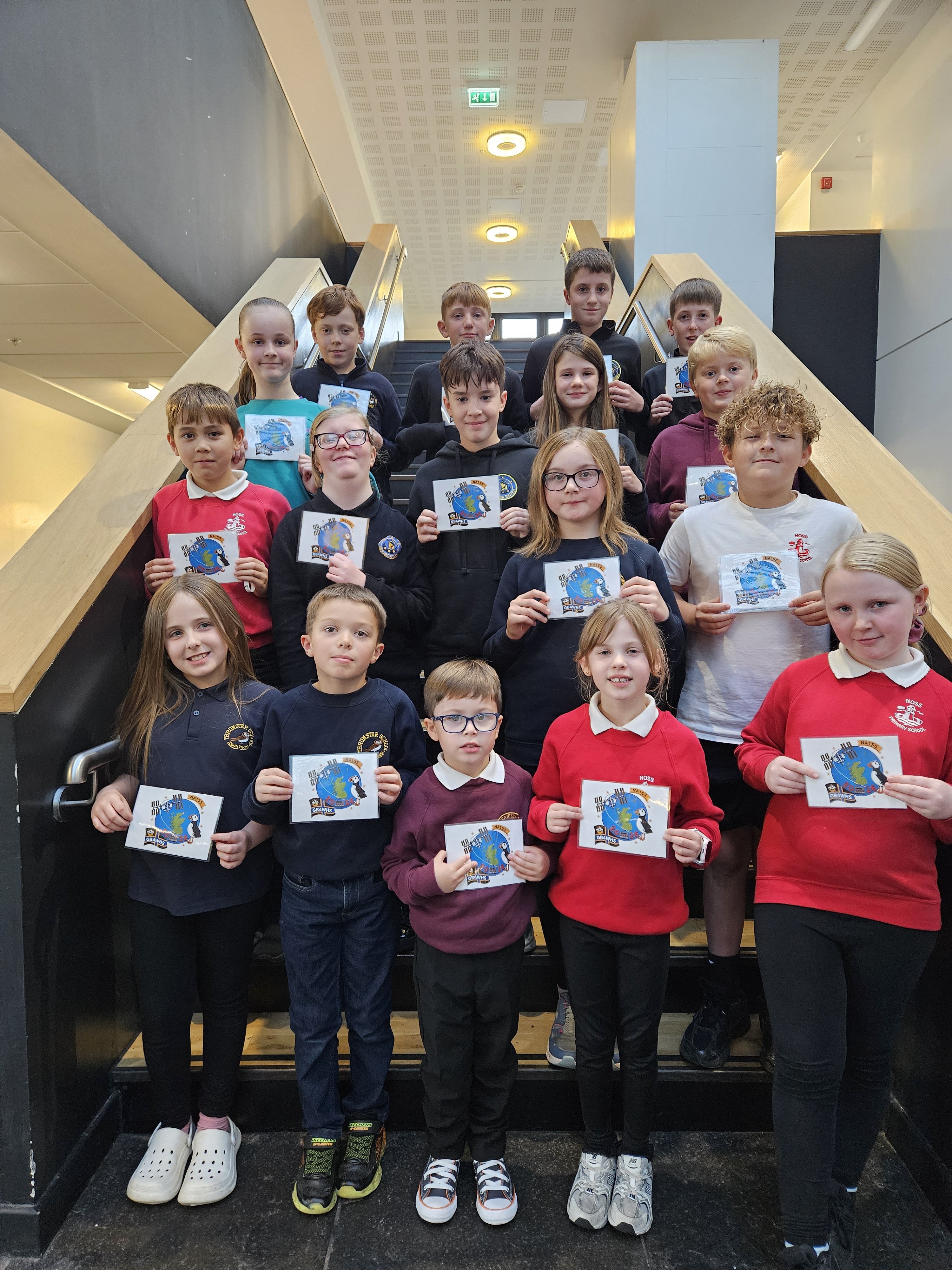
Young questioners with their practice cue cards at Wick High School

Young questioners with their practice cue cards – Credit: Wick High School

Questions (if the time of radio contact allows):
1. Which one thing do movies always get wrong about space?
2. What changed in your perspective on Earth after seeing it from outer space?
3. Why do you take the risk of going up into space?
4. What do you do if you have to go outside the ISS?
5. What do you find hard about living in the Space Station?
6. How does food taste in space compared to here on Earth?
7. How much do you use the phonetic alphabet in space?
8. What experiment were you most excited to work on?
9. Which part of your job, when you are in space, is your favourite?
10. How did you prepare your body and mind for going to space?
11. I dream of being an astronaut. What skills should I learn to become an astronaut?
12. I like to play games at home. Do astronauts play games in space?
13. Do astronauts get space sick like getting car sick?
14. Have you ever broke anything on ISS?
15. What other planets have you seen when up in space?
16. When you first went to space were you surprised by anything?
17. What do you do in your free time?
18. In what way is a spacesuit comfortable or uncomfortable?
19. How did you feel when you got chosen to go on the Space Station?
20. Can you get a power outage in space and what would happen?

In an article in the TES (Times Educational Supplement) magazine teacher Chris Aitken MM0WIC explained why he started an amateur radio club at Wick High School.
https://tes.com/magazine/teaching-learning/general/why-i-started-amateur-radio-club-my-school

Follow Wick High School Radio Club on X https://x.com/GM0WHS

Joshua Kutryk KJ5BFU - Credit: Canadian Space Agency

Joshua Kutryk KJ5BFU – Credit: Canadian Space Agency

Follow astronaut Joshua Kutryk KJ5BFU on X https://x.com/Astro_Kutryk

The ARISS program is aimed at students and enthusiasts and aims to inspire them in the study of sciences with this amateur radio activity. The demonstration of amateur radio communication from space invites schools and universities to make use of these educational technical resources. We invite radio amateurs and space enthusiasts to tune in to this exciting moment.

The latest information on the ARISS operation mode can be found at
https://www.ariss.org/current-status-of-iss-stations.html

How to hear the ISS https://amsat-uk.org/beginners/how-to-hear-the-iss/

You can use the AMSAT-UK/BATC WebSDR to listen to the contact on your mobile device https://vhf-goonhilly.batc.org.uk/

What is Amateur Radio? http://www.essexham.co.uk/what-is-amateur-radio

Free UK amateur radio Online Training course https://essexham.co.uk/train/foundation-online/

Students On The Air Satellite Activity Starts March 3

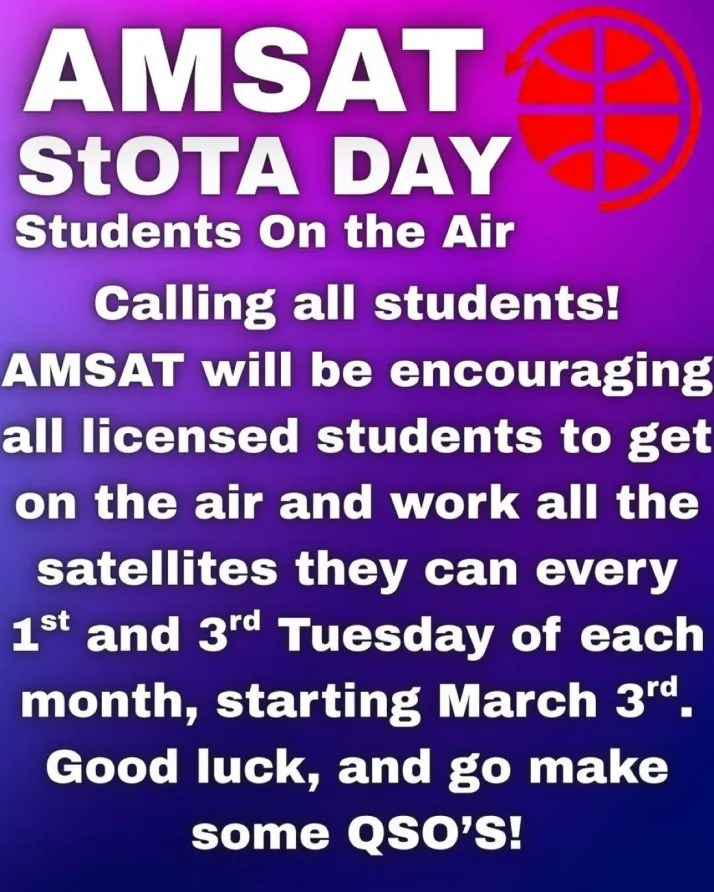
Students On The Air - StOTA Every 1st and 3rd Tuesdays of each month starting March 3, 2026

AMSAT has announced the launch of Students On The Air (StOTA) Days, a new initiative aimed at encouraging student participation in amateur satellite operations. The activity was inspired by AMSAT President Drew Glasbrenner, KO4MA, and his son Carsten, KQ4SJM, and is designed to promote regular on-air activity among licensed student operators.

Students are encouraged to get on the air and operate via amateur satellites on the first and third Tuesdays of each month, beginning March 3, 2026. While student-to-student contacts are especially encouraged, all satellite operators are welcome to participate and help make students feel welcome on the air.

To support coordination, AMSAT has created a dedicated #students-on-the-air channel on the AMSAT Discord Server where participants can arrange contacts and share activity.

AMSAT Discord Invite https://discord.gg/xbTXcPJHyt

StOTA (Students On The Air) channel https://discord.com/channels/715554730323083274/715891435143954512

Reports of StOTA activity and contacts are encouraged and may be submitted to Carsten, KQ4SJM, whose contact information is available via QRZ.com

Activity reports will help AMSAT gauge participation and support future student-focused satellite initiatives.

Source AMSAT News Service https://mailman.amsat.org/postorius/lists/ans.amsat.org/

Webinar for CCSDS Outreach Initiative and Competition

Following on from our announcement of the ESA / CCSDS sponsored outreach competition to develop reference protocols, AMSAT-UK are pleased to announce they will be holding a webinar at 16:00 UTC on Wednesday 14th January.

The webinar will be via Zoom and the event will be recorded. The registration link is here:

https://zoom.us/meeting/register/KgrRSLJgQN2tpriQye18tw

A reminder that the details of the competition can be found here:

https://amsat-uk.org/2025/12/08/ccsds-outreach-initiative-and-competition/

73
Dave Johnson, G4DPZ
Hon Sec, AMSAT-UK
Email: esa-competition@amsat-uk.org

Fram2 Mission Launched

Rabea Rogge LB9NJ / KD3AID - Photo credit DLR

Rabea Rogge LB9NJ / KD3AID – Photo credit DLR

A SpaceX rocket carrying radio amateur Rabea Rogge LB9NJ / KD3AID and three other astronauts launched from Pad 39A at the Kennedy Space Center on April 1 at 0146 GMT on the Fram2 mission. It is the first polar-orbit human spaceflight mission to explore Earth.

During the mission Rabea will be transmitting amateur radio Robot 36 Slow Scan TV (SSTV) images on 437.550 MHz (+/- 10 kHz Doppler shift) starting April 2. Operation will be 36 seconds on and 36 seconds off.

The images are transmitted as part of a competition for students. Please do not post your SSTV images on Social Media or share with others until 72 hours after the completion of the Fram2 mission.

ARISS will provide special commemorative certificates for those who upload their Fram2 SSTV images to the ARISS SSTV Gallery. Certificates will be delivered after the completion of the Fram2 mission.

If possible record all your passes. You can always generate an image later with the recording. Particularly if you have an issue with your audio into your SSTV software.

There are several challenges in receiving the images,  the low transmit power, variations of antenna orientation, and a short, 3-day mission duration, with only a limited time assigned for the SSTV operation. Are you up for the challenge? 📡

Watch a recording made by Robbie Ei2iP of the amateur radio downlink during the contact on April 1 at 0728 GMT between Fram2 astronaut Rabea Rogge LB9NJ / KD3AID and students at the Technical University Berlin (note unexpected frequency change).

Watch the Technical University Berlin video of the contact

Operations Frequency: 437.550 MHz FM (+/- 10 kHz Doppler shift).

SSTV Mode: Robot 36

ARISS are livestreaming orbital predictions for the Fram2 mission at http://live.ariss.org/

Orbital predictions, select Fram2Ham https://www.amsat.org/track/

Fram2 TLEs (also known as Keplerian, or Orbital Elements) https://www.ariss.org/keps.html

See the pictures received in the ARISS SSTV Gallery at https/ariss-usa.org/ARISS_SSTV/

Fram2Ham https://fram2ham.com/

First human Spaceflight to Earth’s polar regions https://f2.com/

Fram2Ham on Discord https://discord.com/invite/GYQzmSh5sp

Student competition details https://fram2ham.com/wp-content/uploads/2025/02/amapay_user_manual-ver-2-7-2025.pdf

Follow Rabea on X https://x.com/rprogge

Follow Chun Wang on X https://x.com/satofishi

Follow ARISS on X https://x.com/ARISS_Intl

Follow AMSAT-UK on X https://x.com/amsatuk

AMSAT-UK Space Colloquium 2024

Kents Hill Park Conference Centre Milton Keynes MK7 6BZAMSAT-UK is pleased to announce that the 2024 Colloquium will take place alongside the RSGB Convention at Kents Hill Park Conference Centre, Milton Keynes, MK7 6BZ on the weekend of 12/13th October 2024.

As in previous years, the AMSAT-UK Colloquium will run as a separate stream within the RSGB Convention and will include presentations on a variety of satellite and space related topics.

The Annual General Meeting of AMSAT-UK will take place during the colloquium.

An AMSAT Gala Dinner will be held on the evening of Saturday 12th October at the Marriott Delta Hotel on Trimbold Drive, Kents Hill, Milton Keynes MK7 6HL. Attendance is restricted this year at the hotel and a limited number of tickets are on sale via the AMSAT-UK Online Shop https://shop.amsat-uk.org/

The cost of the Gala Dinner is £39 per person and includes a three course meal with tea / coffee at its conclusion.

Alongside the Gala Dinner, AMSAT-UK has negotiated a deal at the Marriott Delta for the evening of Saturday 12th October 2024. These rooms include breakfast on Sunday 13th and are priced at £89 per room for single occupancy. Tickets for the Gala Dinner can be purchased on the AMSAT-UK Online Shop.

Bookings for the Gala Dinner are now available on the AMSAT-UK Shop, but must close on 1st October 2024 unless sold out sooner, so please book early to avoid disappointment.

Entrance to the RSGB Convention is managed by the RSGB and you will be required to purchase Day Tickets for the Saturday and/or Sunday to attend the AMSAT-UK Colloquium.

RSGB Convention booking is at https://rsgb.org/main/rsgb-2024-convention/

The schedule of Colloquium talks will be released closer to the date.