Live stream of AMSAT-UK Colloquium Talks

AMSAT-UK LogoFor those who cannot attend the AMSAT-UK Colloquium on October 10-11 the talks will be streamed live on YouTube from 9:15 AM BST (08:15 GMT).

Saturday 10th http://youtube.com/live/WQy0CXqjp3M

Sunday 11th https://youtube.com/live/CS6i-xeDm7o

The schedule of AMSAT-UK talks can be seen in the RSGB Convention programme  listings for Saturday and Sunday, see the Lecture Room 5 AMSAT-UK column
https://rsgb.org/main/about-us/rsgb-convention/rsgb-2026-convention-programme-and-speakers/

Videos of the talks will be added later to the AMSAT-UK YouTube channel

Follow AMSAT-UK on X

Wick High School ARISS Contact a Great Success

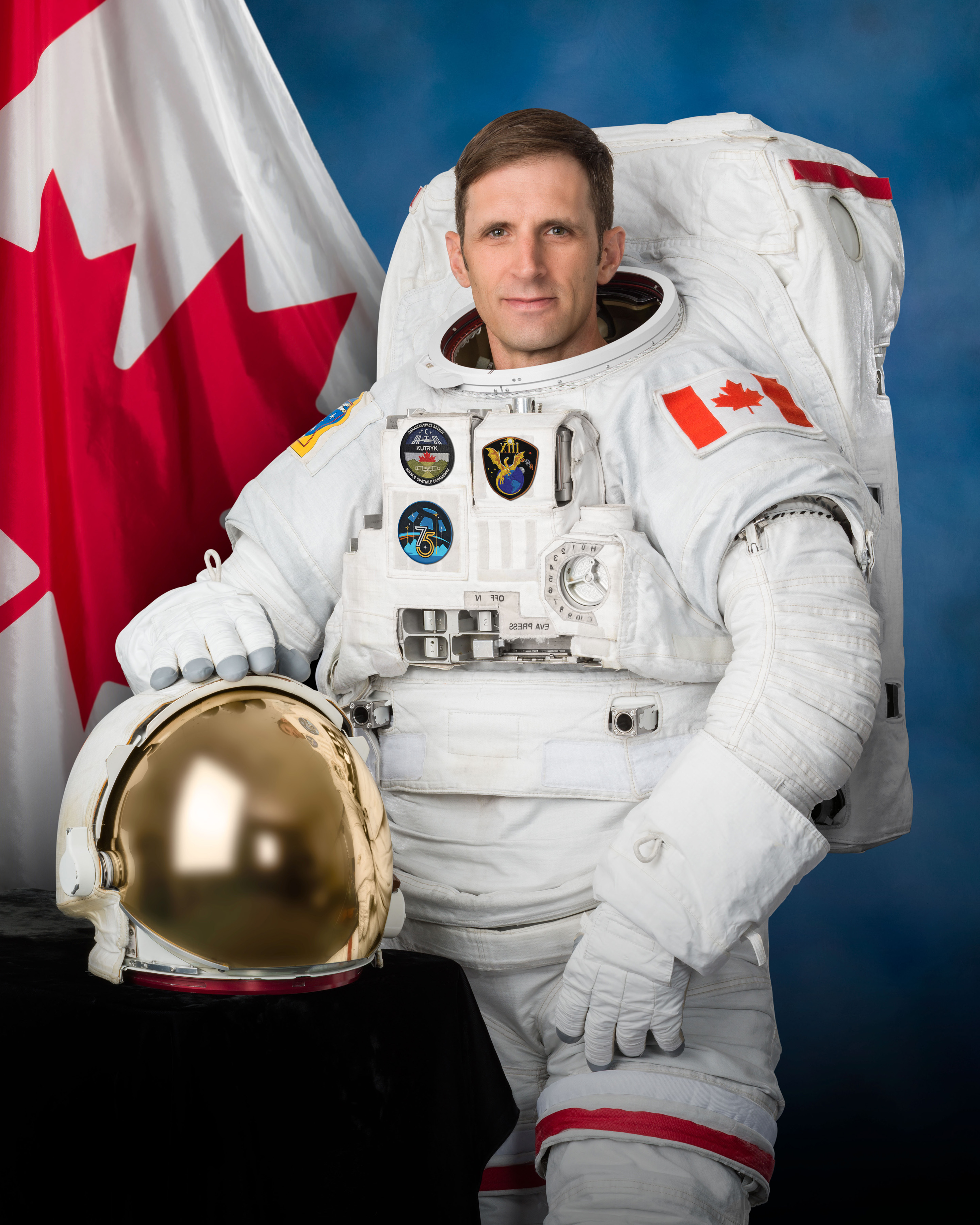
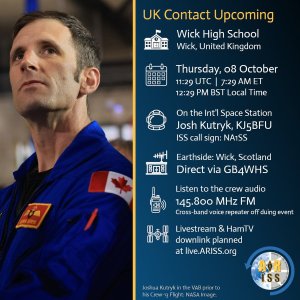
Joshua Kutryk KJ5BFU - Credit: Canadian Space Agency

Joshua Kutryk KJ5BFU – Credit: Canadian Space Agency

Wick High School (@GM0WHS on X) in Caithness used amateur radio to have an eight minute question and answer session with astronaut Joshua Kutryk KJ5BFU on the International Space Station (ISS).

This historic event took place at 12:29 BST on Thursday, October 8, 2026, and was the most northerly school contact with the ISS ever achieved anywhere in the world.  At a latitude of 58.4° North the space station was low on the horizon making it particularly challenging.

In addition to the 150 students and dozens of parents gathered in the dance studio for the event, students and feeder primary school pupils across the region were able watch a live web stream.

The event was a great success and attracted considerable media interest. A full video of the event at the school has been made available on the ARISS Operations UK Team YouTube channel

Among the media outlets reporting on the event were:

BBC News article and video
https://www.bbc.co.uk/newsround/articles/c94g1jle86y8o

STV News
https://news.stv.tv/highlands-islands/wick-high-school-pupils-speak-with-astronaut-joshua-kutryk-on-international-space-station

The John O’Groat Journal
https://www.johnogroat-journal.co.uk/news/the-audio-was-so-clear-caithness-school-makes-radio-cont-447025/

The Scotsman newspaper
https://www.scotsman.com/education/from-caithness-to-space-school-radio-club-contacts-astronauts-on-space-station-9275794

BBC Scotland used a phone to shoot a video of the Wick High School contact with ISS:
https://x.com/BBCScotlandNews/status/2108225654516756916

Further information on the contact and a list of all the questions asked is at
https://amsat-uk.org/2026/10/03/astronaut-to-use-amateur-radio-to-talk-to-uk-students/

The ARISS program is aimed at students and enthusiasts and aims to inspire them in the study of sciences with this amateur radio activity. The demonstration of amateur radio communication from space invites schools and universities to make use of these educational technical resources. We invite radio amateurs and space enthusiasts to tune in to this exciting moment.

What is Amateur Radio? http://www.essexham.co.uk/what-is-amateur-radio

Free UK amateur radio Online Training course https://essexham.co.uk/train/foundation-online/

Follow AMSAT-UK on X

Astronaut to use Amateur Radio to Talk to UK Students

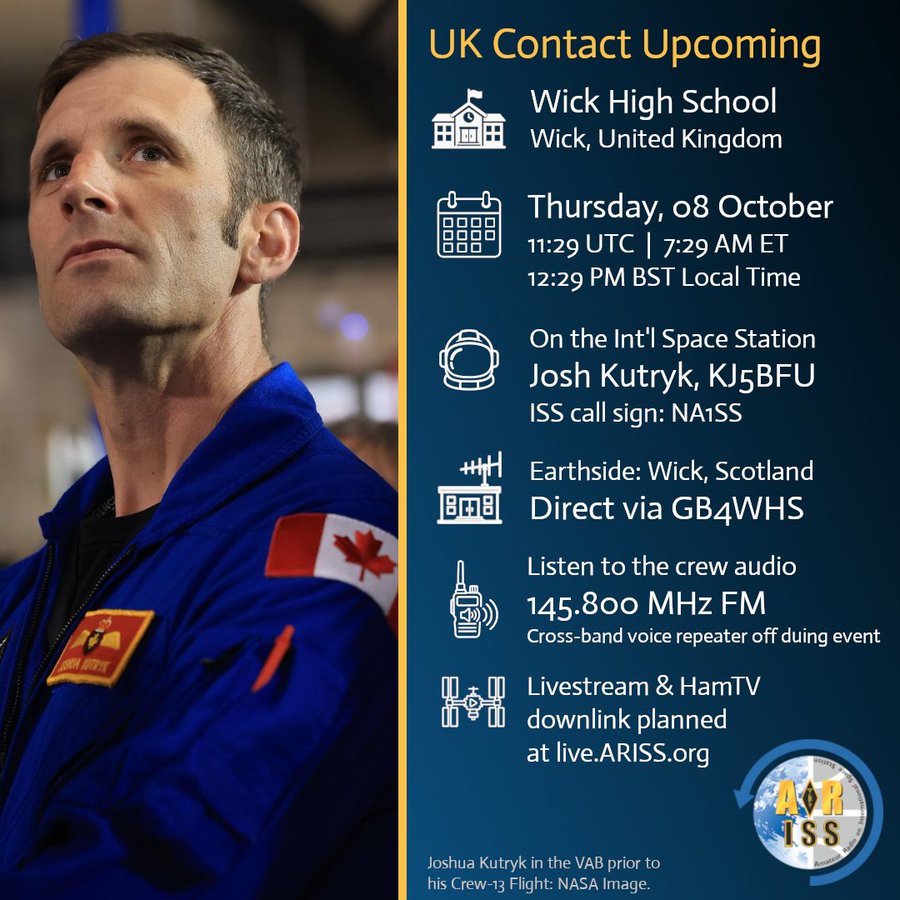
Wick High School ARISS Contact DetailsRescheduled Date: Students at Wick High School in Caithness will use amateur radio to ask astronaut Joshua Kutryk KJ5BFU questions about space.

The ARISS contact, using the call signs NA1SS on the International Space Station and GB4WHS at the school, will take place on Thursday, October 8, 2026, at 12:29 PM BST (11:29 GMT). You can listen in to the ISS downlink on 145.800 MHz (plus/minus 3 kHz Doppler shift) FM.

The event will be streamed live at https://live.ariss.org/

The space and ground teams will attempt to use the HamTV transmitter during this contact to send live Digital Amateur TV pictures of the astronaut on a frequency of 2395 MHz.

The HamTV downlink will be streamed at https://live.ariss.org/hamtv/

Wick High School is a comprehensive secondary school with 725 students aged 11-18. The school has 9 feeder primaries with around 800 children aged 5-11. The Caithness community is in the very far north of mainland Scotland. The area has a large employment focus on engineering, nuclear and renewable energy, with many of our students looking to careers in these industries. The High School encourages and supports pathways into these industries through our excellent Technologies departments.

The Wick High School Radio Club, GMØWHS, plays an important role in this programme by introducing students to amateur radio, satellite communications and wireless technology. Through practical activities, pupils develop technical knowledge alongside teamwork, problem-solving and communication skills while gaining an insight into careers in engineering, aerospace and technology, all while studying for their industry-recognised Foundation licence qualification.

For many young people living in this remote part of Scotland, opportunities to engage directly with the space sector are limited. A live conversation with an astronaut aboard the International Space Station would provide an unforgettable educational experience, raising aspirations and inspiring the next generation of scientists, engineers and explorers.
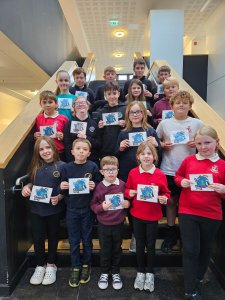
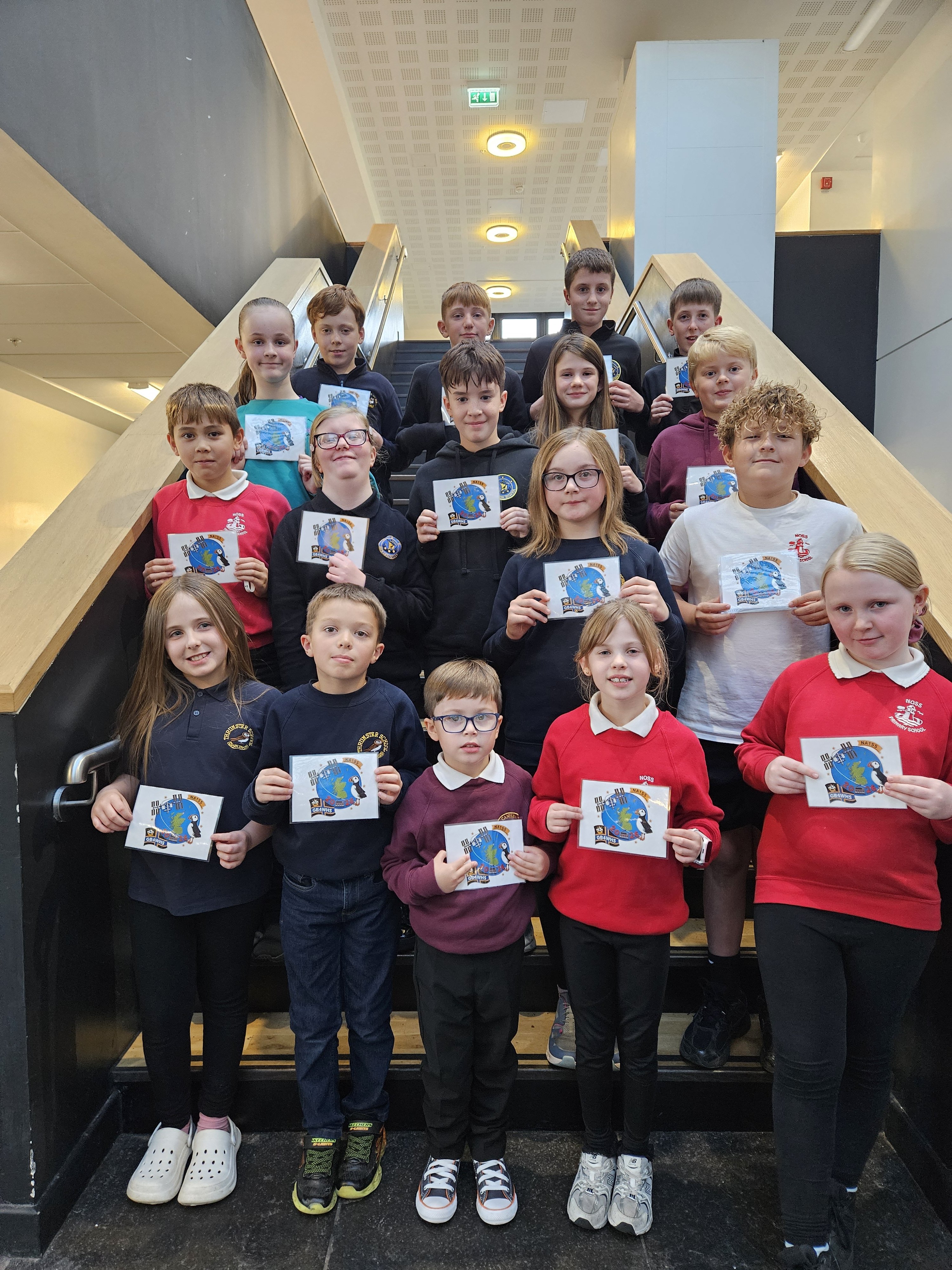
Young questioners with their practice cue cards at Wick High School

Young questioners with their practice cue cards – Credit: Wick High School

Questions (if the time of radio contact allows):
1. Which one thing do movies always get wrong about space?
2. What changed in your perspective on Earth after seeing it from outer space?
3. Why do you take the risk of going up into space?
4. What do you do if you have to go outside the ISS?
5. What do you find hard about living in the Space Station?
6. How does food taste in space compared to here on Earth?
7. How much do you use the phonetic alphabet in space?
8. What experiment were you most excited to work on?
9. Which part of your job, when you are in space, is your favourite?
10. How did you prepare your body and mind for going to space?
11. I dream of being an astronaut. What skills should I learn to become an astronaut?
12. I like to play games at home. Do astronauts play games in space?
13. Do astronauts get space sick like getting car sick?
14. Have you ever broke anything on ISS?
15. What other planets have you seen when up in space?
16. When you first went to space were you surprised by anything?
17. What do you do in your free time?
18. In what way is a spacesuit comfortable or uncomfortable?
19. How did you feel when you got chosen to go on the Space Station?
20. Can you get a power outage in space and what would happen?

In an article in the TES (Times Educational Supplement) magazine teacher Chris Aitken MM0WIC explained why he started an amateur radio club at Wick High School.
https://tes.com/magazine/teaching-learning/general/why-i-started-amateur-radio-club-my-school

Follow Wick High School Radio Club on X https://x.com/GM0WHS
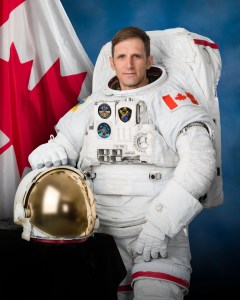
Joshua Kutryk KJ5BFU - Credit: Canadian Space Agency

Joshua Kutryk KJ5BFU – Credit: Canadian Space Agency

Follow astronaut Joshua Kutryk KJ5BFU on X https://x.com/Astro_Kutryk

The ARISS program is aimed at students and enthusiasts and aims to inspire them in the study of sciences with this amateur radio activity. The demonstration of amateur radio communication from space invites schools and universities to make use of these educational technical resources. We invite radio amateurs and space enthusiasts to tune in to this exciting moment.

The latest information on the ARISS operation mode can be found at
https://www.ariss.org/current-status-of-iss-stations.html

How to hear the ISS https://amsat-uk.org/beginners/how-to-hear-the-iss/

You can use the AMSAT-UK/BATC WebSDR to listen to the contact on your mobile device https://vhf-goonhilly.batc.org.uk/

What is Amateur Radio? http://www.essexham.co.uk/what-is-amateur-radio

Free UK amateur radio Online Training course https://essexham.co.uk/train/foundation-online/

YouTube: The Addictive World of Amateur Radio Satellites

The Online Amateur Radio Community (OARC) talk by John Stringer M5JFS titled ‘Chasing Birds: The Addictive World of Amateur Radio Satellites’ is now on YouTube.

“An introduction to the world of amateur radio satellite working. John will start with a brief potted history of how he got hooked on this aspect of the hobby, getting started with very modest and basic gear that he had to hand and how he later developed and improved his ‘station’ to where it is today as he grew in experience and interest. He’ll then cover the types of satellites that are out there, the gear you need (or don’t need) to work them, operating etiquette and best practices, useful software, tools and social networks, and finally he’ll tell us about a few notable moments and achievements that he’s had in his 6 years on the birds.”

The Online Amateur Radio Community (OARC) on Discord has a dedicated channel for discussions of Satellites, including Weather Satellites, a separate channel for QO-100 discussions and numerous channels covering a wide range of amateur radio interests.
You can join OARC via https://oarc.uk/join

OARC Wiki pages https://wiki.oarc.uk/directory

Follow John Stringer M5JFS on X: https://x.com/M5Jfs

Follow AMSAT-UK on X: https://x.com/AmsatUK

AST SpaceMobile to use 430 MHz band for 248 satellites

434.100 MHz downlink received September 12, 2024 by PE0SAT

434.100 MHz downlink received September 12, 2024 by PE0SAT

On April 21, the FCC announced that AST SpaceMobile (AST & Science, LLC) will be using the Amateur 430 MHz band for 248 satellites in its planned Low-Earth-Orbit constellation which aims to provide global cellular broadband communications.

Center frequencies are 430.5 MHz, 432.3 MHz, 434.1 MHz, 435.9 MHz, 439.5 MHz with 50 kHz bandwidth.

Read the FCC announcement at https://docs.fcc.gov/public/attachments/DA-26-391A1.pdf

ISS Astronaut to use Amateur Radio to Talk to UK Students

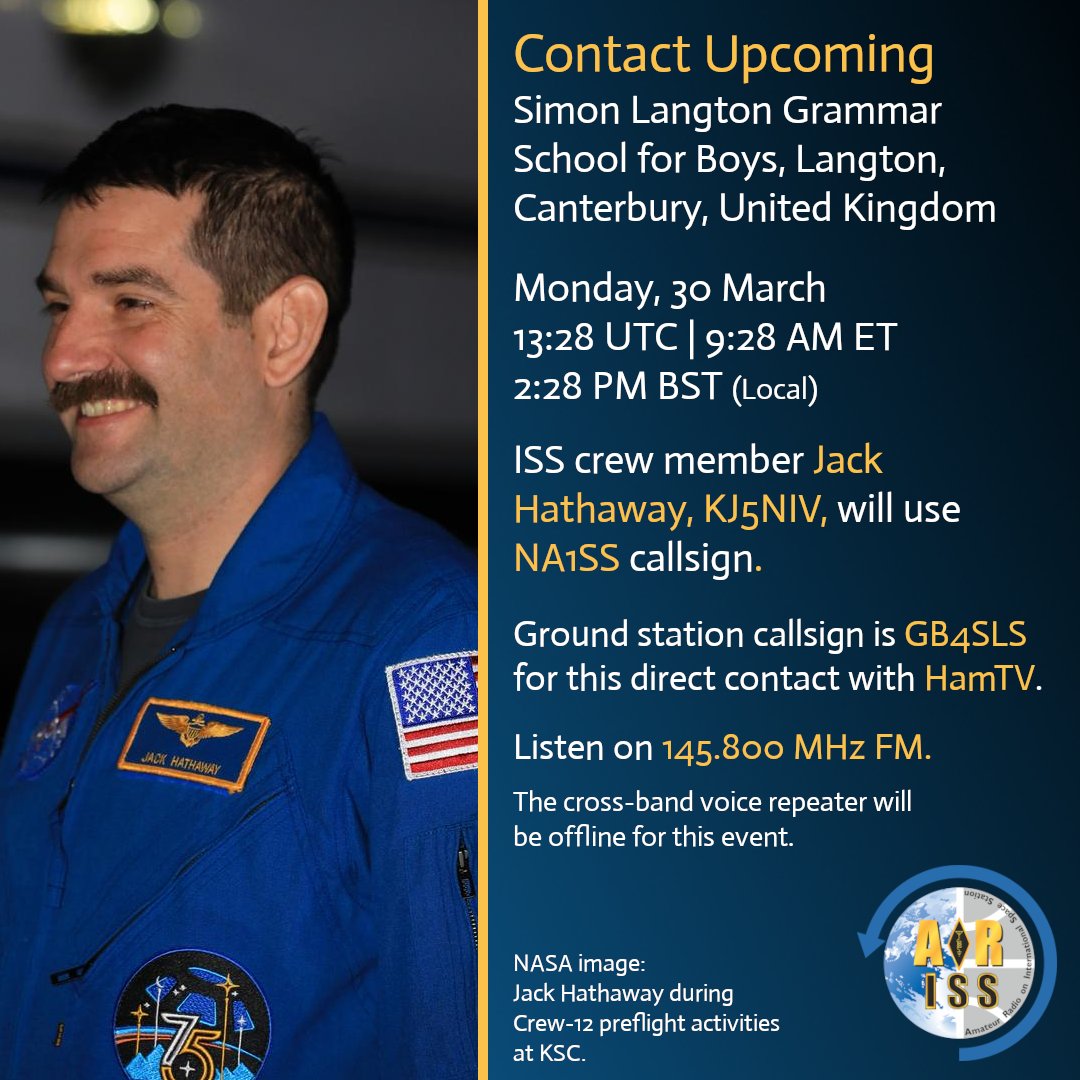
2026-03-30 ARISS UK ContactStudents at Simon Langton Grammar School for Boys will use amateur radio to speak to astronaut Jack Hathaway, KJ5NIV, on the International Space Station (ISS).  The ARISS contact, between NA1SS on the ISS and GB4SLS at the school, will take place on Monday, March 30, 2026 at 2:28 PM BST (13:28 GMT). You can listen in on 145.800 MHz (plus/minus 3 kHz Doppler shift) FM.

Astronaut Jack Hathaway, KJ5NIV, will answer questions from Simon Langton Grammar School for Boys, Canterbury, U.K.

The space and ground teams will attempt to use the HamTV transmitter during this contact. The HamTV DATV frequency is 2395 MHz.

The event will be streamed live: https://live.ariss.org/

The HamTV downlink will be streamed: https://live.ariss.org/hamtv/

Questions:
1. What are the purposes of the experiments you do in space?
2. Why do we go to space to do some experiments rather than do them on Earth?
3. How does the ISS stay in orbit around the earth?
4. How does it feel to see so many sunsets and sunrises each day from the ISS
5. What food do you eat on the ISS?
6. Why is there no air in space?
7. How does rocket fuel work when there is no air for combustion?
8. What do you do for entertainment on the ISS?
9. How hard do you have to train to go into space?
10. What is it like launching into space?
11. What is like to be in zero gravity for a long period of time?
12. Without weight pulling things down onto the ground there must be a lot less friction to help you move, how do you compensate for that?
13. Do you have any source of internet in space?
14. What is the most amazing thing that you have seen from space?
15. What ordinary daily tasks are the most difficult to do in space?
16. How does being in space affect the human body?
17. Is there a lot of noise on the ISS or is it quite quiet?
18. How do you clear up spills in space?
19. Do you ever feel lonely from the isolation in space?
20. How do you prepare for space walks?

The ARISS program is aimed at students and enthusiasts and aims to inspire them in the study of sciences with this amateur radio activity. The demonstration of amateur radio communication from space invites schools and universities to make use of these educational technical resources. We invite radio amateurs and space enthusiasts to tune in to this exciting moment.

Follow ARISS International on X

The latest information on the ARISS operation mode can be found at
https://www.ariss.org/current-status-of-iss-stations.html

How to hear the ISS https://amsat-uk.org/beginners/how-to-hear-the-iss/

What is Amateur Radio? http://www.essexham.co.uk/what-is-amateur-radio

Free UK amateur radio Online Training course https://essexham.co.uk/train/foundation-online/