In this HamRadioNow video Lou McFadin W5DID describes the ARISSat-1 satellite, using the operational model at the AMSAT booth at the Orlando HamCation. HamRadioNow says Gary KN4AQ feels inadequate in the presence of such accomplished hams, and he insults the astronauts. That makes Lou uncomfortable, so he goes on to talk about the future of AMSAT and ARISSat.
Lou says that the reason for the ARISSat-1 435 MHz antenna snapping off was due to damage in transit up to the Internatonal Space Station (ISS). He mentions that he hopes NASA can be persuaded to take ARISSat-2 to the ISS. Lou also describes the problems caused by the US Federal Government ITAR restrictions.
Watch HamRadioNow Episode 2, Part 2 – AMSAT
The grab handles shown on ARISSat were supplied by a member of AMSAT-UK.
Original design of the Euroluna Romit-3 Lunar Rover – Image courtesy of Andrew Collis/X-Prize Foundation
The President of Euroluna Palle Haastrup OZ1HIA gives an update on the Romit1 CubeSat and plans for Romit2 and Romit3.
Euroluna are a Danish amateur team participating in the $30 million Google Lunar X PRIZE contest to be the first privately funded team to land and drive a rover on the Moon.
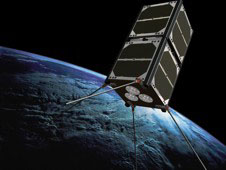
Romit1 is a 2U CubeSat that is planned to launch on the Interorbital Systems Neptune 9 rocket. It will transmit on 437.505 MHz at 1200 bps.
If everything goes well it should, after a year, be out in a 700 km orbit, having started in a 310 km orbit.
Romit1 – Image Credit GomSpace ApS
When the rocket reaches its orbital altitude, the satellite is deployed using a spring-loaded device. Romit1 then powers up and conducts a systems test. The satellite must stabilize itself so that it has the right orientation (with the propulsion system pointing aft). The spacecraft will immediately start its engine so that it can begin its journey to a higher altitude, away from any traces of atmosphere that would produce drag, slow it down, and shorten its orbital lifespan.
It is hoped that radio amateurs across the world will assist the team in retrieving the data sent down, for example, they can gather images from the six cameras. Radio amateurs can send the pixels they receive to Euroluna who will assemble them into a full image.
The group are currently looking for a launch opportunity for Romit2 as well as Romit3 that is planned to reach the Moon.
The amateur radio satellite HAMSAT VO-52 ceased operating on February 28, neither it’s beacon or 435/145 MHz SSB/CW linear transponder have been heard since.
Ib Christoffersen OZ1MY reported that he heard and briefly used the transponder on the pass with Acquisition of Signal (AOS) in Copenhagen at 0826 UT on February 28. On the next pass with AOS at 1003 UT it was not on.
Mani VU2WMY provides this update:
Dear HAMSAT VO-52 users,
With regrets, we confirm the non-availability of the transponder on HAMSAT VO-52 since 28th February 2012. This is the first ever interruption in the services of HAMSAT since 5th May 2005.
The timely feed back from John K8YSE, Domenico I8CVS, Eugenio IZ8JHD, Jan PE0SAT and Nitin VU3TYG were highly appreciated and acknowledged by the ISRO’s HAMSAT Mission Management Board.
I’m herewith enclosing the mail received from Mr. T.Parimalarangan, Operations Director-HAMSAT VO-52 regarding the ‘Temporary Non-availability’ of VO-52 transponder and beacon.
__________________
Mr. Subramani VU2WMY:
Thanks for obtaining the user feedback. You may please post the following message in the Users website. If possible, try to find out who has last operated HAMSAT payload transponder on 28th and at what time
“HAMSAT Transponder services not available temporarily due to operational reasons. Inconvenience regretted”
With Best Regards,
T PARIMALARANGAN
OD, HAMSAT (NP)



 AMSAT-UK
You must be logged in to post a comment.