First Tent In Space

In May 2012, while the world’s eyes were on the Space X Dragon launch, another piece of history was made.

In the Scottish Highlands four intrepid Vangonauts attempted their first mission and managed to pitch a tent at 104,000ft (over three and a half times the height of Mt Everest).

Mission control was in the Scottish Highlands near Oban. The tent was launched in light winds, and initially headed South East, before catching the jetstream and heading North East.

The tent was tracked by GPS by the ground crew who were then able to plan a rendezvous with the campers post trip. The mission landed in wilderness near Loch Tay resulting in a 10km hike through snow, hail and bogs for the ground crew to rendezvous with the intrepid campers. It is hoped that in future Space Camping missions, less remote landings can be orchestrated for the convenience of the campers.

Watch First tent in Space – short version 3:25

Watch Vango Space Camping :: Whole Trip (30:23)
Stunning HD images show the curvature of the Earth high up in the stratosphere

Project AirBeam® “Space Camping” Technical Data:

Initial ascent rate: Approx 5.5 metres per second
Trip duration: 1hour 42 mins
Trip ground distance:
– By Air: 68.91 Kilometres
– By Road: 95.8 Kilometres
Trip peak altitude: 31.5 Kilometres
Trip monitoring: 2 x GPS trackers giving location updated every 4 minutes to mission control.
Ground pressure: 1020 millibar.
Destination pressure: 3-4 millibar.
Helium use: 8 cubic metres
Launch balloon diameter (ground level): 2.5 metres
Launch balloon diameter (peak altitude): 10+ metres
Descent rate:
– Stratospheric: Approx 70-80 metres per second
– Sub Tropopause: Approx 6 metres per second

Space Camping http://www.spacecamping.org/
Watch Venus Transit Online June 5-6

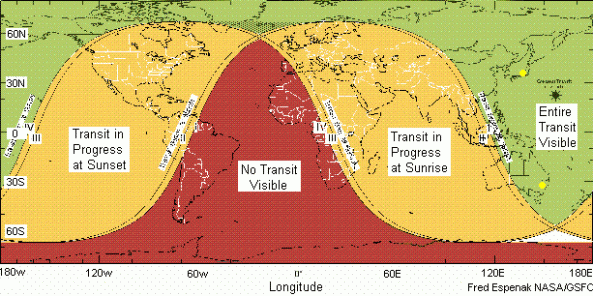
At 22:09 UT on June 5, 2012 the planet Venus will appear as a small, dark disk moving across the face of the Sun. The transit will finish at 04:49 UTC on June 6 (exact time depends on location of observer).

Clouds permiting, it may be visible to observers in the UK from dawn (about 03:46 UT in London).

This will be the last time the planet Venus will make the trek across the face of the sun as seen from Earth until the year 2117.

Note: Observing the Sun directly without appropriate protection can damage or destroy retinal cells, causing temporary or permanent blindness.

Clint Bradford K6LCS has posted a collection of URL’s where you should be able to watch the Venus transit online from sites around the world.

NASA (USA) http://venustransit.nasa.gov/2012/transit/

NASA Edge http://www.nasa.gov/multimedia/podcasting/nasaedge/index.html

University of Barcelona  (from a telescope in Norway) https://gaia.am.ub.es/serviastro/www/html/venus2012/live/index.html

National Solar Observatory http://venustransit.nso.edu/live.html

Exploratorium  (via the Mauna Loa Observatory) http://www.exploratorium.edu/venus/

NASA TV http://www.nasa.gov/ntv

Coca Cola Space Science Center (from Australia) http://www.ccssc.org/transit2012.html

Bareket observatory (Israel)
http://www.bareket-astro.com/live-astronomical-web-cast/live-free-venus-transit-webcast-6-june-2012.html

Mt. Lemmon Sky Center http://skycenter.arizona.edu/annoucement/live

Astronomers Without Borders (from Mt. Wilson, California)
http://www.astronomerswithoutborders.org/projects/transit-of-venus/live-webcast.html

The 2012 Transit of Venus using HAM Radio http://aprs.org/VenusTransit2012.html

Transit of Venus Special Event June 6, 2012
http://www.southgatearc.org/news/may2012/transit_of_venus_special_event.htm

Ultra-high Definition video recording of 2012 Venus Transit
http://www.nasa.gov/multimedia/videogallery/index.html?media_id=145648241

HO-68 CW beacon with Funcube Dongle and Arrow antenna

Reception of the HO-68 (XW-1) satellite beacon using the Funcube Dongle receiver and an Arrow II hand-held yagi antenna. Quisk software defined radio receiver running on Ubuntu Linux 10.10 64bit.
I was located indoors pointing the Arrow out through the window (and Doppler tuning with left hand, hence the high pitch 😉
The peak was around 52 deg elevation, range 1400 km. The CW beacon transmitter is 200mW RF.

The Funcube Dongle is a USB stick SDR receiver for 64 MHz – 1.7 GHz by Howard Long G6LVB, see http://www.funcubedongle.com/

Video recorded by Alexandru Csete OZ9AEC

13cm Band Rules Expanded to Allow MedRadio Adjacent to Satellites

The ARRL is reporting in a First Report and Order and a Further Notice of Proposed Rulemaking (ET 08-59) released on May 24, the FCC decided to expand the Part 95 Personal Radio Service rules to allow medical devices to operate on a secondary basis in the 2360-2400 MHz band. International amateur satellite operations are allocated between 2400-2450 MHz, adjacent to the new devices.

The new allocation is  Medical Body Area Networks (MBAN) which provide a way for health care facilities to monitor their patients via wireless networks. Because use of these frequencies will be on a secondary basis, MBAN stations will not be allowed to cause interference to, and must accept interference from, primary services, including US radio amateurs who operate on a terrestrial primary basis in the 2390-2395 MHz and 2395-2400 MHz bands.

The ARRL has posted their full analysis and report at:
http://tinyurl.com/13cm-Medical-Allocation (arrl.org)

Source AMSAT News Service (ANS)

Satellite Link Budget Information and Lunar Beacons

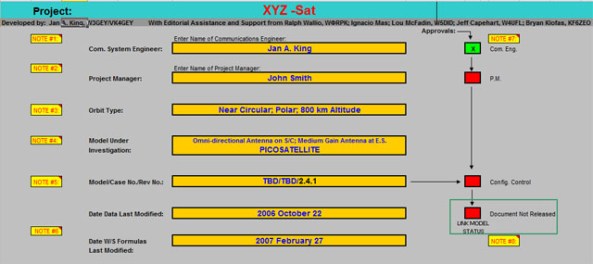
Download the spread sheet here (1.2 MB) (ver 2.4.1 – updated 11/4/2007)

Download Basic Analog Transponder Spread sheet here and its notes here

Lunar Beacons – The Earth Moved by James Miller G3RUH http://www.amsat.org/amsat/articles/g3ruh/110.html

Lunar Transponder Calculations by Domenico I8CVS http://www.uk.amsat.org/wp-content/uploads/2012/06/Lunar-Transponder-Calculations-by-I8CVS.txt