Gathering of Female Astronauts and Former Johnson Space Center Director

Gathering of some Female Astronauts in memory of Sally Ride

Gathering of some Female Astronauts in memory of Sally Ride. Image credit NASA
Seated (from left): Carolyn Huntoon, Ellen Baker KB5SIX, Mary Cleave, Rhea Seddon, Anna Fisher, Shannon Lucid R0MIR, Ellen Ochoa KB5TZZ, Sandy Magnus KE5FYE.
Standing (from left): Jeanette Epps, Mary Ellen Weber, Marsha Ivins, Tracy Caldwell Dyson KF5DBF, Bonnie Dunbar KD5DCB, Tammy Jernigan KC5MGF, Cady Coleman KC5ZTH, Janet Kavandi, Serena Aunon, Kate Rubins, Stephanie Wilson KD5DZE, Dottie Metcalf-Lindenburger KE5DAT, Megan McArthur, Karen Nyberg, Lisa Nowak KC5ZTB
Photographer: Lauren Harnett

On September 17, 2012, 22 female astronauts, a number of them radio amateurs, along with Johnson Space Center’s first female director, Carolyn Huntoon, met to honor Sally Ride and her legacy.

Sally Ride - Image Credit NASA

Sally Ride – Image Credit NASA

Sally Kristen Ride was one of 8,000 people to answer an advertisement in a newspaper seeking applicants for the space program. As a result, she joined NASA in 1978. On June 18, 1983, she became the first American woman in space as a crew member on Space Shuttle Challenger for STS-7.

She was the president and CEO of Sally Ride Science, a company she co-founded in 2001 that creates entertaining science programs and publications for upper elementary and middle school students, with a particular focus on young women. The science books, student programs and professional development programs place a strong emphasis on gender and racial equality in the classroom and provide role models of working scientists, engineers and mathematicians who exemplify this diversity in their respective fields

Sally Ride wrote or co-wrote five books on space aimed at children, with the goal of encouraging children to study science.

She died on July 23, 2012, aged 61, seventeen months after being diagnosed with pancreatic cancer.

Wiki – Sally Ride http://en.wikipedia.org/wiki/Sally_Ride

Astronuat Sally Ride - Image Credit NASA

Astronuat Sally Ride – Image Credit NASA

Video of ISS amateur radio contact with students at Lycee Polyvalent Anatole France

International Space Station ISS with shuttle Endeavour 2011-05-23A video has been released of the International Space Station (ISS) school contact with participants at the Lycee Polyvalent Anatole France.

The contact took place  at 1142 UT on Saturday, March 9, 2013. ISS Commander Chris Hadfield VA3OOG, used the call sign OR4ISS, and the high school used F4KIS.

Anatole France is a French high school located in Lillers, a small town in the center of the Pas-de-Calais department. There are about 850 students 15 to 20 years old. The science teachers and the local amateur radio club F4KIS, which became in 2010 the ‘Artois Lys Radio Club’, have developed a partnership since 2007 collaborating on projects to send sounding balloons into the stratosphere.

Continue reading

A Decade of CubeSats

In this video Professor Bob Twiggs KE6QMD talks about a decade of CubeSats.

The presentation was given to the 1st International Workshop on LunarCubes November 13, 2012 Palo Alto, California.

Continue reading

Interplanetary CubeSats

In this video Rob Staehle discusses the communication and propulsion challenges involved in getting a CubeSat to the Moon.

The presentation was given to the 1st International Workshop on LunarCubes November 13, 2012 Palo Alto, California.

Continue reading

Amateur Radio CubeSat burns-up in atmosphere

Altitude of the five CubeSats - Image credit Masahiro Arai JN1GKZ

Altitude of the five CubeSats compared with ARISSat-1/Kedr – Image credit Masahiro Arai JN1GKZ

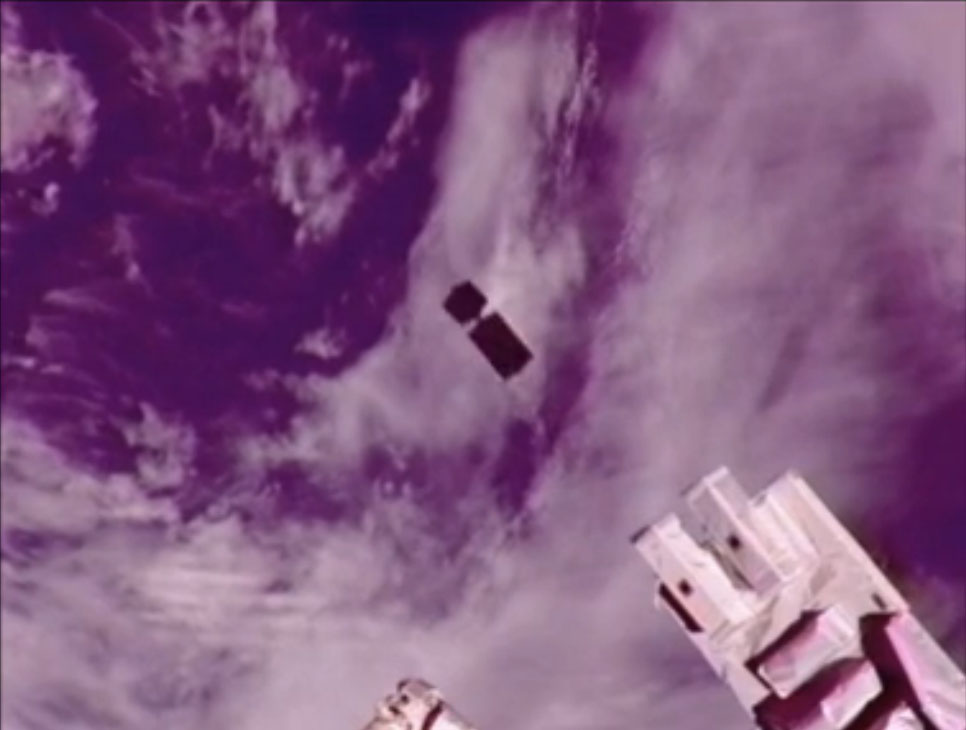
WE-WISH, one five CubeSats deployed from the International Space Station (ISS) on October 4, 2012. burnt up in the Earth’s atmosphere on Monday, March 11. On the AMSAT Bulletin Board Nico Janssen PA0DLO suggested it burnt up at 02:59 UT near 48 degrees North, 119 degrees East. He says TechEdSat is likely to be the next of the five to re-enter sometime in April.

Deployment of CubeSats WE-WISH and RAIKO from the ISS

Deployment of CubeSats WE-WISH and RAIKO from the ISS – Image NASA

Built by members of the Meisei Amateur Radio Club WE-WISH carried an infrared camera for environmental studies. The 320 by 256 pixels images  of the Earth’s surface were transmitted in approx 110 secs using SSTV. The callsign was JQ1ZIJ and the 100mW downlink on 437.515 MHz operated on CW (A1A), AX.25 1200 bps packet radio (F2D) or SSTV (F3F).

Masahiro Arai JN1GKZ has produced a chart that shows the declining altitude of the five CubeSats since their deployment. RAIKO was the largest of the CubeSats at about 2 kg and 10 × 10 × 20 cm and the others being about 1 kg and 10 × 10 × 10 cm. The chart compares their orbital decay with that of ARISSat-1/Kedr (30 kg, 55 × 55 × 40 cm) which was deployed on August 3, 2011 and and re-entered Earth’s atmosphere on January 4, 2012, having spent 154 days in orbit.

Further information and some spectacular pictures of the CubeSats taken just after deployment can be seen at https://amsat-uk.org/satellites/techedsat-f-1-fitsat-1-we-wish/

Status of active satellites on amateur radio frequencies

Mike Rupprecht DK3WN 640

Mike Rupprecht DK3WN

One of the most frequently asked questions from newcomers to amateur satellites must be “Which satellites can I receive?”

Mike Rupprecht DK3WN has produced a summary of all active amateur radio satellites with frequencies and links to more detailed information. It is available at  http://www.dk3wn.info/p/?page_id=29535