Gillian takes a step towards Mars mission

Late Spring on MarsUniversity of Sheffield astrophysics student and UKSEDS member, Gillian Finnerty, has made it through to the next round of selection for the first human mission to Mars.

ITV news report she is one of just 40 from the UK who have been chosen to go through to the next stage of the selection process for the trip to the Red Planet. They say Gillian read about the private Mars One mission on Facebook and knew it was for her.

Watch the ITV News report at
http://www.itv.com/news/calendar/story/2014-01-16/sheffield-student-eyes-one-way-trip-to-mars/

University of Sheffield story
http://www.sheffield.ac.uk/news/nr/mars-mission-could-solve-earth-biggest-issues-says-university-of-sheffield-student-1.340116

Sheffield Star story
http://www.thestar.co.uk/news/video-sheffield-girl-s-mission-to-mars-1-6373178

Gillian Finnerty and UK astronaut Tim Peake

Gillian Finnerty and UK astronaut Tim Peake

Sheffield Telegraph story
http://www.sheffieldtelegraph.co.uk/news/local/gillian-takes-a-step-towards-mars-mission-1-6363050

Gillian Finnerty
YouTube http://www.youtube.com/user/gillianfinnerty
Facebook https://www.facebook.com/gillian.finnerty
Twitter https://twitter.com/GillianFinnerty

UK Students for the Exploration and Development of Space (UKSEDS)
https://www.facebook.com/groups/ukseds/

Mars One https://www.facebook.com/MarsOneProject

Deploying software updates to ArduSat in orbit

An exploded view of the ArduSat (1U configuration) - Image Nanosatisfi

An exploded view of the ArduSat (1U configuration) – Image Nanosatisfi

Radio amateur Jonathan Oxer VK3FADO gave this Keynote presentation on the latest developments in the ArduSat CubeSat project to the 2014 Linux conference in Perth, Western Australia.

Jon has been hacking on both hardware and software since he was a little tacker. Most recently he’s been focusing more on the Open Hardware side, co-founding Freetronics as a direct result of organising the first Arduino Miniconf at LCA2010. His books include “Ubuntu Hacks” and “Practical Arduino”.

Jon has been variously referred to as Australia’s geekiest man and as a cyborg-in-progress. As part of his “SuperHouse” home automation series, Jon has taken keyless entry to an all new level by embedding an RFID tag into his arm using a vet’s chipping tool.

Recently he has been working on ArduSat, a satellite that aims to give hobbyists, students and space enthusiasts an opportunity to design and run their own experiments in space. By choosing a standardised platform based on the hugely popular Arduino hardware design, ArduSat allows anyone to develop and prototype experiments at home using readily accessible parts and all based on a simple open source software environment.

Watch Deploying software updates to ArduSat in orbit – Jonathan Oxer VK3FADO

ArduSat Open Source Ham Radio CubeSats
https://amsat-uk.org/2013/08/09/ardusat-open-source-ham-radio-cubesats/

Linux Conference Perth Jan 6-10 http://lca2014.linux.org.au/

Linux Australia http://www.linux.org.au/

New Guide Promotes FUNcube-1’s Educational Value

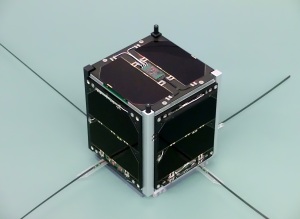
FUNcube-1 flight model - Image credit Wouter Weggelaar PA3WEG

FUNcube-1 flight model – Image credit Wouter Weggelaar PA3WEG

A new FUNcube guide developed by ARRL Education & Technology Program (ETP) Director Mark Spencer, WA8SME, aims to maximize the educational focus of the tiny FUNcube-1 (AO-73) satellite. Spencer’s Pragmatic Guide for Using the FUNcube (AO-73) Materials Science Experiment in the Classroom prompts readers to dig beyond AO-73’s Amateur Radio transponder and telemetry uploads and downloads and “take a closer look at what is really going on” as the satellite orbits Earth. The diminutive spacecraft includes an AMSAT-UK-developed materials science experiment (MSE). Spencer’s guide helps teachers and students to analyze telemetry and apply the laws of thermodynamics to examine how heat is radiated into space from materials having different surface finishes.

AMSAT-UK FUNcube Mission Patch Rev4 20100609

AMSAT-UK FUNcube Mission Patch

“The primary mission of the FUNcube is education, and the MSE is the focus of that mission,” Spencer said. When it’s not in educational mode the spacecraft switches on an Amateur Radio SSB/CW inverting transponder (435.150‑435.130 MHz LSB up/145.950‑145.970 MHz USB down). “I know there is an ongoing discussion of the value of CubeSat telemetry when compared to transponder operations,” he said. “You just might find that an occasional look at the telemetry will help you better understand satellites and make you a better satellite operator.”

As Spencer explained, the FUNcube-1 MSE includes two separate experiments — one using the thermally isolated aluminum bars mounted on one face of the satellite, and the second using four aluminum bars that form part of the satellite’s body in the corners of the cube. MSE data are transmitted via a 2 meter downlink (145.935 MHz BPSK) and decoded and displayed by the AMSAT-UK Dashboard software.

Final gluing of FUNcube-1 bolt by Wouter Weggelaar PA3WEG – Image credit Gerard Aalbers

Final gluing of FUNcube-1 bolt by Wouter Weggelaar PA3WEG – Image credit Gerard Aalbers

“Collecting the data is only part of the education mission,” Spencer said. “The other — and more meaningful part — is interpreting the data.” That, he explained, starts with a thermodynamics refresher. “In the broadest terms, thermodynamics is the study of how heat moves from one place to another,” he continued. “The purpose of the FUNcube MSE is to allow students to witness heat transfer by radiation firsthand in an environment — space — where convection and conduction are not present.”

Spencer called the FUNcube MSE “an exceptional educational resource,” and he praised AMSAT-UK’s efforts. “It’s now our turn to gain as much as we can from their efforts, and I hope the Guide will help you get started.”

AMSAT-UK Logo

AMSAT-UK said its FUNcube project was designed “to create an educational CubeSat which is intended to enthuse, excite and educate students about radio, space, physics and electronics. It will also support educational science, technology, engineering, and mathematics (STEM) initiatives.” FUNcube-1 was put into orbit as a standalone 1U (10 × 10 × 10 centimeters) CubeSat. The follow-on FUNcube-2 will be part of the UKube-1 3U spacecraft.

Visit ARRL’s Classroom Library: Satellite Communications page, which includes a link to the new guide, for more information on bringing space into the classroom. AMSAT-UK has put out its own FUNcube Handbook to provide some practical advice to interested hams and classroom teachers on how to access and use the satellite’s onboard MSE.

Source: ARRL http://www.arrl.org/news/new-guide-promotes-funcube-1-s-educational-value

BBC News video about FUNcube-1 http://www.bbc.co.uk/news/science-environment-25084547

Wouter Weggelaar PA3WEG talking about FUNcube-1 to students at Abbeys Primary School in Bletchley

Wouter Weggelaar PA3WEG talking about FUNcube-1 to students at Abbeys Primary School in Bletchley

PhoneSat 2.4 CubeSat

PhoneSat 2.4 - Credit NASA Ames

PhoneSat 2.4 – Credit NASA Ames

Jan Stupl provides an update on PhoneSat 2.4 which was part of  the ORS3 / Elana 4 launch from the Wallops Flight Facility on November 19, 2013.

Minotaur-1 Launch from Wallops Flight Facility

Minotaur-1 Launch from Wallops Flight Facility

By now there are TLEs at space-track for all 29 objects of that launch (NORAD ID 39380 – 39409), but only five of them have been identified on space-track.

The PhoneSat team thinks that 39381 is theirs, but 39402, 39400 and 39397 are also (less likely) possibilities. Because the satellites are still close, using the radio beacon for identification is somewhat ambiguous. Getting more observations would be very helpful for everybody on that launch.

You find all information about the 437.425 MHz PhoneSat 2.4 on the phonesat.org website and people can submit received packets as well, and comment which TLE they used. The latter is obviously important to gain confidence on the assigned TLEs.

PhoneSat 2.4 http://www.phonesat.org/

Minotaur-1 ELaNa-4 Satellites https://amsat-uk.org/satellites/elana-4-cubesats/

Dashboard uploads to the Data Warehouse

FUNcube-1 AO-73 Upload Trend

FUNcube-1 AO-73 Upload Trend

The FUNcube team were interested to know the trend of the number of uploads to the warehouse since launch, we thought we would share our findings.

We have been consistently getting more than 5000 raw packets per day and the trend is increasing, thanks folks!

The plan is to issue this on a monthly basis.

Regards

Dave Johnson, G4DPZ, FUNcube Team member

Data Warehouse – Telemetry Archive http://warehouse.funcube.org.uk/

Dashboard App – Telemetry Decoder http://funcube.org.uk/working-documents/funcube-telemetry-dashboard/

Videos: Understanding orbits

Understanding Orbits

Understanding orbits can be called the key to understanding satellites. These videos by Nanosatisfi cover many facts about orbits.

Watch Coding For Space – Orbits 1

This second video about orbits covers the math involved in calculating a pure circular orbit.

Watch Coding For Space – Orbits 2

Physics Classroom: Mathematics of Satellite Motion http://www.physicsclassroom.com/class/circles/u6l4c.cfm

PLAN-13 Satellite Position Calculation Program by James Miller G3RUH
http://www.amsat.org/amsat/articles/g3ruh/111.html

Nanosatisfi http://www.nanosatisfi.com/