Valerie Vaz MP has congratulated pupils at Queen Mary’s Grammar School in Walsall on their near Space Program which uses a 434 MHz downlink.
Valerie said:
“Pupils at Queen Mary’s Grammar School in my constituency are attempting to beat the altitude achieved by Felix Baumgartner, who skydived from 39,045m, for a fraction of the cost with their own atmospheric probes.”
“The initiative shown by this group of student to design and build the probes and computer systems, while at the same time raising money for the project through sponsorship is commendable.”
“The Beat Felix Team’s first probe, ‘Gagarin’, reached an altitude of 35,118m and was only 3,927m short of their goal. They are now concentrating on their final two probes, ‘Armstrong’ and ‘Hadfield’, which are both set to launch within the next month. I wish the whole team the best of luck and hope they reach their goal.”
On Tuesday, July 1, Chris Stubbs M6EDF will be giving a talk on 434 MHz high altitude balloons to the Chelmsford Amateur Radio Society (CARS). Weather permitting it is hoped to be able to do a balloon launch (434.300 MHz FSK). The meeting is open to all.
Chris took the amateur radio Foundation training course run by CARS in January 2013. He is keen on both electronic construction and software development and combines the two interests in High Altitude Ballooning (HAB). Chris has built many tracker payloads for his balloon launches which usually take place from Danbury Common near Chelmsford.
In May he undertook a STEM (Science, Technology Engineering and Mathematics) event for pupils at the Sandon School in Chelmsford, launching a balloon equipped with his 434.300 MHz tracker enabling the students to track the position of the balloon in real-time. In June he did a similar event for pupils at the Stewards Academy in Harlow.
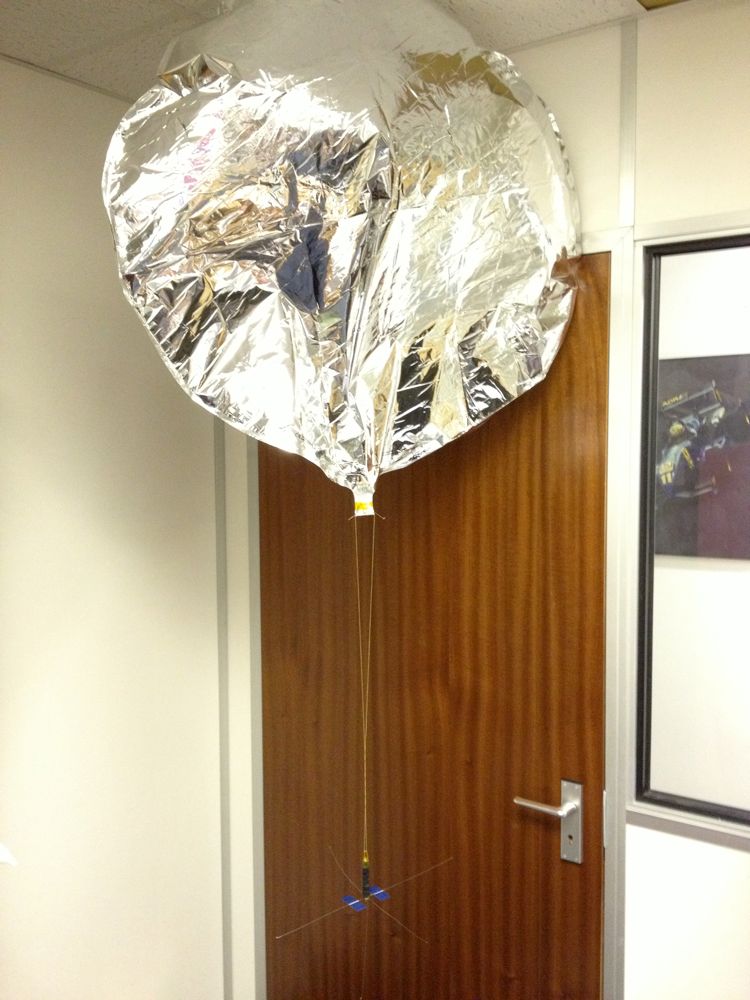
A balloon like this carrying a small electronic tracker payload traveled all the way to Japan – Image credit Leo Bodnar M0XER
The trackers typically transmit 50 bps FSK RTTY in 434 MHz and can have a radio range of over 500 km. The data transmitted comprises the GPS location of the balloon and other sensor readings such as pressure, temperature and altitude. The signals are received by a network of listeners who upload the data to the UK High Altitude Society (UKHAS) central server enabling anyone to see the current location of the balloon on the web.
Some balloon flights aim to achieve very high altitudes, other aim to stay aloft for as low as possible. Leo Bodnar M0XER recently achieved a record breaking flight from Silverstone to Japan using a party balloon with a tiny solar powered payload.
The talk will explain how you can participate in this increasing popular activity.
The Chelmsford Amateur Radio Society meeting takes place at the Oaklands Museum, Oaklands Park, Moulsham Street, CM2 9AQ on Tuesday, July 1. The doors open at 7pm for a 7:30pm start. Admittance and parking are free and the usual raffle will be held.
The Chelmsford Amateur Radio Society run short training courses for those wishing to get their amateur radio licence. To find out more about amateur radio and the course speak to Clive on
Tel: 01245-224577
Mob: 07860-418835
Email: training2014 at g0mwt.org.uk
Web: http://www.g0mwt.org.uk/training/
Note overseas viewers may need to use a UK based Proxy Server.
The Isle of Man Government say they are “firmly ‘pro-space’ and together with a clear and simple tax regime, absence of Insurance Premium Tax and commitment to the development of space law and satellite registry, the Island offers the right environment for the space industry to flourish.” http://www.gov.im/lib/docs/iomfinance/factsheets/isleofmanspaceindustry.pdf
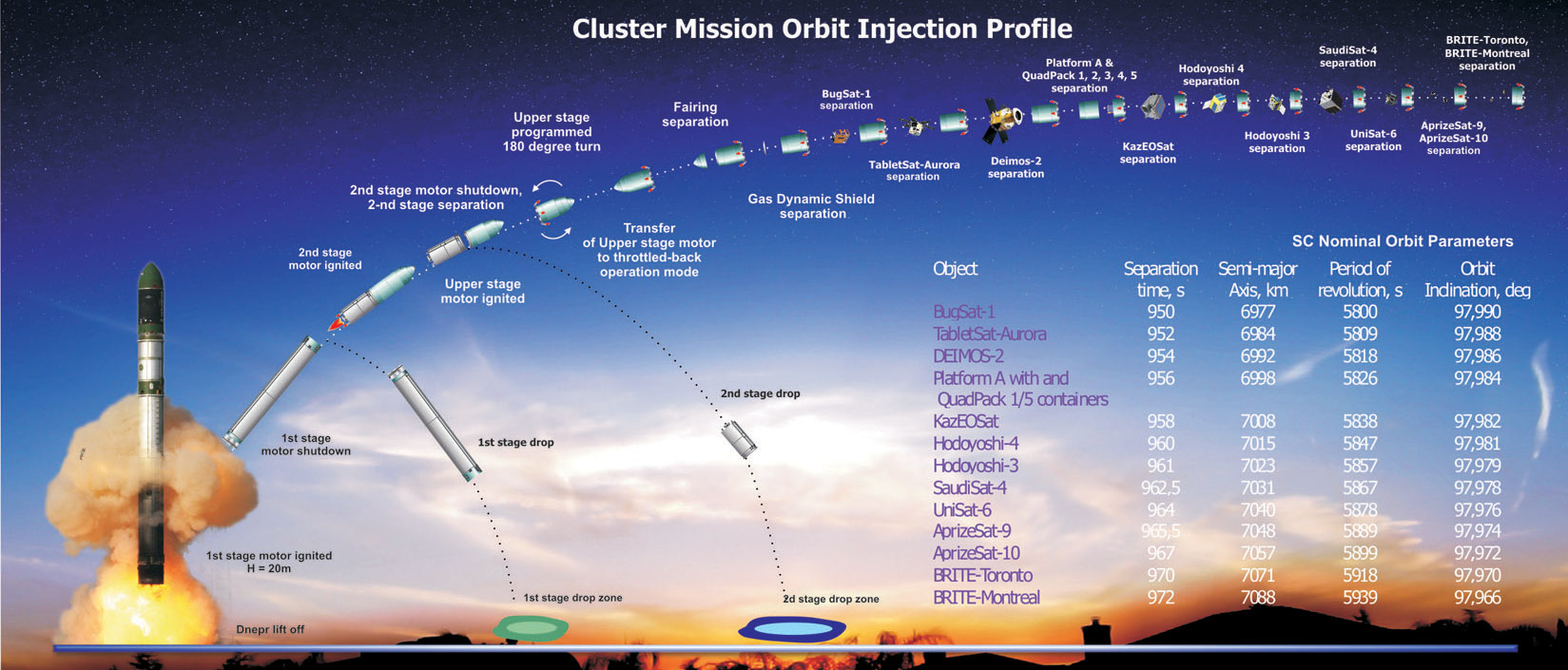
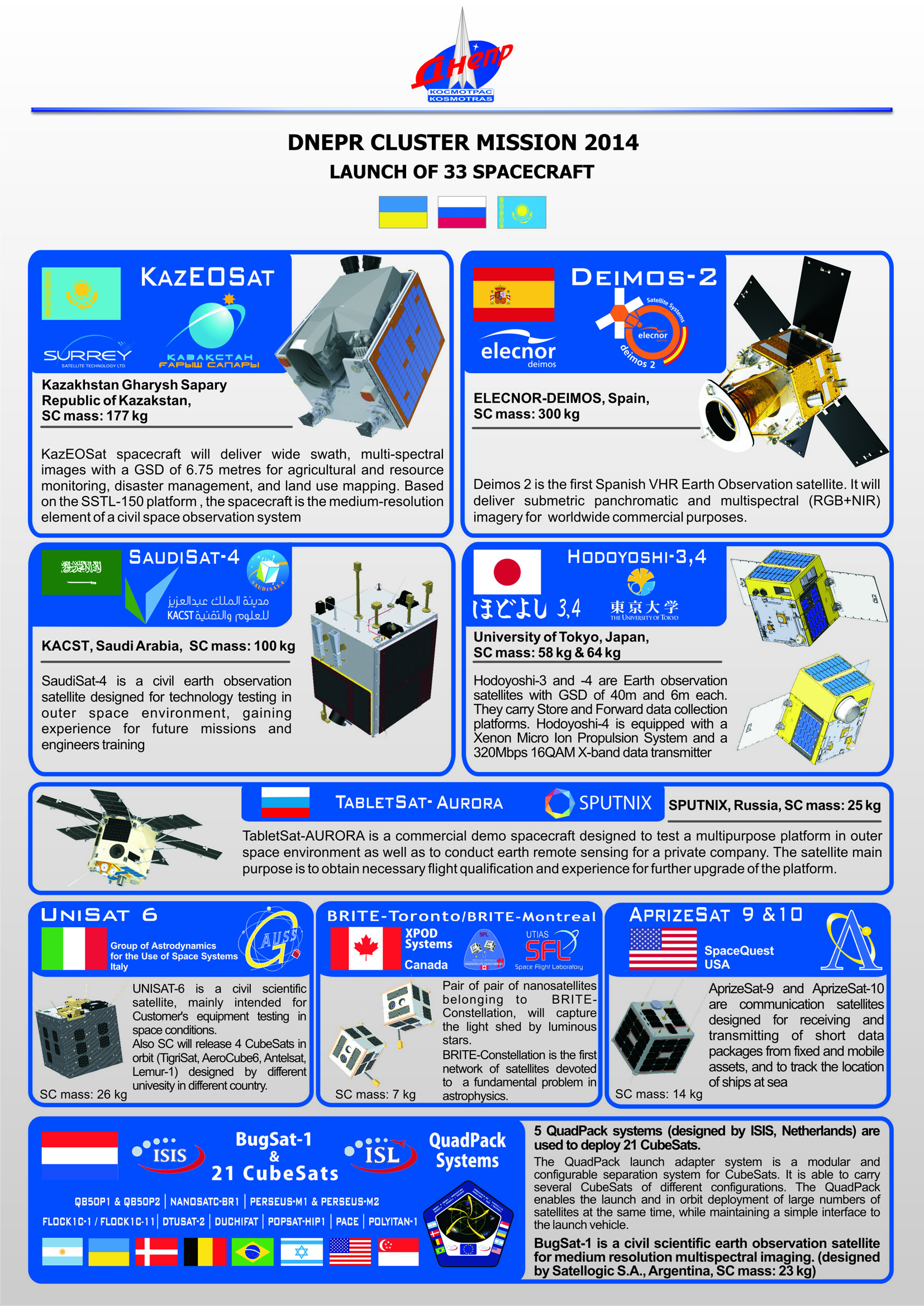
On Thursday, June 19, 2014 at 19:11:11 UT a Dnepr rocket was launched from Dombarovsky near Yasny in the Russian Federation, 12 of the satellites on-board carried amateur radio payloads.
In total 33 satellites were deployed from the Dnepr on June 19. One of those satellites UniSat-6 carried four smaller satellites, Tigrisat, Lemur 1, ANTELSat and AeroCube 6, which it deployed on June 20. On June 23, AeroCube 6 split into two separate satellites bringing the total of deployed satellites to 38.
Satellites launched June 19, 2012 on the Yasny Dnepr
Among the amateur radio payloads are a SSB/CW linear transponder, FM voice transponder, D-STAR Parrot Repeater, three Packet Radio Digipeaters and APRS.
In the hours immediately after launch signals were reported from POPSAT, QB50p1, QB50p2, UniSat-6, BugSat-1, NanosatC-BR1, Duchifat-1, TabletSat-Aurora and DTUsat-2.
The two QB50 precursor Cubesats on the launch carry amateur radio transponders. They were deployed at 19:32 UT and CW signals from both were received shortly after by Andre Van Deventer ZS2BK in Port Elizabeth, South Africa. Brian Best ZS5SB and Leon Steenkamp ZS1HD also reported receiving signals.
The FUNcube team send their thank to the stations in South Africa who received the first signals and also to the ISIS teams both at the launch site and at their HQ in Delft. A job very well done!
QB50p1 carries the FUNcube-3 400 mW inverting linear 435/145 MHz transponder provided by AMSAT-NL with support from AMSAT-UK.
• 145.815 MHz BPSK telemetry
• Transponder
– 435.035-435.065 MHz Uplink LSB
– 145.935-145.965 MHz Downlink USB
QB50p2 carries a 435/145 MHz FM transponder and FX25 data transmitter from AMSAT-F.
• 145.880 MHz BPSK telemetry
• 145.840 MHz 9600 bps FSK FX25
It is expected that both these transponder payloads will be activated after the science missions have been completed.
Dnepr Satellite Frequencies June 19, 2014 – Credit Mike Rupprecht DK3WN
The D-STAR satellite TabletSat-Aurora is expected to launch with 11 other satellites carrying amateur radio payloads from Dombarovsky near Yasny on Thursday, June 19, 2014 at 19:11:11 UT.
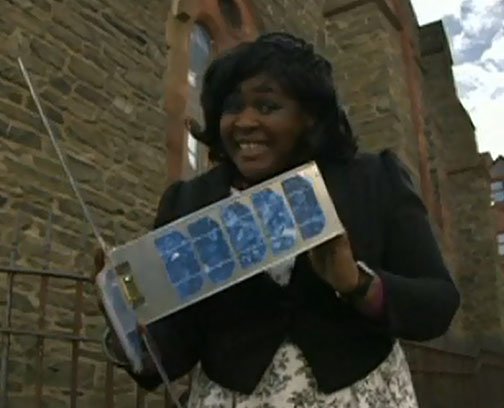
TabletSat-Aurora – Image Credit Sputnix
It carries a D-STAR Parrot (Store and Forward) Repeater running 0.8 watts of GMSK on 437.050 MHz (+/- 10 kHz) to a whip antenna. It can store up to 8 seconds of voice message.
There are two other transceivers on the satellite that operate on 435.550 MHz and 436.100 MHz. Their power can be varied by command from the ground station between 0.8 and 2.0 watts and it is understood they will be used for command and control and transmit GMSK telemetry data. There is also a downlink on 8192 MHz.
Dmitry Pashkov R4UAB reports the D-STAR repeater could become operational in early July. It is understood that when the D-STAR repeater is active the telemetry transmitters will be inactive.
There are 37 satellites and a 2U Mass Dummy on the launch and it is thought a dozen of them are carrying amateur radio payloads. A list of frequencies is at http://r4uab.ru/?p=6393
QST Editor and ARRL Publications Manager Steve Ford, WB8IMY will give a presentation to the AMSAT-UK International Space Colloquium at the Holiday Inn in Guildford on Saturday, July 26.
Steve will be traveling to the UK to talk about the satellite operations at the impressive ARRL Headquarters station in Newington, Connecticut.
He has written many amateur radio books including the ARRL Satellite Handbook, Get on the Air with HF Digital, VHF Digital Handbook and Remote Operating for Amateur Radio.






 AMSAT-UK
You must be logged in to post a comment.