LightSail-1 launch announced

LightSail-1 with sail deployed - Credit Justin Foley KI6EPH

LightSail-1 with sail deployed – Credit Justin Foley KI6EPH

The first of The Planetary Society’s two LightSail spacecraft will ride to space aboard an Atlas V rocket in May 2015. The mission is a shakedown cruise designed to test out the CubeSat’s critical systems.

The LightSail-1 entry on the IARU Satellite Frequency Coordination Panel status page lists a 9k6 GMSK AX25 amateur radio payload on 437.325 MHz but the LightSail-1 site is quoting 437.435 MHz.

In 2016, the second LightSail spacecraft will piggyback into orbit aboard the first operational flight of SpaceX’s new Falcon Heavy rocket for a full-fledged solar sailing demonstration.

This video about the project features Bill Nye (the Science Guy on PBS TV) as well as Justin Foley KI6EPH, Alex Diaz KJ6KSF and Stephanie Wong.

Watch LightSail – Flight by Light (full version)

IARU Satellite Frequency Coordination Panel Status Page http://www.amsat.org.uk/iaru/

LightSail – Flight by Light http://sail.planetary.org/

3400 MHz and 10 GHz – ARRL’s comments on WRC-15

Logo WRC RA 2015The ARRL has commented on two draft recommendations of the FCC’s 2015 World Radiocommunication Conference (WRC-15) Advisory Committee (WAC) as well as on a draft proposal provided to the FCC by the National Telecommunications and Information Administration (NTIA).

Regarding 3400 MHz they say:
“[The] failure to even superficially address the protection of all existing services — including the Amateur and Amateur-Satellite services — is glaring,” the ARRL said. The WAC’s so-called “View A” — to make no change in the allocation — in part said, “The secondary nature of the Amateur Service allocation requires flexibility in frequency selection to permit an Amateur Service licensee to use the allocation and fulfill his or her obligation not to cause harmful interference to the numerous primary services, including the FSS [Fixed-Satellite Service].”

On 10 GHz the ARRL supported the FCC WAC view on Agenda Item 1.12 that the US not be added to international footnote 5.480 — basically an exception — to the Table of Allocations that could make part of the 10.0-10.5 GHz segment vulnerable to additional allocation for Fixed Service applications. The Amateur and Amateur-Satellite services have a secondary allocation in the band, and the Federal Radiolocation Service is primary. The proposed “footnote amendment,” the League argued, “plainly, clearly, and indisputably contradicts existing United States regulations.” The League’s comments accused Mimosa Networks, which has argued in favor of having the US sign on to the international footnote, of advancing an “illogical construction to obtain the result it desires.”

Read the full ARRL story at
http://www.arrl.org/news/arrl-comments-to-fcc-on-wrc-15-draft-recommendations

ED-SAT CubeSat Training Kit

Nader Omer ST2NH brings news of the ED-SAT training kit, a Cube Satellite simulator.

It has been developed for inspiring young people at variety of educational levels provide opportunities to discover and apply learning to real-world scenarios.

It aims to provide a unique environment for students at any fields to explore, just to name a few. Science, Electronics, Communication, Programming, Mechanic and Physics.

Watch ED-SAT training kit

Educational Satellite Co Ltd
https://www.facebook.com/pages/Educational-Satellite-co-ltd/233280410183741

Amateur radio satellite talk near Farnham

AO-73 (FUNcube-1) - Image credit Wouter Weggelaar PA3WEG

AO-73 (FUNcube-1) – Image credit Wouter Weggelaar PA3WEG

This Monday, January 26 there will be a presentation on the FUNcube-1 (AO-73) and SO-50 satellites at the Hog’s Back Amateur Radio Club near Farnham.

Mike Parkin, G0JMI, will give a talk entitled: Amateur Radio Satellites: A General Overview and Understanding of FUNcube-1 (AO-73) and Saudi-Sat 1c (SO-50).

Satellite operation is not quite as daunting as it can at first appear, and Mike will enlighten the audience with some of his experiences, as well as the equipment and techniques used for satellite communication.

Doors open at 7:30 pm for 8:00 pm on Monday, January 26, 2015 at the Crondall Scout Hut, Pankridge Street, Crondall, Farnham, Surrey, GU10 5RQ. As usual the kettle will be on to provide the refreshment.

A map of the meeting place can be found on the Contact Details page at
http://www.hogsback-arc.org.uk/

Facebook https://www.facebook.com/groups/Hogsbackarc/

Radio ham interviewed on TV about Beagle 2

Illustration of the UK Beagle 2 lander on Mars - Credit ESA

Illustration of the UK Beagle 2 lander on Mars – Credit ESA

Essex-born radio amateur Dave Rowntree M6DRQ was interviewed on Channel 5 TV news about the Beagle 2 Mars mission.

Dave, formerly drummer in the band Blur, is currently a DJ on London radio station XFM 104.9 MHz.

On December 25, 2003 the pioneering UK spacecraft Beagle 2, developed by a team led by Professor Colin Pillinger, landed on Mars, however, communications with it could not be established. This meant it was not known if the landing had been successful or where on the planet it was.

On July 30, 2004 Professor Pillinger gave a presentation about Beagle 2 to the AMSAT-UK International Space Colloquium in Guildford, he received a standing ovation from the audience.

On January 15, 2015 it was announced that Beagle 2 had been located in images taken of Mars. These confirmed it had made a successful soft landing on the planet. Sadly Professor Pillinger had passed away a few months earlier on May 7, 2014.

Watch Dave talking about Beagle 2

Radio ham becomes XFM 104.9 DJ
http://www.southgatearc.org/news/2014/february/radio_ham_becomes_xfm_dj.htm

Dave Rowntree M6DRQ on Twitter https://twitter.com/DaveRowntree

2011 BBC interview with Professor Colin Pillinger
http://www.southgatearc.org/news/december2011/bbc_interview_with_colin_pillinger.htm

AESP-14 CubeSat deployed from ISS

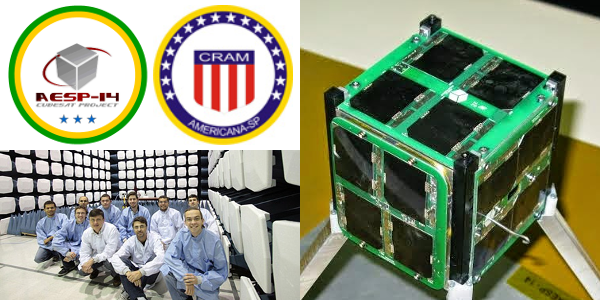
AESP-14 CubeSat

AESP-14 CubeSat

The AESP-14 is a 1U CubeSat developed by undergraduate and graduate engineering students at the Technology Institute of Aeronautics (ITA) in Brazil. The satellite’s primary mission is to test the various subsystems in the space environment.
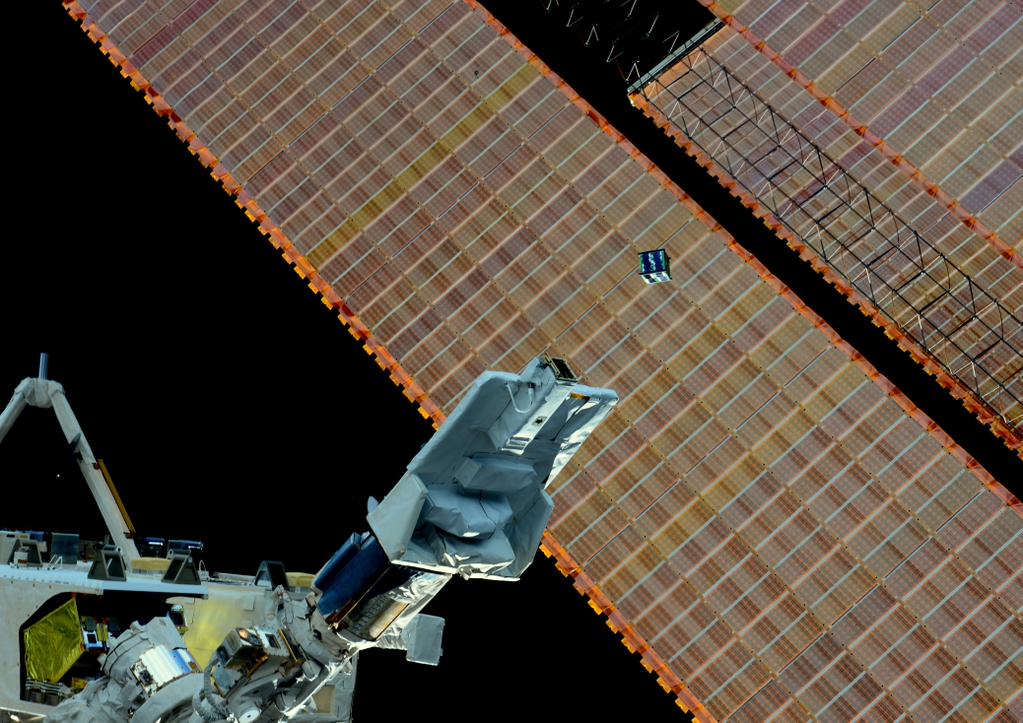
AESP-14 CubeSat released from ISS - Photo by Samantha Cristoforetti IZ0UDF

AESP-14 CubeSat released from ISS – Photo by Samantha Cristoforetti IZ0UDF

The satellite was sent to the International Space Station (ISS) as cargo on the SpaceX Falcon 9 mission CRS-5. Launch had been scheduled for December 16, 2014 but was postponed three times and it wasn’t until January 10, 2015 that the launch eventually took place. Since arriving at the ISS on January 12 AESP-14 has been awaiting deployment by the JEM Small Satellite Orbital Deployer (J-SSOD) which is in the Japanese Experimental Module, Kibo.

The deployment took place around 1250 UT on Thursday, February 5. The AESP-14 telemetry beacon has a power output of 500 mW and uses AX.25 with 9600 bps GMSK modulation (G3RUH standard) on 437.600 MHz. It should have started transmitting 30 minutes after deployment but as of February 11 nothing had been heard. It may be the battery did not survive several months without being recharged or the antenna may have failed to deploy.
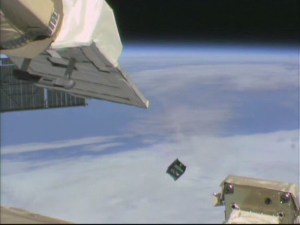
AESP-14 CubeSat deployment from ISS - Image JAXA

AESP-14 CubeSat deployment from ISS – Image JAXA

The AESP-14 team would like to ask the help of radio amateurs around the world to forward any received telemetry frames back to the team. For this, please save the AX.25 frames in KISS format and forward the file to aesp14@ita.br

The satellite has an amateur radio experiment developed by the Americana Amateur Radio Club (CRAM). The experiment consists of the random transmission of 100 sequences of ASCII characters prefixed with the “CRAM” word that will used as part of a contest among receiving stations. The first 10 amateur radio stations that complete receiving the 100 sequences will be awarded a commemorative diploma. Further details at http://wabicafe.com.br/aesp14/cram.php

AESP-14 website http://www.aer.ita.br/~aesp14

Telemetry information sheet http://www.aer.ita.br/~aesp14/AESP-14Telemetry.pdf

AESP-14 CubeSat released from International Space Station
http://www.spaceflight101.com/iss-expedition-42-updates-february-2015.html

AMSAT-UK thanks Edson Pereira PY2SDR for this information.