DeorbitSail Launch Information

deorbitsail_slide2The CubeSat DeorbitSail built by researchers and radio amateurs at the Surrey Space Centre in Guildford carries a  1200 bps BPSK beacon on 145.975 MHz. It is expected to launch at 1627 UT on  Friday, July 10.

DeorbitSail is a 3U CubeSat sized satellite with a deployable sail that will demonstrate rapid deorbiting.

Chris Bridges 2E0OBC writes:

Dear AMSAT’ers, CubeSat’ers, Friends,

Please find attached exclusive details of a UK CubeSat called DeorbitSail flying out tomorrow evening on PSLV. Please feel free to distribute to other hams that can help out.

This contains all the info you should need including:
• Initial TLE
• DeorbitSail Flyer > Launch details, etc.
• Predicted first packet transmission on 145.975 MHz, 1k2 BPSK -> we predict to be over Russia in the evening.
• Beacon and Packet Formats are here: DOS Message Definitions RD+CPB

First packets sent in will get a Signed Certificate of thanks from the team!

If you have any telemetry or TLE/frequency information, please send it to me and/or to deorbitsail.messages@gmail.com so we can quickly learn our satellite state.

Any questions, don’t hesitate to ask!

73 Chris 2E0OBC

DEORBITSAIL
1 55554U 58056A   15191.72643157  .00000000  00000-0 +13828-4 0   335
2 55554  97.9842  81.0881 0007584 273.9578  86.0949 14.75593446209360

Follow @SpaceAtSurrey on Twitter

DeorbitSail website http://www.surrey.ac.uk/ssc/research/space_vehicle_control/deorbitsail/

Download DeorbitSail leaflet

Download DeorbitSail Message Definitions

ISRO PSLV-C28 / DMC3 Mission http://www.isro.gov.in/launcher/pslv-c28-dmc3-mission

International Space Colloquium at Guildford July 25-26
https://amsat-uk.org/2015/06/16/international-space-colloquium-at-guildford/

CAMSAT Launch Postponement

CAMSAT XW-2A formerly known as CAS-3A

CAMSAT XW-2A formerly known as CAS-3A

A launch postponement has been announced for Beijing’s new CZ-6 rocket which is planned to carry a constellation of amateur radio satellites.

Soon to be launched six CAMSAT satellites CAS-3A to F have now been named as XW-2 (Hope-2) amateur satellite system, and correspond to the XW-2A to F.

All the satellites have completed environmental testing, currently being burn-in tests, everything is underway. The satellites will be moved to the launch center in mid-August and launch date has been postponed to early September.

73!

Alan Kung, BA1DU

CAMSAT XW-2 satellites https://amsat-uk.org/satellites/communications/camsat-xw-2/

UK Spectrum Strategy

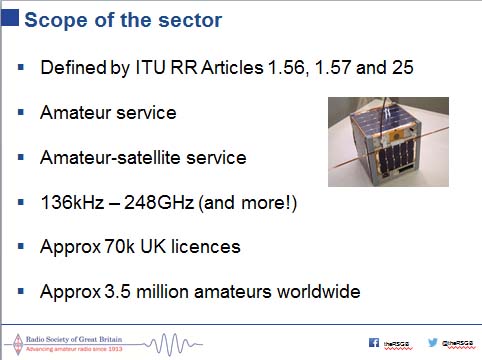
RSGB Amateur Radio SlideOn June 30, 2015, Graham Murchie, G4FSG, RSGB Chairman and Murray Niman, G6JYB, Chairman of the RSGB Spectrum Forum presented the case for amateur radio to the UK Spectrum Policy Forum (UKSPF). The Amateur-Satellite Service featured in this presentation.

The Forum has been established as a sounding board to UK Government and Ofcom on future approaches on spectrum with a view to maximising the social and economic value from the spectrum.

The UK Prime Minister David Cameron has stated the ambition to double “the economic benefits of spectrum to UK companies and consumers from roughly £50 billion today, to £100 billion in 2025″.

The UK Spectrum Policy Forum, open to all users of spectrum, is the main vehicle for harnessing user insights and informing these policy decisions.

Read the RSGB story at http://rsgb.org/main/blog/news/gb2rs/headlines/2015/07/06/uk-spectrum-strategy/

Download the presentation slides http://thersgb.org/archives/events/ukspf/150703-RSGB-UKSPF-presentation.pptx

UK Spectrum Policy Forum (UKSPF) https://www.techuk.org/about/uk-spectrum-policy-forum

UWE-3 Status Report

UWE-3 LogoThe UWE-3 team have provided an update on investigations into a recent communications anomaly on the CubeSat

After the communication anomaly and the autonomous recovery of UWE-3 two weeks ago we uploaded an extended software to the OBC to analyse the event in detail. As we already have known the EPS, OBC and ADCS were not affected, so the secondary radio.

During the tests made possible by the new software we temporarily switched back to the primary radio to check its electrical characteristics and communication performance. As the values were promisingly normal we performed extensive communication tests without seeing any existing anomaly.

Therefore we will continue normal operation.

Yours sincerely,

UWE-3 Team

UWE-3 was launched with FUNcube-1 on November 21, 2013. Latest UWE-3 news at
http://www7.informatik.uni-wuerzburg.de/forschung/space_exploration/projects/uwe_3/uwe_3_news/

School plans 2am balloon launch

Sun Chaser - LogoStudents at Queen Mary’s Grammar School, Walsall plan to launch the Sun Chaser 2 balloon (434.448 MHz USB) to capture images of the sunrise on Saturday, July 11.

Depending on altitude the signals from the balloon may have a range of up to 800 km, potentially covering much of the British Isles. Those outside the coverage area can receive the signals online using the SUWS WebSDR.

The school’s Project Horizon team say: We’re having a second attempt to capture footage of the sunrise from the Stratosphere over Wales/West England.

Watch the mission trailer

The report on launch 1 (some useful lessons learn’t, such as check interference by testing the GPS will all other kit running in the box and ALWAYS duct tape batteries into a cell holder) can be found here:
http://horizon.qmgs.walsall.sch.uk/index.html#sunchaserlaunch1

All being well, we have planned to launch from:

Location: Queen Mary’s Grammar School, Sutton Rd, Walsall, West Midlands, WS1 2PG
Latitude: 52.577498
Longitude: -1.965008
Altitude: 135m

The launch will take place at ~2:00am on Saturday 11th July (Sunday 12th is our reserve date).

The chase team will track and chase throughout the flight.

The probe will have a radio tracker (with two smartphone trackers as backup connected to two different networks). We’ve also got a couple of 16MP cameras and a GoPro onboard.

Tracker information:

Tracker: SUNCH1
Frequency: 434.448 MHz USB
Carrier Shift: 280-290
Baud Rate: 50
Bits per character: 7 (ASCII)
Parity: 0
Stop Bits: 2

As before, we’ll probably be the only ones tracking (unless any of you are night owls) so we’ll do our best. Our internet connection may be patchy at times so be prepared for quiet moments when we’re passing through low signal areas (we’ve got two hotspots with us: EE and O2).

We’ll be posting a steady stream of updates to twitter: https://twitter.com/horizonqmgs

We’re quietly confident, now we just need the wind speed on the ground to drop to 3-5mph 😉

Wish us luck!

QMGS Project Horizon http://horizon.qmgs.walsall.sch.uk/

Links for tracking balloons online and the SUWS WebSDR are at
https://amsat-uk.org/beginners/balloons/

Phase 4 Spacecraft Frequencies


At the Hamfest event at Friedrichshafen held during last weekend, more information was provided about the exciting new Phase 4 amateur satellites presently under construction.


p4a_coverage

P4A – This is a hosted payload on the geostationary spacecraft Es’hailSat 2. This spacecraft will be located at 26 degrees east. Launch is expected in late 2016 with operations commencing shortly thereafter. This spacecraft will carry two amateur radio linear transponders. One will consist of a 250 kHz wide linear analogue transponder and the other will be a transponder for experimental digital modulation with an 8 MHz bandwidth.


The proposed frequency plan for this spacecraft is:

Narrowband transponder:
Uplinks: 2400.050-2400.300 MHz
Downlinks: 10489.550- 10489.800 MHz

Wideband transponder:
Uplinks: 2401.500 – 2409.500 MHz
Downlinks: 10491.000 -10499.000 MHz

P4B – This is a hosted payload on a US geosynchronous spacecraft. This spacecraft is expected to be initially located over America. The transponder will use digital modulation schemes with FDMA up and TDMA down. In addition, there will be linear transponder facility. Ground station hardware is already well developed and the launch is expected to take place in mid 2017.

The proposed frequency plan for this spacecraft is:

Uplinks: 5655-5665 MHz
Downlinks: 10455-10465 MHz

Further, similar, High Earth Orbit, projects were also mentioned during the meeting. These will also use downlink frequencies in the 10 GHz band in the Amateur Satellite Service.

Geosynchronous Amateur Radio Satellites https://amsat-uk.org/satellites/geosynchronous/

AMSAT-UK
http://twitter.com/AmsatUK
http://facebook.com/AmsatUK