Fort Worth students talk to ISS

Daggett Montessori Students - Credit Fort Worth ISD

Daggett Montessori Students – Credit Fort Worth ISD

Students at Daggett Montessori School in Fort Worth used amateur radio to talk to astronaut Kjell Lindgren KO5MOS, aboard the International Space Station.

Grace Jordan talks to the ISS

Grace Jordan talks to the ISS

Before the contact Cowtown Amateur Radio Club member Keith Pugh W5IU explained to the students how they are able to talk to the ISS.

The contact, which took place on Thursday, October 29, gave the students the opportunity to ask questions about life in space. The Star-Telegram newspaper reports Grace Jordan, a seventh-grader, wondered about the effects of microgravity on food digestion.

Kjell used the amateur radio station in the ESA ISS Columbus module callsign NA1SS, while the students used the station K5COW set up by Cowtown Amateur Radio Club in the school auditorium.

Amateur Radio on the International Space Station (ARISS) lets students worldwide experience the excitement of talking directly with crew members of the International Space Station, inspiring them to pursue interests in careers in science, technology, engineering and math, and engaging them with radio science technology through amateur radio.

Watch Daggett Montessori MS Talk to Space Station 2015

Read the Star-Telegram story at
http://www.star-telegram.com/news/local/community/fort-worth/article41837055.html

ARISS http://ariss.org/

Proposed 50-54 MHz Agenda Item for WRC-19

Logo WRC RA 2015Details have been released by Ofcom of the UK positions for WRC-15 which takes place in Geneva, November 2-27, 2015.

Ofcom’s statement references the document containing the European Common Proposals for agenda items for the next conference, WRC-19. One proposal is EUR-A25-2 – Primary allocation of the band 50-54 MHz to the Amateur Service in Region 1. The inclusion of this proposal is very welcome since it would facilitate further worldwide harmonization.

Although the proposal only references the Amateur Service such an allocation would be of great benefit to the Amateur Satellite Service.

A 50 MHz Amateur Satellite allocation would offer:
• low Doppler shift
• good link budget requirements
• relieve pressure on the only existing VHF amateur satellite allocation on 145 MHz.

Doppler
A 50 MHz signal from a satellite in an 800 km orbit would have a Doppler shift of +/-1.1 kHz during a 15 minute pass compared with +/-3.27 kHz at 145 MHz greatly easing tuning requirements.

Link Budget
The free space path loss at 50 MHz would be 9.2 dB lower than on 145 MHz. A low path loss is particularly important for small satellites with a limited power budget such as CubeSats or PocketQubes. These satellites may be just 10x10x10 cm or smaller and the limited surface area restricts the amount of solar power than can be generated. Typical transmitter output powers range between 100 mW and 400 mW. This power might be shared by a beacon and up to 5 SSB stations in the transponder passband, giving maybe 50 mw per station. Because of their size these satellites have to use simple omni-directional antennas such as a dipole or monopole

Satellite antennas for this band will need to be kept to a manageable size, this will help drive experimentation and innovation in antenna design for these frequencies. Where the band is used as a satellite uplink there is no need to utilize a full size antenna.

The low path loss of this band could facilitate the development of compact rapid deployment satellite ground stations utilizing omni-directional antennas for emergency communication scenarios.

Relieve Congestion
The existing satellite segment at 145.8-146.0 MHz is already congested with satellite downlinks. Most frequencies are already in use by four or more satellites. An additional VHF allocation would relieve the pressure.

ITU Footnote 5.282
This footnote currently covers the Amateur Satellite Service UHF and Microwave allocations between 435 MHz and 6 GHz.
It would be desirable if the footnote could be expanded to include operation in 50-51 MHz.
http://life.itu.int/radioclub/rr/arsfoot.htm

Read the European Common Position on Agenda Item 10

Ofcom statement http://stakeholders.ofcom.org.uk/binaries/consultations/wrc15/statement/UK_Positions_for_WRC-15.pdf

Detailed information on the hunt for XO53

SSETI Express LogoFollowing on from the brief notes provided earlier, AMSAT-UK now have been given exclusive access to the full SSETI Express Phase E 400-800 THz Downlink Report. This report provides a clear insight into the work carried out during their recent campaign and to methods and equipment used.

It is worthy of note that ten years ago there was only one radio amateur in the launch team and that, since then, four of the other five team members have now obtained their licences.

Read the EXPRESS_E_ESA_2015-11-14_-_400-800_THz_Downlink_Report

As the report states, further observations will be much appreciated!

Young people build antennas at Goonhilly

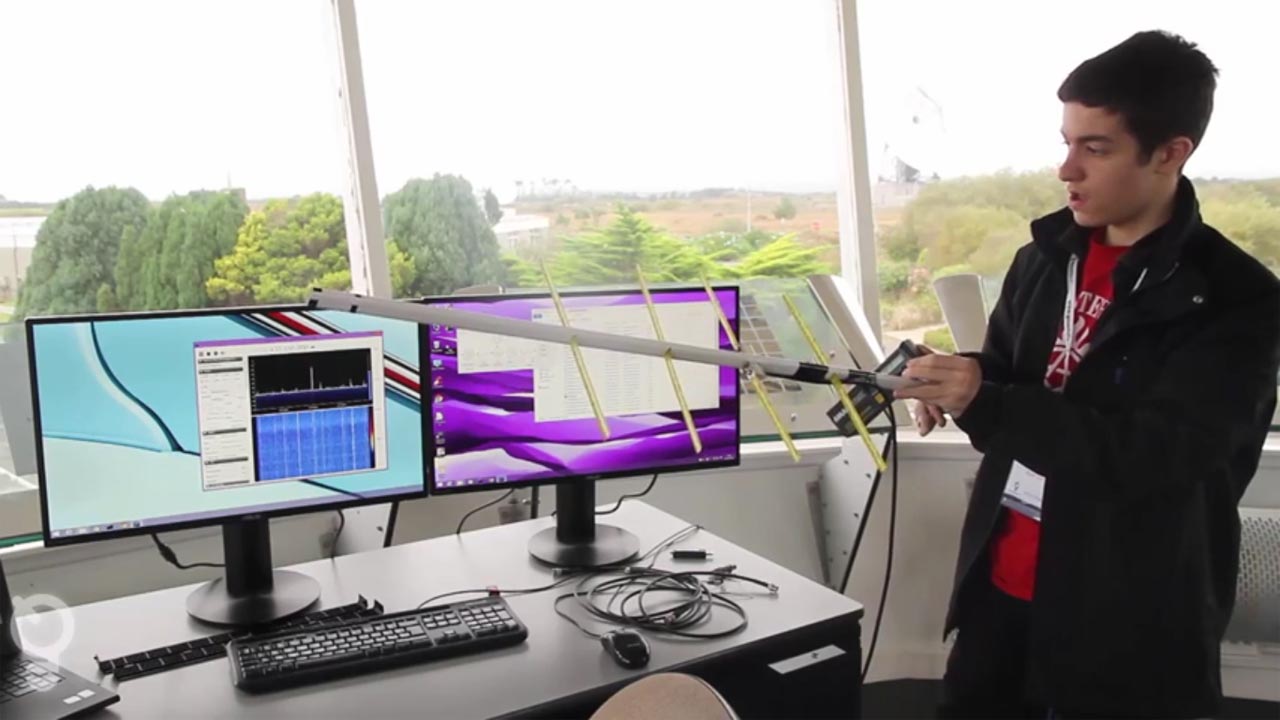
Young people build antennas at GoonhillyYear 11 students have been spending a week’s work experience at Goonhilly Earth Station learning about radio and satellite receivers. They researched and built a low-cost receiver using the FUNcube Dongle Pro+ Software Defined Radio.

Watch the video How to listen to the International Space Station

Goonhilly Earth Station http://www.goonhilly.org/

FUNcube Dongle Pro+ SDR http://FUNcubeDongle.com/

Tenth Anniversary of XO-53 Launch

SSETI Express XO-53 streaks across the dark Swedish sky on October 27, 2015. Two images combined, and zoomed. As you can see, they caught a flare. The gap in the middle is when the mirror of the camera was moving in between shots. The two stars marked are the upper two of The Plough.

SSETI Express XO-53 streaks across the dark Swedish sky on October 27, 2015.
Two images combined, and zoomed. As you can see, they caught a flare.
The gap in the middle is when the mirror of the camera was moving in between shots.
The two stars marked are the upper two of The Plough.

The XO-53 (SSETI Express) satellite was launched October 27, 2005 at 06:52 UT on board a Kosmos 3M rocket launched from the Plesetsk Cosmodrome in central Russia.

SSETI Express XO-53

SSETI Express XO-53

SSETI Express was developed by the Education Office of the European Space Agency (ESA) as part of the “Student Space Exploration and Technology Initiative”. The satellite measures 60x60x70 cm with a mass of about 50 kg. It was built by university students from a number of teams from all across Europe and assembled at the ESA ESTEC facility in the Netherlands.

AMSAT-UK provided a 3 watt S band transmitter to the project – on the basis that it could be linked to the UHF receiver for operation as a single channel FM voice transponder when all the experiments have been completed. The unit also incorporates its own switch mode power supply and a 38k4 TNC to allow the rapid downlinking of data – especially necessary for the camera experiment.

Shortly after launch SSETI deployed three CubeSats, XI-V, UWE-1 and Ncube-2, developed by university students. After deploying the CubeSats, XO-53’s batteries stopped charging and the spacecraft went silent.

ESRANGE in Arctic Sweden

ESRANGE in Arctic Sweden

On the 10th Anniversary of the SSETI Express Launch a crack squad of geeks, Neil Melville-Kenney PA9N, Graham Shirville G3VZV, Karl Kaas OZ2KK, Sascha Tietz KJ6LIL and Lars Mehnen OE3HWM, headed to the ESRANGE facility in Northern Sweden to attempt to SEE the spacecraft for the first time in a decade.

They successfully captured images of the satellite as it streaked across the dark Swedish sky.

Read the AMSAT-UK SSETI Express Handbook

Read the Story of the birth of the On Board Computer for SSETI Express by Karl Kaas

AMSAT-UK has been given exclusive access to the report on the hunt for SSETI Express. Read the SSETI Express Phase E – 400-800 THz Downlink Report

Further pictures are available on the Facebook page of Neil Melville-Kenney PA9N

Explanation of the SSETI Express XO-53 observed flare in terms of the two images captured on Oct. 27, 2015. Note, the team couldn't use mirror lock-up in combination with the specific remote. Hence the wobble.

Explanation of SSETI Express observed flare in terms of the two images captured Oct. 27, 2015
Note team couldn’t use mirror lock-up in combination with the specific remote, hence wobble

UKube-1 CubeSat Completes Mission

UKube-1 in flight configuration in the cleanroom at Clyde Space Ltd - Credit Steve Greenland 2M0SCG

UKube-1 in flight configuration in the cleanroom at Clyde Space Ltd – Credit Steve Greenland 2M0SCG

UKube-1, the UK Space Agency’s first national spacecraft, has now completed its nominal mission following over 14 months of operations. Discussion is underway with AMSAT-UK about the possibility of taking over UKube-1 operations to continue its educational and outreach activities.

UKube-1 CubeSat installed in Deployment Pod

UKube-1 CubeSat installed in Deployment Pod

Launched in July 2014, UKube-1 is a technology demonstration mission with a broad set of objectives aimed at attracting and training future generations of engineers, encouraging collaboration across sectors and institutions, fast tracking space technology development and engaging with students.

As a 3 unit CubeSat (30x30x10cm), flying 4 main payloads, with all the key subsystems of much larger satellites, UKube-1 remains one of the most advanced CubeSats ever built. Despite some technical challenges in orbit, the mission has achieved a range of milestones including:

• delivery into the correct planned orbit (around 650km, sun-synchronous)
• successful deployment of solar panels and antenna
• good battery health
• slow spin rate measured
• uplink and downlink capabilities checked, including Large Data Transfer, downlink at 3 speeds, and redundant communications mode
• all core payloads commissioned and data collected for each
• on-board camera technology successfully tested
• data downlinked from multiple ground stations across the globe

UKube-1 has also helped maintain the UK’s leading position in the CubeSat sector. Participation in the mission placed Clyde Space in an excellent position to capitalise on the fast growing global nanosatellite market. The company has experienced 100% year on year growth, both in turnover and employees, as a direct result from involvement in UKube-1, and is firmly established as a global leader.

Andy Strain and Steve Greenland 2M0SCG in Kazakhstan with UKube-1 and Deployment Pod

Andy Strain and Steve Greenland 2M0SCG in Kazakhstan with UKube-1 and Deployment Pod

Mark McCrum, Bright Ascension Ltd, said:

“UKube-1 provided us with an invaluable opportunity to gain flight heritage for our software technology and to get deeply involved in the operation of a complex CubeSat mission. It gave a huge boost to our credibility as a space software provider and has been instrumental in winning further work.”

Craig Clark, CEO Clyde Space Ltd, said:

“UKube-1 represents a pivotal achievement in the development and growth of Clyde Space. The project moved the company from being a spacecraft subsystems supplier to providing full missions for our customers. To give some context to the extent that Ukube-1 has had to our business, Clyde Space has more than quadrupled in size in the last 3 years and there are currently over 60 CubeSats planned through production here in Glasgow over the next 18 months. The return on investment for Ukube-1 in terms of jobs and export sales for the UK has been outstanding and is a great example of industry and the UK Space Agency working together to put the UK at the forefront of global space technology.”

Professor Andrew Holland, Open University, added:

“Involvement in the UKube-1 mission, though our C3D instrument, has had a positive effect on our research and technology programme within the Space Instrumentation Group at the Open University, as well as a positive effect on our technology partners in the project; XCAM Ltd and e2v Ltd. The project has helped the OU to build a new strand of instrument development within the group, raised awareness of the CubeSat platform as a potential vehicle to accelerate the development of scientific space instrumentation, and has provided early in-orbit-demonstration of technologies. The mission introduced us to new academic and industrial collaborators operating in the space sector and supported the career development of the young engineers and scientists working on the project.”

Dr Helen Walker at the AMSAT-UK Space Colloquium - Credit DK3WN

Dr Helen Walker at the AMSAT-UK Space Colloquium – Credit DK3WN

STFC’s RAL Space provided the Ground Station for the misison at Chilbolton Observatory in Hampshire UK, and UKube-1 operations were commanded from there. Mission Manager Dr Helen Walker said:

“It has been a very exciting time, made possible only with the great support from all the teams involved.”

Although the Agency-supported mission phase has ended, discussion is underway with AMSAT-UK about the possibility of taking over UKube-1 operations to continue its educational and outreach activities until the satellite orbit naturally degrades.

More information about UKube-1 can be found in the missions section of the UK Space Agency website https://www.gov.uk/government/case-studies/ukube-1

Source https://www.gov.uk/government/news/ukube-1-completes-mission

UKube-1 carries a set of AMSAT-UK FUNcube boards which provide an educational beacon for use by schools and a linear transponder for amateur radio communications.

UKube-1 nominal frequencies:
• 145.840 MHz Telemetry downlink
• 145.915 MHz FUNcube subsystem beacon
• 400 mW inverting SSB/CW linear transponder
– 435.080-435.060 MHz Uplink
– 145.930-145.950 MHz Downlink

Dr Helen Walker gave a presentation on UKube-1 to the 2015 AMSAT-UK International Space Colloquium in Guildford.

Watch UKube-1: technology, mission and operations – Dr Helen Walker

UKube-1 https://amsat-uk.org/satellites/communications/ukube-1/