Essex STEM Balloons Launched

Image received from The Boswells School payload on June 29, 2015

Image received from The Boswells School payload at 1416 GMT on June 29, 2015

On Monday, June 29, 2015 three high altitude balloons from Essex schools and colleges transmitted Slow Scan Digital Video (SSDV) in the 434 MHz band.

The balloons, part of the educational Science, Technology, Engineering and Mathematics (STEM) initiative, were taken to an approved site at Elsworth, Cambridge for the launch.

Transmission coverage area of the balloons at 1352 GMT June 29

Transmission coverage area of the balloons at 1352 GMT June 29

The balloon from The Boswells School, Chelmsford reached an altitude of 36,937 metres. It had the call sign BWELLS and transmitted Frequency Shift Keying (FSK) ASCII RTTY at 600 bps on a nominal frequency of 434.450 MHz USB. Balloon frequencies may vary from nominal by several kHz during a flight due to the cold temperatures at high altitudes.

Stewards Academy, Harlow achieved an altitude of 39,876 metres. Their call sign was SWARDS and had a nominal frequency of 434.050 MHz USB and 300 bps data rate.

The Prospects College of Advanced Technology, Basildon reached an altitude of 38,659 metres with their balloon, call sign PROSP, which transmitted on a nominal frequency of 434.150 MHz USB with a 300 bps data rate.

All three balloons transmitted images using SSDV. Individual packets from an image were received by radio amateurs across the UK and NE Europe and automatically uploaded to a central server with the final image being built up from all the good packets and displayed on the web for all to see.

The SSDV images transmitted by the balloons can be seen at:
http://ssdv.habhub.org/SWARDS
http://ssdv.habhub.org/BWELLS
http://ssdv.habhub.org/PROSP

The balloon tracks were displayed live on the web at http://tracker.habhub.org/ and may still be available to view if you select the option to display the past 3 days.

The balloons carried a Raspberry Pi computer board and a Pi in The Sky (PITS) high altitude balloon tracker. On May 24 Chelmsford radio amateur Chris Stubbs M6EDF carried out a test of the PITS tracker for Essex Council, read his report at http://chris-stubbs.co.uk/wp/?p=578

Pi in The Sky project
http://pi-in-the-sky.com/
https://twitter.com/pitsproject

High Altitude Balloon links for online tracking, UKHAS mail list / chat room, WebSDR and SSDV
https://amsat-uk.org/beginners/balloons/

MADHEN EGGSPLORER-1 Balloon Launch

Eggs in Space on front page of the Sleaford Standard newspaper

Eggs in Space on front page of the Sleaford Standard newspaper

At around 10-11am on Sunday, June 28, 2015 Andrew Garratt M0NRD and the South Kesteven Amateur Radio Society are planning to launch balloons from the 10th World Egg Throwing Championship held at the Swaton Vintage Day at Swaton, near Sleaford, Lincolnshire.

As well as telemetry data it is also planned to transmit Slow Scan Digital Video images in 434 MHz. Depending on altitude the signals from a balloon may have a range of up to 800 km, potentially covering much of the British Isles. A real-time track with altitude will be displayed online at http://tracker.habhub.org/

Andrew provided this information on the UKHAS Mailing List : First ever flights for me, so in at the deep end. The ‘egg’ payload will be carried aloft by the balloon and will have a parachute decent into the North Sea when the balloon eventually bursts. There will be SSDV and backup tracker, kindly sponsored by MADHEN http://madhen.net/

Callsign – MADHEN
USB RTTY 300 Baud 880 Hz Shift – Ascii 8 bits, no parity, 2 stop bits Telemetry and SSDV – 434.400 MHz

Callsign – EGG1
Backup tracker
USB RTTY 50 Baud 380 Hz Shift – ASCII 7 bit, no parity, 2 stop bits
Telemetry – 434.650 MHz (old non-tcxo NTX fixed frequency)

Second flight planned, a foil floater with VAYU-NTX tracker kindly donated by Steve Smith G0TDJ

Callsign – EGGDX
USB RTTY 50 Baud 450 Hz Shift – ASCII 7 bit, no parity, 2 stop bits
434.450 MHz (fixed frequency)

Launch should be around 10-11am.

All help in tracking greatly appreciated

Andrew Garratt M0NRD
Chairman South Kesteven Amateur Radio Society
http://www.skars.co.uk/
https://twitter.com/eggsplorer1

UPDATE June 30, 2015:
BBC News report on the balloons http://www.bbc.co.uk/news/uk-england-lincolnshire-33277561

Andrew M0NRD’s report on the day
http://nerdsville.blogspot.co.uk/2015/06/first-hab-flights-were-success.html

Read the Sleaford Standard newspaper report
http://www.sleafordstandard.co.uk/news/local/eggs-in-space-team-of-radio-hams-scramble-to-be-first-to-achieve-egg-straterrestrial-space-mission-1-6803863

High Altitude Balloon links for online tracking, chat room, free software and SSDV
https://amsat-uk.org/beginners/balloons/

Ham Radio Field Day from Space

As part of the #askAstro program 16-year-old Brandon Martinez KF7RAO submitted a video question to astronaut Reid Wiseman KF5LKT about Amateur Radio on the International Space Station (ARISS)

On September 14, 2014 Brandon posted his question to YouTube and on October 10 Reid KF5LKT answered it from the space station. In his reply Reid describes his experience in June of Field Day from space.

Watch Brandon’s question and Reid’s reply

ARISS http://ariss.org/

NASA Astronaut’s ISS Field Day Operation Puts Smiles on Several Faces
http://www.arrl.org/news/nasa-astronaut-s-iss-field-day-operation-puts-smiles-on-several-faces

AMSAT 2015 Field Day – June 27-28
http://www.southgatearc.org/news/2015/june/amsat_2015_field_day.htm

Geosynchronous payload inches closer to reality

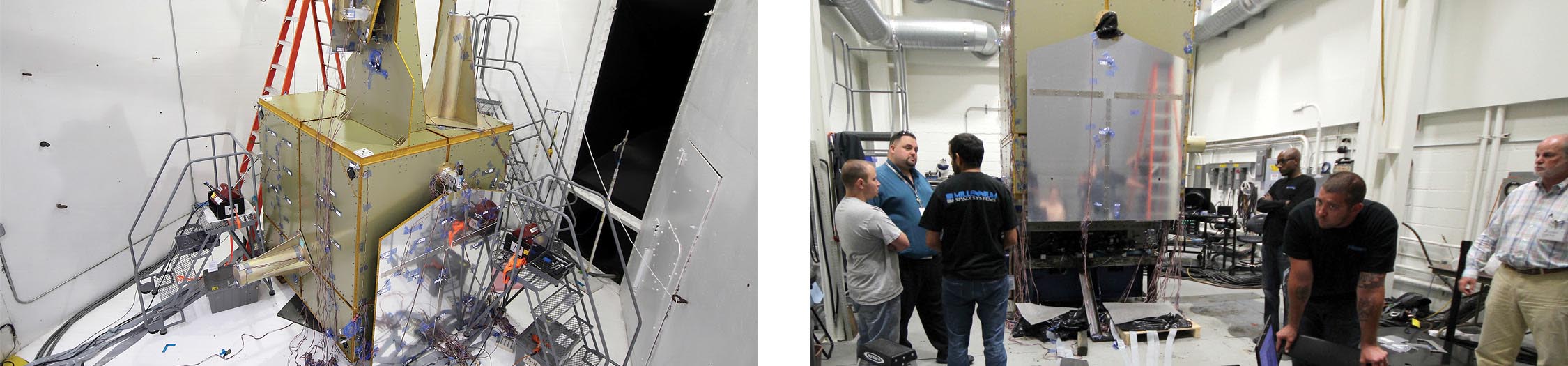
Millennium Space Systems AQUILA M8 Series Satellite Structure

Millennium Space Systems AQUILA M8 Series Satellite Structure

Colonel Fred Kennedy, USAF, Space Production Division and Program Manager for the Wide Field of View satellite (hereinafter WFOV) has accepted the proposal to allow Virginia Tech to place a hosted payload consisting of a Software Defined Radio designed and built by Rincon Research Corporation using support equipment and antennas designed by Virginia Tech and other volunteers to this effort.

The spacecraft hosted amateur payload will be included in the Aquila M8 bus by Millennium Space Systems who is the integrator for WFOV.  Our first role and immediate action item is to raise the $100,000 for Millennium to complete the study of the inclusion of this payload on Wide Field Of View.  Following successful completion of this study,  Virginia Tech will raise money to defray the cost of integration and launch of this payload.  After achieving orbit,  volunteers managed by Sonya Rowe and Zach Leffke of Virginia Tech will operate the payload for as long as it is over the US.  We at VT with the help of the ARRL will prepare partners in other regions to operate the spacecraft should it be moved in order to allow the WFOV to accomplish its primary mission and be prepared to take over operation of the hosted payload on its return to the area of the Contiguous United States (CONUS).

Colonel Kennedy told me how much he admires how unbelievably capable amateurs around the world have been in their many organizations to get spacecraft to orbit and wishes us the best of luck in the onerous task we will have of raising $5M to get this on board.

I will be making many details public now that Colonel Kennedy has told us we are a go if we raise the money.  I know this is a tall order but “A coward dies a thousand deaths and a brave person dies only once”.  I would rather go down trying than cower in a closet.  This is not intended as casting aspersions on any individual or organization just saying I must proceed hastily to succeed at all and I cannot afford caution.

Let’s GO!

Bob McGwier
Co-Founder and Technical Director, Federated Wireless, LLC
Research Professor Virginia Tech
Senior Member IEEE, Facebook: N4HYBob, ARS: N4HY
Faculty Advisor Virginia Tech Amateur Radio Assn. (K4KDJ)

Geosynchronous Amateur Radio Payload https://amsat-uk.org/satellites/geosynchronous/na-gso-sat/

FUNcube-1 / AO-73 Glitch and Commanded Reboot

AO-73 (FUNcube-1) - Image credit Wouter Weggelaar PA3WEG

AO-73 (FUNcube-1) – Image credit Wouter Weggelaar PA3WEG

On Sunday, June 21, there was an anomaly on FUNcube-1 that required the reboot of the satellite’s MCU (Microcontroller).

After a bus freeze, the databus watchdog did kick in as expected and rebooted the satellite. However, we did need to command the satellite back on to automatic mode.

When we did so on the 20:00 UTC pass, it came back up in the correct mode.

We envisage to switch back to autonomous mode either tonight or tomorrow morning local time.

FUNcube is still happy and healthy. This is the 4th reboot since launch, of which one was intentional. Thanks for your reports and concerns.

On behalf of the whole team best 73s,

Wouter Weggelaar PA3WEG
FUNcube team

FUNcube-1 (AO-73) Telemetry:
• Dashboard App http://funcube.org.uk/working-documents/funcube-telemetry-dashboard/
• Data Warehouse Archive http://warehouse.funcube.org.uk/
• Whole orbit data http://warehouse.funcube.org.uk/wod.html?satelliteId=2

KLETSkous Project Update

KLETSkous LogoThe South African Radio League (SARL) report at the pre-conference Engineering meeting held on Friday [June 19] members of the SA AMSAT CubeSat team made some tough decisions.

During the past few years, various options and subsystems have been experimented with.

The team has now set the launch date of KLETSkous at July 2017 with the first flight model to be ready by February 2016 for testing after which final integration will start. This requires that various module designs are locked down and built by October 2015.

It is planned to have all the modules wired together in a breadboard configuration for testing the interoperation of the various sub-units by December 2015. Some modules are at a more advanced stage than others, but in the next few months, the team expect to catch up and meet the deadline for the first breadboard test.

Frik Wolff, ZS6FZ, the League’s technical manager, has joined the team and is working on solar panels and stabilisation issues. Francois Oberholzer, an honours student at Stellenbosch University, is working on improving the weight/strength relationship of the space frame, a project that is part of his thesis. Nico van Rensburg, ZS6QL, as programme manager and the person responsible for documentation, will support the project manager, Hannes Coetzee, ZS6BZP.

There are many opportunities for radio amateurs to join the engineering team. If you have a particular expertise or passion to add value to the  KLETSKOUS project, please discuss your participation with Hannes Coetzee or any of the team members and send your details to saamsat@intekom.co.za

Source SARL http://www.sarl.org.za/

KLETSkous http://www.amsatsa.org.za/KLETSkous.htm

SA AMSAT Space Symposium June 20, 2015
http://www.amsatsa.org.za/SA%20AMSAT%20SPACE%20SYMPOSIUM%202015%20programme.pdf