Isabella Payne being interviewed by BBC TVs Josie Hannett
On Tuesday, August 16, BBC TV’s Josie Hannett interviewed 8-year-old Isabella Payne about her amateur radio contact with NASA astronaut Kjell Lindgren KO5MOS on the International Space Station.
On August 2, Isabella, a member of Hilderstone Radio Society G0HRS, used her Dad’s amateur radio station M0LMK to make contact with Kjell who was using the ISS amateur station, callsign NA1SS. Isabella has been involved in several amateur radio events and hopes to have her own amateur radio licence soon.
Isabella’s picture being viewed by Kjell on the ISS
Kent’s Isle of Thanet News reports on the amateur radio contact between 8-year-old Isabella Payne and NASA astronaut Kjell Lindgren KO5MOS on the International Space Station.
A Broadstairs eight-year-old has chatted with an astronaut aboard the International Space Station and a recording of the conversation will feature on the NASA website.
Isabella Payne spoke to Astronaut Kjell Lindgren as the ISS flew overhead last week.
The youngster was with dad Matthew [M0LMK] who is a license holding amateur radio enthusiast and tutor. He and Isabella are both members of Hilderstone Radio Society.
Matthew said: “Isabella has been a member of the radio club ever since she was born and has been playing with the radio since she was six. Because I have the full licence she can sit on my knee and use the radio to speak to people as long as I am controlling it. Everyone at the club can do that. She has been involved in a few radio events, Children On The Air events, and will hopefully go for her own licence soon.
Matthew M0LMK tweeted about the picture shown above: “Isabella has been having an email exchange with the @NASA #ISS team, you know, as you do! She sent a photo for their publicity team and asked for it to be sent onto @astro_kjell. Here’s what she got in return…” https://twitter.com/m0lmk/status/1556976125359919105
NASA astronaut Kjell Lindgren KO5MOS, who is on the International Space Station, describes his amateur radio contact with 8-year-old Isabella from Kent, UK, as his favorite so far.
He tweeted: I’ve had a lot of fun using the #ARISS amateur radio station #NA1SS on the @Space_Station to talk with ham radio operators all over the world. I’ve even (unofficially) worked stations on all continents! But this may be my favorite contact so far. Thanks Isabella and @m0lmk ! https://twitter.com/astro_kjell/status/1554592817024040960
Matt M0LMK had tweeted: April 23, 2016. A 2 year old sat on my knee and watched the students of Wellesley House school chat with @astro_timpeake, an event I helped organise. Today she got her chance. Thank you so much @astro_kjell, you have changed her world. #iss #NASA #ARISS https://twitter.com/m0lmk/status/1554561621640585224
On July 21 ten amateur radio CubeSats built by students at the Southwestern State University were deployed from the ISS. QSL cards and a diploma are available for receiving the SSTV, APRS and Voice messages
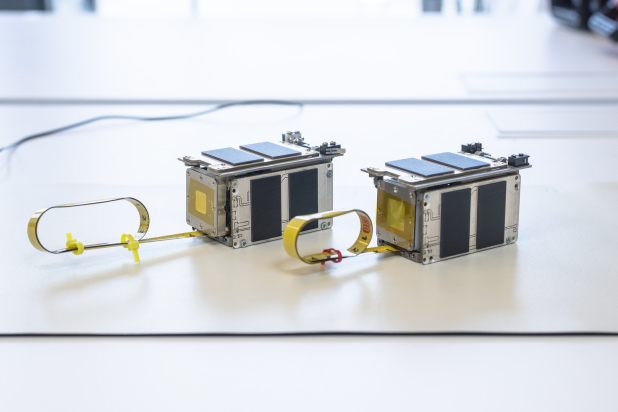
Small spacecraft (ICA), created on the YUZGU-55 platform, have been operating in real space flight for more than ten days. The cyclogram of work includes the transmission of voice messages, telemetry, call sign and SSTV images.
In view of the great interest in the space experiment “Radioskaf”, which is aimed at popularizing space research, Southwestern State University will be happy to send a QSL card to all radio amateurs who have successfully conducted a communication session with satellites.
To receive a QSL card, you need to send information: call sign, location, session date and time, carrier frequency, modulation type (APRS, FM-Voice, Robot36) and the result of a successful session (audio sample, telemetry text and image). The data is sent in the form of Applications for QSL. In the return letter you will receive the address where you need to send the card.
To obtain a diploma, you need to take 10 different SSTV images and voice messages, as well as decode 10 APRS telemetry messages (AFSK 1142 baud format) from any of the satellites, and apply for a Diploma
The Chair of IARU Region 1 Spectrum and Regulatory Liaison Committee, Barry Lewis G4SJH, reports on the response to the EU WRC-23 consultation and the CEPT RNSS/23cm band study.
On the IARU-R1 site he writes:
In a collaboration between the IARU-R1 Spectrum and Regulatory Liaison Committee (SRLC) and the Political Relations Committee (PRC) an IARU Region 1 response has been provided to the European Union consultation on the WRC23 agenda items.
All the agenda items of interest to the IARU are covered with particular attention paid to the AI9.1b issue on the GALILEO / 23cm band amateur service coexistence. This is an important messaging activity and the IARU response again underlines the IARU view that with only two cases of interference recorded globally, the potential for interference is being over-stated and that any regulatory solutions should be proportionate, realistic and appropriate and should not hinder the future development of amateur services. The IARU would be pleased if member societies could share these same views with their national regulators.
The PRC/SRLC is also developing a response to the European Commission Radio Spectrum Policy Group (RSPG) on the same topics.
Secondly the CEPT project team SE40 that is carrying out the CEPT studies on the RNSS/23cm band topic met during the week 25 – 28th July 2022. The IARU provided a contribution and participated in the meeting supported by USKA. Good progress was made but further work continues to be required to finalise the conclusions from the studies. The IARU continues to be concerned about the lack of consideration being given to the low probability of interference and more work is needed on this aspect. A summary report can be found at https://www.iaru-r1.org/wp-content/uploads/2022/07/IARU-Report_SE40_77.pdf
On July 21, 2022, during a spacewalk by Samantha Cristoforetti IZ0UDF and Oleg Artemyev, 10 amateur radio CubeSats were deployed from the International Space Station.
On July 21, 2022, during extravehicular activities (VKD-54), Russian cosmonaut Oleg Artemyev deployed ten Russian small spacecraft (MKA) – SWSU-55 No. 1 & R-390 (SWSU No. 5), SWSU-55 No. 2 (SWSU No. 6), SWSU-55 No. 3 (SWSU No. 7), SWSU-55 No. 4 (SWSU No. 8), SWSU-55 No. 5 (SWSU No. 9), SWSU-55 No. 6 (SWSU No. 10), SWSU-55 No. 7 & R-390 (SWSU No. 11), SWSU-55 No. 8 (SWSU No. 12), “Tsiolkovsky-Ryazan 1” and “Tsiolkovsky-Ryazan 2” according to the program of the space experiment “Radioskaf”.
The SWSU series satellites were developed at the Research Institute of Space Instrumentation (part of Roscosmos) and radio-electronic systems of southwestern State University (SWSU). The main developer of the SWSU series satellites is Egor Shilenkov (UB3WCL), Candidate of Technical Sciences, Director of the Center for Space Instrumentation, Advanced Research and Development of Southwestern State University.
The mission of the SWSU series satellites is to
create a peer-to-peer information network. Within the network, retransmission and parallel transmission to the ground monitoring point are organized.
– Study of the Earth’s magnetic field.
– measurement of the noise of the radio broadcast in outer space.
– transmission of photos (SSTV) and voice messages (AUDIO) to radio amateurs around the world. For each satellite, a personal phrase will be selected, which is translated into 8 different languages.
The Tsiolkovsky-Ryazan 1/2 satellites have special radio transmitting equipment designed to perform the scientific task of calibrating the sensitivity of radio telescopes of the Pushchino Radio Astronomy Observatory of the AstroSpace Center of the Lebedev Physical Institute of the Russian Academy of Sciences (PRAO ACC FIAN, http://www.prao.ru ). Also, these satellites can emit specialized radio signals to study the effects of the propagation of radio waves through the ionosphere using radio receiving equipment, which is supposed to be manufactured at the RSRTU and used as part of the radio telescopes of the PRAO ACCC FIAN.
The Radioskaf space experiment is carried out within the framework of the student program on space education of the youth of Russia and implements projects for the development, training and launch of experimental ultra-small spacecraft for various purposes in the process of extravehicular activities of cosmonauts. The director of the experiment “Radioskaf” is RSC Energia named after “S.P. Korolev”.
You must be logged in to post a comment.