Astronaut’s first school contact from ISS

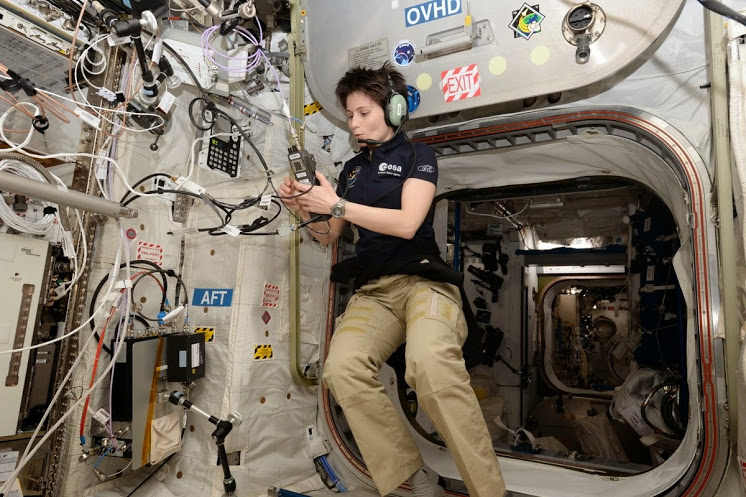
Samantha Cristoforetti IZ0UDF using the amateur radio station in the ISS Columbus module

Samantha Cristoforetti IZ0UDF using the amateur radio station in the ISS Columbus module

Samantha Cristoforetti IZ0UDF has written about her first amateur radio school contact from the International Space Station.

20 students from “Elena di Savoia” in Bari and “Alessandro Volta” in Bitonto were able to ask her questions about space and the ISS.

Read her post at https://plus.google.com/+SamanthaCristoforetti/posts/do2vfeVgAw7

ARISS contact planned for two Italian schools
http://www.southgatearc.org/news/2014/december/ariss_event_1512.htm

OK1DFC and PE1ITR report DESPATCH beacon at 4.7 million km

ARTSAT2-DESPATCH received by Zdenek Samek OK1DFC on December 14, 2014 at 21:18:41 UT

ARTSAT2-DESPATCH received by Zdenek Samek OK1DFC on December 14, 2014 at 21:18:41 UT

Zdenek Samek OK1DFC and Rob Hardenberg PE1ITR reported receiving the amateur radio beacon from the ARTSAT2:DESPATCH spacecraft on December 14 at a distance of 4,700,000 km.

Data 2014-12-14-211841Z ARTSAT2-DESPATCH - Zdenek Samek OK1DFCCongratulations to both radio amateurs on a remarkable achievement.

The amateur radio spacecraft ARTSAT2:DESPATCH JQ1ZNN and Shin’en2 JG6YIG were launched on their journey to deep space at 04:22:04 UT on Wednesday, December 3, 2014. The two spacecraft will have an elliptic orbit around the Sun and travel to a deep space orbit between Venus and Mars. The inclination will be almost zero, which means the spacecraft should stay in the Earth’s equatorial plane. The distance from the Sun will be between 0.7 and 1.3 AU. An Astronomical Unit (AU) is 149,597,871 km.

OK1DFC website http://www.ok1dfc.com/eme/despatch/despatch.htm

See images of the reception of ARTSAT2:DESPATCH by Rob Hardenberg PE1ITR at http://www.pe1itr.com/artsat2despatch/

PE1ITR Shin’en2 reception http://www.pe1itr.com/shinen2/

Shin'en2 on left - ARTSAT2:DESPATCH on right

Shin’en2 on left – ARTSAT2:DESPATCH on right

Tracking utilities for the DESPATCH and Shin’en2 spacecraft are available at
http://ji1izr.air-nifty.com/ham_satellite/in_english/index.html

Shin’en2 437.385 MHz http://www.shin-en2.jp/index_E.html

ARTSAT2:DESPATCH 437.325 MHz CW
Web http://despatch.artsat.jp/en/Main_Page
Facebook https://www.facebook.com/artsat
Twitter https://twitter.com/DESPATCH_ARTSAT

DESPATCH reception reports are summarized at:
https://docs.google.com/spreadsheets/d/1WP-FzXHe8axAzNy44SGbKpJqIRKWHAcIP9vXnaHMb6g/edit#gid=0
http://despatch.artsat.jp/en/Cooperative_Data_Reconstruction

Ham radio spacecraft launched into deep space
https://amsat-uk.org/2014/12/03/ham-radio-spacecraft-launched-into-deep-space/

ARTSAT2:DESPATCH spacecraft becomes FO-81

ARTSAT2:DESPATCH Internal Structure

ARTSAT2:DESPATCH Internal Structure

OSCAR Number Administrator Bill Tynan, W3XO issued this announcement on December 12:

“Since DESPATCH appears to have met all of the requirements for an OSCAR number, including IARU coordination, I hereby with the authority vested in me be by the AMSAT-NA President, do confer on DESPATCH, the OSCAR number Fuji OSCAR 81 or FO-81.”

ARTSAT2 DESPATCH  Deep Space Sculpture

ARTSAT2 DESPATCH Deep Space Sculpture

Continuing, Bill wrote, “I use the Fuji designation in recognition of the long history of contributions the Japanese have made to Amateur Radio satellites. I trust that Fuji OSCAR-81’s mission will be successful and much valuable data will be collected.”

Akihiro Kubota replied from Japan, “It is a great honor for us to receive the OSCAR number from AMSAT. We are very glad to hear it! FO-81 form the name of Fuji is also special for us. DESPATCH will transmit its beacon until this Xmas. We will keep informed of the status of the mission and share it over the world.”

AMSAT congratulates the DESPATCH and ARTSAT teams!

Source ANS

New tracking utilities for the DESPATCH and Shin’en2 spacecraft are available at
http://ji1izr.air-nifty.com/ham_satellite/in_english/index.html

Polish radio amateurs two million km record https://amsat-uk.org/2014/12/09/despatch-2m-km-record/

CubeSat Amateur Laser Communications

Block diagram of proposed Cubesat with laser communicator - Credit Oleg Nizhnik

Block diagram of proposed Cubesat with laser communicator – Credit Oleg Nizhnik

On November 19 Oleg Nizhnik gave a presentation on CubeSat amateur laser communication with Earth to Moon orbit data link capability.

In his paper Oleg says the available bands at 2.4 GHz and 5.8 GHz for amateur satellite communication are increasingly crowded. Higher frequency amateur bands meanwhile require uncommon microwave parts to implement transceivers, and working with 10 GHz or above require electric power typically not available in CubeSat. Therefore, to enable amateur Moon exploration, amateur laser communicator built of common, low-cost parts will help to extend amateur satellites operating range up to at least moon orbit.

The presentation was made in the 3rd Mission Idea Contest (MIC3) held during the 2nd UNISEC Global Meeting at Kyushu Institute of Technology, Kitakyushu, Japan, Nov. 19, 2014.

Watch MIC3 #7 – CubeSat amateur laser communication with Earth to Moon orbit data link capability

Presentation slides https://www.spacemic.net/pdf/mic3_finalist/P8)CubeSat%20amateur%20laser.pdf

Abstract https://www.spacemic.net/pdf/mic3_finalist/8)CubeSat%20amateur%20laser%20communicator%20with%20Earth%20to%20Moon%20orbit%20data%20link%20capability.pdf

The videos of other presentations given at MIC3 are at
https://www.youtube.com/user/UNISECmovie/videos

Slides and abstracts are at
https://www.spacemic.net/index.html#finalpresentations

Amateur Satellite Seed Funding

AMSAT FOXOn December 2, 2014 the AMSAT-NA Board of Directors approved Technology Development Seed Funding.

As a part of AMSAT’s “Design The Next AMSAT Satellite” challenge, the Board of Directors approved $5000, within the 2015 engineering budget, to be used as seed money for future satellite development. Additional fund raising sources will also be investigated and pursued.

AMSAT President Barry Baines, WD4ASW, said, “We’re prepared to return to space starting in 2015 with a fleet of satellites that will equal, if not exceed, the performance, and availability to the average ham, of our previously popular AMSAT OSCAR 51. Meanwhile, we are preparing for the future looking to potentially leverage new technologies, to provide the best opportunities for enhancing amateur radio’s presence in space.”

Director Tom Clark, K3IO, noted the need for a defined future systems program. Tom said, “We saw a significant number of both new and old members who want to see the development of critical system elements for future opportunities by 2018-20. As I see it, critical ‘tall poles’ in applying potential technologies require significant work to begin now to ensure success.”

AMSAT is interested in supporting technology ideas that enhance the utility of using the CubeSat form factor to support more robust amateur satellite capabilities.  The scope of potential interest in not limited; some examples of  technology enhancement might include:

+ Microwave technology suitable for use in amateur spacecraft. This includes the need to identify optimum frequency bands.

+ Complementary, low-cost ground systems, including an effective ~1º antenna pointing system.

+ Define and develop optimum coding and modulation schemes for low power microwave use.

+ Attitude determination & control systems to point the spacecraft antennas towards the user while maximizing solar panel production.

Individuals interested in learning more about this initiative should contact AMSAT Vice President-Engineering Jerry Buxton, N0JY (n0jy at amsat.org).

Meanwhile, the development of AMSAT’s current series of the Fox-1 cubesats continues on schedule. AMSAT Vice-President of Engineering, Jerry Buxton, N0JY reported during the Board meeting that construction and testing of five Fox satellites is on schedule:

+ Fox-1A will launch on a NASA ELaNa flight during the 3rd quarter of 2015 from Vandenberg AFB,

+ Fox-1B will fly with the Vanderbilt University radiation experiments expected in 2016.

+ Fox-1C will launch on Spaceflight’s maiden mission of the SHERPA multi-cubesat deployer during the 3rd quarter of 2015. This flight was purchased by AMSAT.

+ Fox-1D is a flight spare for Fox-1C. If not needed as a spare it will become available to launch on any open launch slot which becomes available and be submitted in a CSLI proposal in 2015.

+ Fox-1E is built as a flight spare for Fox-1B but has been included in a student science proposal as part of the November, 2014 Cubesat Launch Initiative (CSLI) for an ELaNa flight slot. If selected the Fox-1B spare will fly as Fox-1E.

More details of the “Design The Next AMSAT Satellite” challenge can be found on-line at:
http://www.amsat.org/?p=3395

[ANS thanks the AMSAT Board Of Directors for the above information]

AMSAT-NA http://amsat.org/
UWE-3 CubeSat Update

UWE-3 LogoUWE-3 was launched with FUNcube-1 on November 21, 2013, the team say they will now be temporarily ending operations.

Today, more than one year after launch, there will be a temporary end of operations caused by the end of funding.

However, UWE-3 is in a very good health condition with fully charged batteries and operations may be continued depending on future research plans.  

Without any reception from ground, UWE-3 will carry out a warm reset every four days and switch regularly between the redundant on-board processors and radios. Therefore, UWE-3 will switch back to its nominal frequency of 437.385 MHz.

Nevertheless we appreciate the extensive support we received from the HAM amateurs in the past and hope that also in the future the status of UWE-3 will be monitored with your support, like you did so many times in the past year. Thank you so much for the very helpful cooperation in this respect!

Yours sincerely,

UWE-3 Team

UEW-3 News
http://www7.informatik.uni-wuerzburg.de/forschung/space_exploration/projects/uwe_3/uwe_3_news/