
The system board containing RF transmitter module, receiver module, level adjustments, duplexer and antenna connector. Image credit LU7AA
AMSAT Argentina is pleased to announce that on Saturday, June 29, 2013 from 1400 GMT, weather permitting, it is planned to launch an amateur radio high altitude balloon FM repeater ‘Betty II’ from Victorica, La Pampa, 665 km. west of Buenos Aires, it is expected to travel east.
The 435.950/145.950 MHz FM repeater will be activated by a 123 Hz CTCSS subtone. The balloon can also transmit Slow Scan Television (SSTV) ROBOT-36 images from the onboard camera on 145.950 MHz. There is an APRS transmitter on 144.930 MHz.
It should be possible to access the balloon using a 2 watt FM handheld rig from 750 km away giving a theoretical maximum distance for two-way contacts of 1500 km.
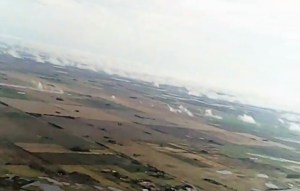 Details and photos of the announcement and prior experiences in http://www.amsat.org.ar/globo29.htm
Approval of ANAC (Argentina FAA)) had been granted by NOTAM (notice to air crew) http://amsat.org.ar/images/faxanac.jpg .
For these experiments members of AMSAT-LU, LUSEX, project development group http://lusex.org.ar , are working together with Pampeano and QRM Belgrano Radio Clubs, APRS Group, etc.
Electronics is comprised of a voice UHF to VHF FM repeater with CW TLM, APRS, DTMF and SSTV. According to estimates balloon could reach 30,000 meters high, traveling for 3 hours, 150 km east of the launch site.
This would allow contacts between stations located in the provinces of Buenos Aires, Santa Fe, Entre Rios, Cordoba, Catamarca, Santiago del Estero, La Pampa, San Luis, Mendoza, San Juan, Rio Negro, Neuquen, Uruguay and Chile. (It is launched from the center of the country to facilitate greater participation). Coverage at http://www.amsat.org.ar/picocubr.jpg
To receive the payload, if less than 750 km from launch site, only need is a handy or base FM receiver on 145.950 MHz for voice/sstv and 144.930 for APRS.
The repeater which is enabled via 123 Hz CTCSS subtone, receives 435.950 MHz FM voice (-112dBm, 0.56 uV) emitting 2W output simultaneously on 145.950 MHz.
 Payload will also carry an emergency long duration APRS transmitter sourced by solar cells and supercapacitors as batteries.
To enable better utilization, it is suggested short QSOs (license, own locality, grid locator, received signal and short comments).
Simultaneous emits APRS 1200 baud at 144.930, and also in 145.950. The DTI symbol on APRS will change from a balloon ( /O ) during ascent to a slider ( /g ) during the parachute descent.
Will operate for 90 seconds voice, then a beep alerting the end of that time will make way for the issuance of APRS at different frequencies. Every five minutes CW TLM via telegraphy audio tones sends callsign LU7AA and height in meters, then repeat the cycle.
On 145.950 MHz SSTV images ROBOT-36 mode (36 seconds) will be emitted on demand showing what the balloon sees (Can be received, with either MIXW or RX-SSTV (recommended)).
Balloon will carry two GoPro TV cameras (one to ground and another to the horizon) that will record images and sound during flight and can be retrieved with the payload.
It will be live in APRS on http://aprs.fi/?call=lu7aa-11 every minute, including speed, height, internal and external temperatures and battery voltage.
Local georeferenced maps are available for UI-View in http://www.amsat.org.ar/pico2.jpg , http://www.amsat.org.ar/pico2.txt to be renamed to pico2.inf .
The experiment on 435.950 MHz voice also receives and accepts DTMF user issued commands i.e. B * (DTMF keypad UHF handy) will return S5 … ….. on VHF CW 145.950, your signal strength received at balloon, if P10 that states S9 +10.
There are more commands that enable issuance of TLM in CW or APRS beacon and remote commands to drop payload, mode changes, control of timers, energy, power, enable SSTV, etc..
Additionally a VAISALA RS92SGP radiosonde emitting FM wide on 402.740/403 MHz has been added, which provides GPS location, pressure, winds, height, course, dwt point, temperatures, etc. Same data as daily collected by the National Meteorological Service.
Data can be received using an SDR dongle and sondemonitor program available as test for 21 days from internet.
On launch day/time AMSAT-LU will have one of his members on the Ezeiza Airport Traffic Control, acting as a contact between ANAC and AMSAT-LU, using VOR locations application, adapted from EOSS and available on http://amsat.org.ar/vor.asp .
Local frequencies coordination and announcements before and during flights will be 7095 kHz LSB + / -10 kHz and VHF frequencies of local repeaters in the area.
During flight 430.930 AMSAT-LU APRS will operate wide coverage Igate LU7AA-10, installed at the Investigation Center, besides a portable Igate close to launch site. Any area stations that can receive and provide bridge to the APRS network are welcome.
Being an experiment aimed at a next satellite, contacts made between stations thru this UV repeater will be considered valid and awarded upon request by AMSAT-LU Permanent Satellite Certificate, free and also applicable for license upgrades, see http://www.amsat.org.ar/certsat.html, http://www.lu4ao.org.ar, http://www.amsat.org.ar/lu4aao.
Top 10 participants with the highest two-way contacts/distances sum thru repeater will be awarded with a special certificate. Send email with data filled on form http://www.amsat.org.ar/lu4aao/Globo_29jun2013.xls QSOs with stations via the balloon including QRA Locators, QTR to RC QRM Belgrano before July 23.
All reports welcome. If you want or can organize or be part of launch teams, control, monitoring and recovery, operating as an independent station and capturing data, and / or want to join us in this adventure from the launch site can do it through an email to parapente arroba amsat.org.ar.
We appreciate having read this information and forward if possible.
73, LU7AA, AMSAT-LU. aiming to the future by making present fun.
Email: info at amsat.org.ar
AMSAT Argentina http://www.amsat.org.ar/
Facebook http://facebook.com/AMSAT.LU


You must be logged in to post a comment.