
RadFxSat/Fox-1B Amateur Radio CubeSat Proposal Accepted by NASA

AMSAT FOX

AMSAT-NA reports that the RadFxSat/Fox-1B proposal has been accepted by NASA. Tony Monteiro AA2TX writes:

I am pleased to announce that our NASA ELaNa proposal for RadFxSat/Fox-1B has been accepted.

Here is the NASA announcement. Note that the projects are listed in alphabetical order, not priority order. Look for “Vanderbilt and AMSAT.”
http://www.nasa.gov/home/hqnews/2013/feb/HQ_13-064_CubeSat_4.html

We requested a launch in 2014.

STRaND-1 Amateur Radio Beacon – New Type with Message

Dr Susan Jason working on STRaND-1

Tweets from Surrey Space Centre @SpaceAtSurrey regarding #STRaND-1.

We have a new beacon type out at the moment – and it has a message in it! See if you can receive it 😀

First to pick it up gets … free STRaND-1 stickers!

STRaND-1 437.568 MHz telemetry information

General STRaND-1 information

Decoding the STRaND-1 amateur radio telemetry beacon

STRaND-1 PSLV-C20 Launch - Image credit ISRO

STRaND-1 PSLV-C20 Launch – Image credit ISRO

STRaND-1 carries an amateur radio AX.25 packet radio downlink on 437.568 MHz using 9600 bps FSK modulated data with HDLC frame, NRZI encoding.

Dr Chris Bridges would be delighted to receive all available telemetry files by email to C.P.Bridges@surrey.ac.uk

Excel Spreadsheet of STRaND-1 Telemetry Format_20130327

On the AMSAT Bulletin Board Mark Hammond N8MH has provided these tips to decode STRaND-1:

(1) Sprint-2 TNC set at 9600 baud in KISS mode (or any 9600 in KISS mode probably)

(2) Using this software to capture:
http://www.dk3wn.info/files/online_kiss_plus.zip

(3) And using this software to decode the captured KISS files:
http://www.dk3wn.info/files/kissdump.zip

Thanks to Mike Rupprecht DK3WN for the excellent software.

Jan PE0SAT describes how he used the free TNC emulator software AGWPE and SDR# to decode the telemetry. This approach means you don’t have to buy a dedicated hardware TNC it simply uses your existing PC and radio that supports 9600 bps data:

(1) Record a pass using SDR# and a FUNcube Dongle Pro+ and save the IQ wav file so you can work with it after the pass.
(2) Configure AGW Packet Engine (AGWPE) as a 9600 baud modem using your audio mixer as input. If you don’t have an audio mixer, use audio VAC to route the received audio to the AGW audio input.
(3) When the AGW packet engine is running use AGW-Online-KISS from DK3WN to connect to the packet engine and decode the telemetry.
(4) Open the IQ wav file within SDR# and playback the recorded file and tune to the correct receive frequency, now you can see decoded data within Online-Kiss.
(5) Feed the files captured to KISS-Dump
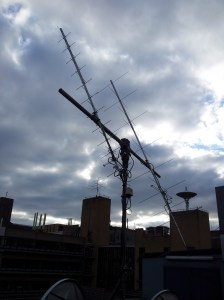
STRaND-1 Ground Station Antennas

STRaND-1 Ground Station Antennas

Descriptions of ONLINE KISS +, AGW ONLINE KISS and KISS Dump + are at http://tinyurl.com/SatSoftwareDK3WN/

The free AGWPE soundcard packet software AGWPE.zip is available at http://www.sv2agw.com/downloads/

Guide on how to use AGWPE http://www.soundcardpacket.org/

Tracking Information

Free satellite tracking software:
• SimpleSat Look Down http://www.tomdoyle.org/SimpleSatLookDown/
• Gpredict http://gpredict.oz9aec.net/
• Orbitron http://www.amsat-uk.org/?p=9051

Keplerian Two Line Elements (TLE’s) ‘Keps’

Reception of UniBRITE amateur radio CW beacon reported from Sudan

AMSAT-UK_Bevelled_LogoUniBrite (CanX 3A) was launched Monday, February 25, on the same rocket as STRaND-1. It has an amateur radio Morse Code beacon on 145.980 MHz.

This report was posted on the AMSAT Bulletin Board by Yasir Osman ST2YM in Khartoum, Sudan.

ST2UOK ground station at the University of Khartoum, Sudan has tracked the
first pass over Africa of AAUSAT-3 , STRaND-1 and UniBRITE after the
launching in 12:25 UTC, a CW signal with high noise heard and expected to
be the beacon of the UniBRITE. As pointed by operators Abubakr, Yasir ,
Mustafa and Hala.

BRITE: World’s Smallest Space Telescopes Launching Monday http://www.amsat-uk.org/?p=13274

Details of other satellites on the same launch http://www.amsat-uk.org/?p=12180

STRaND-1 received by radio amateur in Cuba using FUNcube Dongle SDR

Hector Martinez CO6CBF - 640

Hector Martinez CO6CBF

On the AMSAT bulletin board Hector Martinez, CO6CBF, reports receiving the smartphone satellite STRaND-1 using a FUNcube Dongle Software Defined Radio (SDR).

He posted:

On the 22:36 UTC pass both STRaND-1 and AAUSAT3 have been heard in Cienfuegos city (EL92sd). I was running a FUNcube Dongle with SDR-Radio V1.5 and a homebrew ARROW antenna with a homebrew preamplifier. The STRaND-1 beacon has a great signal (S9+).

Congratulations to the STRaND-1 and AAUSAT3 teams for the great job!

Information on the STRaND-1 smartphonecsatellite is at https://amsat-uk.org/satellites/strand-1/

Join the FUNcube Yahoo Group at http://groups.yahoo.com/group/FUNcube

Further information on the FUNcubeDongle Software Defined Radio is at http://www.FUNcubeDongle.com/

Radio Amateurs asked to collect STRaND-1 telemetry data

AMSAT-UK_Bevelled_LogoThe STRaND-1 team have asked if radio amateurs can assist in collecting telemetry from around the world to help them determine the health and attitude of the spacecraft.

The telemetry downlink is amateur radio AX.25 packet radio on 437.568 MHz using 9600 bps FSK modulated data with HDLC frame, NRZI encoding.

Dr Chris Bridges would be delighted to receive all available files by email to C.P.Bridges@surrey.ac.uk

STRaND-1 information – https://amsat-uk.org/satellites/strand-1/