QRP APRS Packet Radio to the ISS

International Space Station

International Space Station

Doug Cook KD5PDN’s article about contacting the International Space Station with a few watts and a shoestring budget antenna is now available.

The article “QRP to the ISS” appeared in the February, 2012 issue of QST magazine and, with permission from the ARRL, can be downloaded from Clint Bradford K6LCS’s website.

Doug walks the reader through building a simple tape measure beam, and how to successfully work the ISS with it and a handheld radio.

Read the article at http://www.work-sat.com/Work-Sat/Misc_files/QRP-ISS.pdf

A video by author Doug Cook KD5PDN shows the tape rule antenna and how to set up a Yaesu VX-8R for ISS APRS packet data sending and receiving and other aspects to make a digital contact with the International Space Station. You can also learn how to interpret the audio prompts when packet data is being received.

Watch ISS APRS Contact with a Yaesu VX-8R WB5BSA

There is lots of other information on the Work Satellites website at http://www.work-sat.com/

Student D-STAR Satellite to Launch in 2012

Students at workStudents at the University of Liege are hoping their D-Star GMSK satellite OUFTI-1 will be launched towards the end of this year.

An update on the satellite is published in the January 2012  issue of the OUFTI-1 newsletter at
http://www.leodium.ulg.ac.be/cmsms/uploads/OUFTI-1%20Newsletter%204.pdf

The satellite will have uplinks in the 145 MHz band and downlinks on 435.015 and 435.045 MHz.

OUFTI-1 http://www.leodium.ulg.ac.be/cmsms/

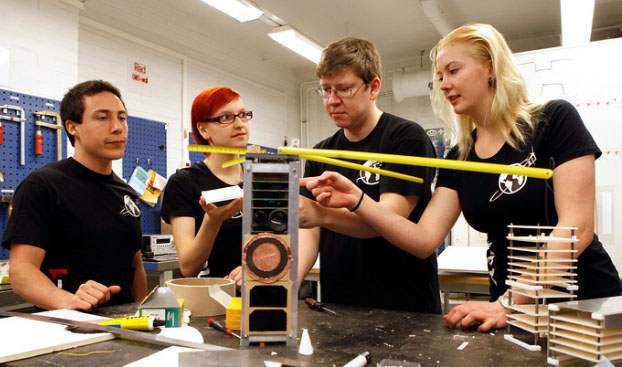
Professor Jacques Verly ON9CWD (Montefiore Institute) and Amandine Denis ON4EYA, Head of Project OUFTI (LTAS) with the flight model (structure) of OUFTI-1 - Image credit ESA

Professor Jacques Verly ON9CWD (Montefiore Institute) and Amandine Denis ON4EYA, Head of Project OUFTI (LTAS) with the flight model (structure) of OUFTI-1 – Image credit ESA

Sounds From Space website looking for additional sounds

 Matthias, DD1US, would like to draw your attention to a collection of audio recordings, the ‘Sounds From Space‘ collection on his website at http://www.dd1us.de. This features a collection which has also a section dedicated to recordings of amateur radio satellite signals.

Please have a look at it. The idea is to give older radio amateurs the chance, to listen to signals of satellites which are already gone and the might have worked in the past, and to younger people interested in ham radio, to get them more excited in satellite communication.

In spite of the fact that the collection now has close to 1000 recordings he is still missing recordings from some amateur radio satellites.
If anyone of you would be willing to contribute recordings to these satellite he would highly appreciate it. He has and always will give full credit to the source of the recordings. Please have a look in your older tapes and recordings!

Here is a list of the most wanted missing satellites:
Amsat Oscar 8
RS-1
RS-2
ISKRA-1
RS-3
RS-4
RS-5
RS-6
RS-8
ISKRA-3
Fuji-OSCAR-12
UOSAT OSCAR 15
WEBER OSCAR 18
UOSAT OSCAR 22
POSAT OSCAR 28
TMSAT OSCAR 31
PANSAT OSCAR 34
UOSAT OSCAR 36
ASUSAT OSCAR 37
WEBER OSCAR 39
SAUDI OSCAR 42
STARSHINE OSCAR 43
MYSAT OSCAR 46
KAGAYAKI (SORUNSAT-1)
ANUSAT
BEVO-1
WASEDA-SAT2
StudSAT

Source: Amsat, Matthias, DD1US and The Sounds From Space website

Student Software Defined Radio CubeSat

Students at the University of Vigo have built Xatcobeo a CubeSat that carries a Software Defined Radio (SDR) and a solar panel deployment mechanism.  A launch on an ESA Vega rocket in February is planned.

The IARU Amateur Satellite Coordination Panel pages report that it carries three payloads:

SRAD: a Software Defined Radio. The aim is to test under space conditions a reconfigurable radio. Different modulation schemes will be selected depending on the link conditions.

RDS: an ionizing radiation dosimeter. This dosimeter will take measures of ionizing radiation in a typical LEO orbit for amateur satellites, thus increasing our knwoledge about radiation conditions in this environment.

PDM: a solar panel deployment mechanism to be tested in-flight.

It is planning to use FFSK with AX.25 on UHF. These frequencies have been coordinated – Simplex 437.365MHz and SSR downlink on 145.940MHz.

Further info available at http://www.xatcobeo.com/


FUNcube in Electronics Weekly

FUNcube_Graphic_Large

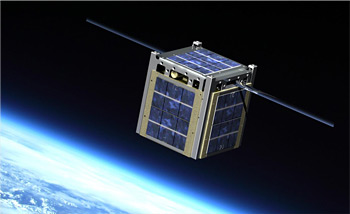
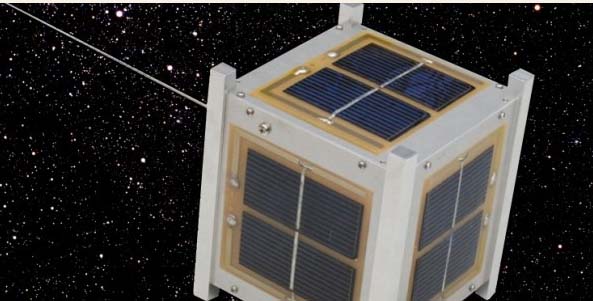
Artists impression of FUNcube in space

The FUNcube amateur radio satellite project is featured on the website of Electronics Weekly.  The printed version of the publication (circulation 36,400) is due out on Wednesday, January 18.

Read the article ‘Radio hams seal launch deal for FUNcube satellite’ http://www.electronicsweekly.com/Articles/13/01/2012/52712/radio-hams-seal-launch-deal-for-funcube-satellite.htm

A free subscription to the digital version of the publication is available via the Electronics Weekly website http://www.electronicsweekly.com/ On the lef-hand side under “SIGN UP TO” click on “Digital Magazine”.


Winter OSCAR News

The Winter issue of OSCAR News has been posted to members.

In this issue:
– It all started here – 50 years ago!
– UKube-1 Update
– Clive Wallis G3CWV column
– RSGB Spectrum Forum Meeting Nov 2011
– FUNcube Report
– Utility of Nearly Geostationary Orbits for Amateur Spacecraft
– Another 50th Anniversary
– News from Bochum
– Winner of Space App Competition
– The AMSAT-UK Survey
– Accurate Time Keeping
– ‘Shorts’