FUNcube Environmental Testing at RAL

Duncan makes a few last minute software changes, while Graham rests his hand on the oven door
Wouter PA3WEG (right) working in the RAL cleanroom
before placing FUNcube into the vacuum chamber

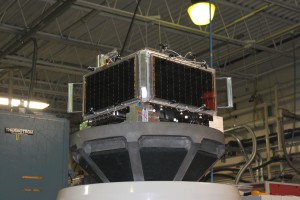
During the week starting 18 July, members of AMSAT-UK performed temperature testing and thermo vacuum testing of the FUNcube satellite. The facilities to do this were very kindly offered by the Assembly, Integration and Verification (AIV) facility at the Rutherford Appleton Laboratories, at Harwell, near Oxford. AMSAT-UK are extremely grateful to them for helping and advising us. The boards we tested were our ‘Engineering Models’ (EMs) which are just about identical to those that will fly. Below are some pictures of the facilities, and the team.

In summary (as at Wed 20 July) we have determined that the stack operates down to a temp of minus 10 degs C and up to +60 degs C and survived storage at -30 and +70. These results were obtained by the use of a temperature controlled oven in air. On Tuesday evening we transferred the stack to a thermo vacuum chamber, and are continuing testing.

AMSAT-UK is aiming to complete the thermo vacuum testing by Friday morning, leaving the rest of Friday to apply glue to the structure, and mount it in its ‘POD’ ready for vibration testing on Monday.

FUNcube EM in air oven at RAL July 2011

The temperature is measured by the means of thermocouples which are mounted in different places on the ‘stack’, one on the PA final amplifier device, one on the microprocessor of the CCT Board, one on the RF board near the rx local oscillator, and the fourth one on the structure. When in the air oven the readings from the thermocouples are noted down manually. In the thermo vacuum chamber these reading are logged automatically once per minute.

All the telemetry sent by the stack is being logged, via a FUNcube dongle, so in this way we will be able to calibrate some of FUNcube’s temperature sensors.

Duncan makes a few last minute software changes, while Graham rests his hand on the oven door
Duncan Hills makes a few last minute software changes, with Graham Shirville G3VZV by oven
For more information on FUNcube see http://www.FUNcube.org.uk/
Join the FUNcube Yahoo Group at http://uk.groups.yahoo.com/group/FUNcube/

Responses to DCMS spectrum release plan

A joint response from the RSGB, UK Microwave Group, AMSAT-UK and BATC is among the 31 responses to the DCMS consultation on releasing public sector spectrum.

The Department of Culture, Media and Sport (DCMS) consultation sought opinion on the release of 500MHz of public sector spectrum by 2020.

The Amateur and Amateur Satellite services share spectrum with the public services.

BAE Systems expressed serious concerns regarding the proposed release of spectrum at 2300-2400MHz and the UK Space Agency highlighted the risks to the space sector, especially in the area of remote sensing and satellite navigation.

NATS pointed out that access to interference free radio spectrum is essential for the safe and efficient operation of aircraft and challenged the assertion that there is significant surplus spectrum that can be released ‘to more productive private sector use’.

Read the responses at
http://www.culture.gov.uk/consultations/8297.aspx

The joint RSGB, UK Microwave Group, AMSAT-UK and BATC response is at
http://www.culture.gov.uk/images/consultation_responses/
Spectrum2011_Radio-Society-of-Great-Britain.pdf

Releasing public sector spectrum document
http://www.culture.gov.uk/images/publications/Spectrum_Release.pdf

Southgate May 2011 – First step to Communications Bill
http://www.southgatearc.org/news/may2011/communications_bill.htm

UK Microwave Group: http://www.microwavers.org/

AMSAT-UK: http://www.uk.amsat.org/

British Amateur Television Club (BATC): http:/www.batc.org.uk/

Radio Society of Great Britain: http://www.rsgb.org/

AMSAT-UK planning ARISSat-1 activation


GB4FUN

GB4FUN

Members of AMSAT-UK hope to be active using GB4FUN during the ARISSat-1 tests, July 30-31, from the International Space Colloquium in Guildford.

ARISSat-1 is a new Amateur Radio satellite that will be deployed from the International Space Station (ISS) during a space walk in early August.

It is currently onboard the ISS and on the weekend of July 30-31 the satellite will be connected to external antennas of the ISS enabling Amateurs to communicate through it’s linear transponder using SSB/CW and receive it’s FM, BPSK and CW downlinks. The FM downlink will also be transmitting Slow Scan TV that can be received using the free MMSSTV software.

AMSAT-UK intend to use the GB4FUN station equipment to listen to the various ARISSat-1 signals.

In addition they will be experimenting with the use of FUNcube Dongle software defined radios to receive the ARISSat-1 signals with a variety of different antennas.

The colloquium is being held on July 30-31 at the Holiday Inn, Guildford, GU2 7XZ. It is open to all Radio Amateurs and SWL’s. Either day passes or full packages comprising overnight accommodation and meals are available. For futher information see http://www.uk.amsat.org/colloquium-2011/


ARRISat-1 Frequencies
http://www.southgatearc.org/news/july2011/
arissat1_deployment_1707.htm

Online Satellite Pass Predictions, select ISS
http://www.amsat.org/amsat-new/tools/predict/

PDF of RadCom article Getting Started on Amateur Radio Satellites
http://www.uk.amsat.org/archives/getting-started-on-
amateur-radio-satellites

AMSAT-UK publishes a colour A4 newsletter, OSCAR News, which is full of Amateur Satellite information.
Join online at http://tinyurl.com/JoinAMSAT-UK


ARISSat-1/KEDR activation planned

ARISSat-1/KEDR Project Manager Gould Smith, WA4SXM said this week the latest status, discussed during the International ARISS teleconference Sergey Samburov, RV3DR announced the ARISSat battery will be charged late July and a test of the system will be conducted on the ISS from 1915 UTC 30 July to about 1200-1400 UTC 31 July.

During the test ARISSat-1 will be in LOW power mode, this means that it will transmit about 40 seconds and then shut down for 2 minutes and then transmit for 40 seconds, etc.
The standard ARISSat-1/KEDR 2m downlink band plan should be
transmitted. Additionally, the FM signal also downlinked on 437.55 MHz.

As to the date of deployment, Gould summarized,
“The deployment date for ARISSat is still subject to change. As of July 14 we are looking at a 3 Aug 2011 date for EVA 29 and the ARISSat-1/KEDR deployment. The ARISSat/KEDR deployment is the first task of the EVA, so it will occur fairly soon after the EVA begins. We will let everyone know more as we know more.”

Continue reading →

ARISSat-1/KEDR deployment information

ARISSat-1/KEDR deployment information

ARISSat-1

ARISSat-1

During the International ARISS teleconference Sergey Samburov, RV3DR announced that the ARISSat battery will be charged late July and a test of the system will be conducted on the ISS from 1915 UTC 30 July to about 1200-1400 UTC 31 July.

The standard ARISSat-1/KEDR 2m downlink band plan should be transmitted as well as the FM signal also downlinked on 437.55 MHz. More information as it becomes available.

Today we are looking at a 3 Aug 2011 date for EVA 29 and the ARISSat-1/KEDR deployment. This is all subject to change.

Gould, WA4SXM

Source: ANS

• Read the ARISSat-1 article from QST at
http://web.me.com/clintbradford/Work-Sat/
ARISSat-1_files/QST-ARISSat1.pdf

• July 30-31 is also the date for the AMSAT-UK International Space Colloquium that will be held in Guildford, further details at
http://www.uk.amsat.org/colloquium-2011/


BIS hosts exhibition of the latest UK-made space technology

Leading space technology manufactured in the UK was showcased at the Department for Business Innovation and Skills (BIS).

David Willetts, Minister for Universities and Science with Phil Davies, Head of Business Development Activities, SSTL.  Credit: UK Space Agency

David Willetts, Minister for Universities and Science with Phil Davies, Head of Business Development Activities, SSTL. Credit: UK Space Agency

The exhibition was designed to show the diverse range of space technology and applications produced in the UK, from satellites to spacecraft engines.

Science Minister David Willetts said:

it’s crucial that UK companies take advantage of rapidly growing markets like space technology

“Manufacturing has a vital role to play in rebalancing our economy, so it’s crucial that UK companies take advantage of rapidly growing markets like space technology.

Continue reading →