AO73/FUNcube-1 is entering a further period of full sunlight

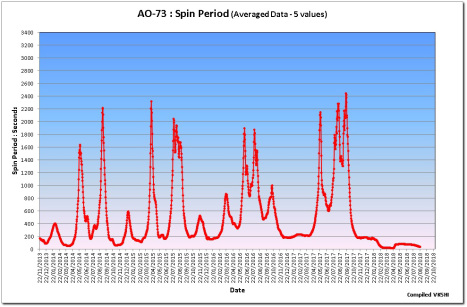
AO-73 Spin PeriodAO73/FUNcube-1 has been in space for almost five years and the original Sun Synchronous Orbit has now changed slightly such that the spacecraft will no longer be in eclipse for 35 mins every orbit.

The eclipse period has already reduced and will again become zero on September 8, 2018. This means that our usual autonomous switching between transponder on in eclipse and high-power telemetry when in sunlight will no longer be effective!

This schedule was originally planned to provide a very strong telemetry signal for schools to use during daylight hours and for amateur operation at night (and also at weekends and over holidays).

We have already experienced a short period of full sunlight but this time it looks like the spacecraft will be in this situation for more than eight months until sometime in April next year.

In addition to the additional thermal effect that will occur during this period, we also expect that the spin rate will increase. The reason for this effect is not yet fully understood but may be related to the amount of current flowing from the solar panels to the spacecraft bus being sufficient to cause a torque effect with the earth’s magnetic field.

We have therefore decided to have AO73/FUNcube-1 initially operate for alternate periods of one week in either safe or educational modes. This should enable us to evaluate whether the currents do affect the spin rate. Safe mode provides low power telemetry and education mode the usual high power telemetry. It will also enable an analysis to see whether the satellite becomes hotter or cooler in each mode.

This schedule may be changed in light of experience and we will update everyone on such changes via the AMSAT-BB in the usual way http://www.amsat.org/pipermail/amsat-bb/

The new schedule will be put into effect on Friday, August 31, 2018.

This will be a new experience for the spacecraft so the capture of the largest possible amount of telemetry remains an important tool for the team to have. We are very grateful to everyone who continues to upload the telemetry they have received to the Data Warehouse. It is invaluable.

In addition to AO73/FUNcube-1, the FUNcube-2 transponder on UKube-1 remains operational and EO88/Nayif-1 continues to operate autonomously with the transponder on when in eclipse and high- power telemetry in sunlight.

JAXA to launch FM voice transponder satellite Diwata-2

Diwata-2 satellite

Diwata-2 satellite

The Philippine Diwata-2 satellite carrying an amateur radio FM transponder and APRS digipeater is expected to launch in October.

The Business Mirror reports:

The 50-kilogram satellite shall soon be sent into orbit by the Department of Science and Technology (DOST) through its partner, Japan Aerospace Exploration Agency (Jaxa).

It should be recalled that the DOST had the Philippines’s first microsatellite—the maiden Diwata-1 that was designed, developed and assembled in Japan by nine pioneering Filipino engineers and scientists along with their “sensei” (instructors) from the Tohoku University (TU) and Hokkaido University (HU).

Diwata-1 was launched into the International Space Station onboard the Orbital ATK’s Cygnus spacecraft on March 23, 2016. It was deployed from the ISS into her orbit on April 27 by the Japanese Experimental Module (JEM)—”Kibo” or Hope—around 400 km above Earth’s surface.

Now, two years and four months later, the government is about to unveil the second iteration of Diwata-1—named Diwata-2 targeted for launching onboard Jaxa’s H-IIA rocket from Tanegashima Island in Japan.

Ariston Gonzalez, a researcher/lead research and development engineer for PHL-Microsat at DOST-Asti, is quoted in the article as saying:

“All one has to do is tune in [a ham radio] to the frequency of Diwata-2 to send voice messages while the other party stands by to receive the voice message.”

“target use for ham radio [of Diwata-2] is for emergency situations wherein all commercial communications are down.”

“What Diwata-2 does is to serve as a relay or connecting point for two persons communicating with each other,” he pointed out.”

“One can also store messages on Diwata-2 that can be broadcasted repeatedly across and over the Philippines, such as prerecorded emergency messages in times of disasters, calamities and other kinds of emergency.”

The IARU has coordinated these frequencies for Diwata-2:
– 145.900 MHz downlink
– 437.500 MHz uplink

Read the full Business Mirror story at
https://businessmirror.com.ph/diwata-2-microsatellite-nears-completion-handover-to-jaxa/

Diwata-2 information
http://phl-microsat.upd.edu.ph/diwata2
https://www.facebook.com/PHLMicrosat

Four Russian satellites to be deployed during ISS spacewalk

SiriusSat-1 RS13S and SiriusSat-2 RS14S CubeSats

SiriusSat-1 (RS13S) and SiriusSat-2 (RS14S) CubeSats

Four Russian satellites with amateur radio payloads are expected be deployed from the International Space Station on Wednesday, August 15 during a spacewalk (EVA-45) by Sergei Prokopiev and Oleg Artemiev.

SiriusSat-1 (SXC1-181) RS13S beacon 435.570 MHz
(signal reported Aug 15 https://network.satnogs.org/observations/?norad=99970)
SiriusSat-2 (SXC1-182) RS14S beacon 435.670 MHz
(signal reported Aug 15 https://network.satnogs.org/observations/?norad=99971)

Tanyusha SWSU №3 RS-8 beacon 437.050 MHz 9k6 FSK or FM voice
(signal reported Aug 15 https://network.satnogs.org/observations/?norad=99974)
Tanyusha SWSU №4 RS-9 beacon 437.050 MHz 9k6 FSK or FM voice
(signal reported Aug 15 https://network.satnogs.org/observations/?norad=99973)

The Tanyushka SWSU CubeSats are also referred to as Tanyusha-YuZGU or Tanusha. The Cryillic spelling is Танюша-ЮЗГУ.

Was ТNS-0 №3 (Technologicesky Nanosputnik) deployed along with the four CubeSats?

Watch Reception of Tanyusha-3 RS-8 by the Chertsey Radio Club

Chertsey Radio Club
https://chertseyradioclub.blogspot.com/2018/08/tanusha-3-satellite.html
https://twitter.com/chertseyRC

Launch announced for Es’hail-2 carrying ham radio transponders

Es'hail-2 coverage area

Es’hail-2 coverage area

Es’hailSat has tweeted their geostationary satellite Es’hail-2 is expected to be launched by SpaceX in the 4th quarter of 2018.

Qatar’s Es’hail-2 satellite will provide the first amateur radio geostationary communications and is capable of linking amateurs from Brazil to Thailand.

Es’hail-2 will carry two “Phase 4” amateur radio transponders operating in the 2400 MHz and 10450 MHz bands. A 250 kHz bandwidth linear transponder intended for conventional analogue operations and an 8 MHz bandwidth transponder for experimental digital modulation schemes and DVB amateur television.

On August 2 the company tweeted the launch information in response to a question about the launch date from Eric Ralph https://twitter.com/eshailsat/status/1024898547165093890

On July 31, 2018 Michael Baylor @nextspaceflight tweeted:
A new #SpaceX Falcon 9 arriving at the Cape. The most likely scenario is that it is B1050.1 for the Es’hail mission. @13ericralph31 is reporting that B1046.2 will launch Merah Putih, making B1049.1 the most likely choice for Telstar 18V.
https://www.reddit.com/r/spacex/comments/93guev/falcon9_booster_headed_through_mount_dora_this/

AMSAT-DL Phase 4A Es’hail-2 geostationary satellite amateur radio transponder slides
https://www.amsat-dl.org/images/stories/satellites/Eshail-2/EsHail2_AMSAT-DL_July2018.pdf

AMSAT-DL Phase 4A leaflet https://www.amsat-dl.org/images/stories/satellites/Eshail-2/P4A_Leaflet.pdf

Es’hail-2 https://amsat-uk.org/satellites/geosynchronous/eshail-2/

BIRDS-2 CubeSats to deploy from ISS August 10

BIRDS CubeSat Project LogoMasa JN1GKZ reports JAXA has announced three BIRDS-2 CubeSats with APRS digipeaters will deploy from the International Space Station at about 0945 GMT on August 10, 2018.

BHUTAN-1, MAYA-1 and UiTMSat-1 will transmit 30 minutes after deployment. Initial mode looks CW on 70cm.

They use same frequency 437.375 MHz and transmit in the order of BHUTAN-1, MAYA-1 and UiTMSat-1. Each CubeSat also has an APRS digipeater on 145.825 MHz.

Watch BIRDS-2 deployment live broadcast at https://www.youtube.com/watch?v=pwS5uE5RStw

Satellite      Country      ID             Call Sign
BHUTAN-1  Bhutan       BIRD-BT   JG6YKL
MAYA-1      Philippines  BIRD-PH  JG6YKM
UiTMSat-1  Malaysia     BIRD-MY  JG6YKN

The live broadcast will open on 0915-1010z August 10. Deployment will be done around 0945z.

Initial operation plan is announced as following.
T=0  deployment form ISS
T+30  V/U antenna deployment
T+32  437.375MHz CW beacon start transmitting

So, CW beacon will start 1017z. The location is over Central Asia. Satellites go towards the east and pass through China, Japan, Pacific Ocean, South America, Africa and Europe. Check the orbit with ISS keps.

BIRDS Project http://birds2.birds-project.com/operation/

Students learn about Amateur Satellites at College Workshops

To popularise Ham Radio in western India two events were conducted back to back recently by Rajesh Vagadia VU2EXP Regional Coordinator AMSAT-INDIA.

LDRP College Gandhinagar - VU2EXP 2018-07-12

LDRP College Gandhinagar

LDRP College Gandhinagar

‘Ham Radio for GenX’ – Full day workshop with demo was conducted at LDRP College Gandhinagar (Gujarat – India) on 12th July 2018. More than 70 EC students + faculties participated in this awareness event.

Program was inaugurated with kind presence of dignitaries from
GIAR, LDRP, IEEE, ISRO & AMSAT-INDIA.

From GIAR, OM Pravinbhai Valera VU2CPV (Joint Secretary) & OM Jagdishbhai Pandya VU2JGI (General Secretary) blessed us with their kind presence.

Presentation on ‘Antennas for Space Application’ was conducted by Dr. Ramesh Kumar Gupta (SAC-ISRO).

Ham Radio history & Introductory session was nicely conducted by Jagdishbhai Pandya VU2JGI with several interesting examples.

Thereafter Rajesh Vagadia VU2EXP gave good overview on Satellite Communication, Digital Communication, APRS, RDF, IOTA, SSTV & RTL-SDR etc. technology.

Live demo of SSTV was conducted which was very much enjoyed by the students & faculties. VHF demo with mock drill was simulated by VU2EXP Rajesh, VU2JGI Jagdishbhai, VU3IKI Ke Ke, VU3EXP Sakshi & team.

Ham Radio stuff were exhibited incl. VHF/UHF Rigs, PSU, Antennas, Digital Interfaces, Cables, SWR Meter, attenuator, FUNcube satellite model,
QSL Cards, Awards, etc stuff was displayed for the knowledge of the students.

We also got nice support from other fellow hams incl. VU3DVA Deepakbhai, VU3GLY Priyesh, VU3DSJ Dipakbhai, SWL Abhigna etc team.

We had guest presence of Dr Narendra Chauhan Sir (IPR) & Prof. N. N. Jani Sir in the event.

I am thankful to Prof. Dave Sir (HOD – EC), Prof. Mendhe Sir (EC), Mr. Nilesh Makwana (IEEE) to nicely coordinate & support the event.

Program concluded in hope to have good number of future hams from the Institute.

LD College Ahmedabad - VU2EXP 2018-07-13

LD College Ahmedabad

LD College Ahmedabad

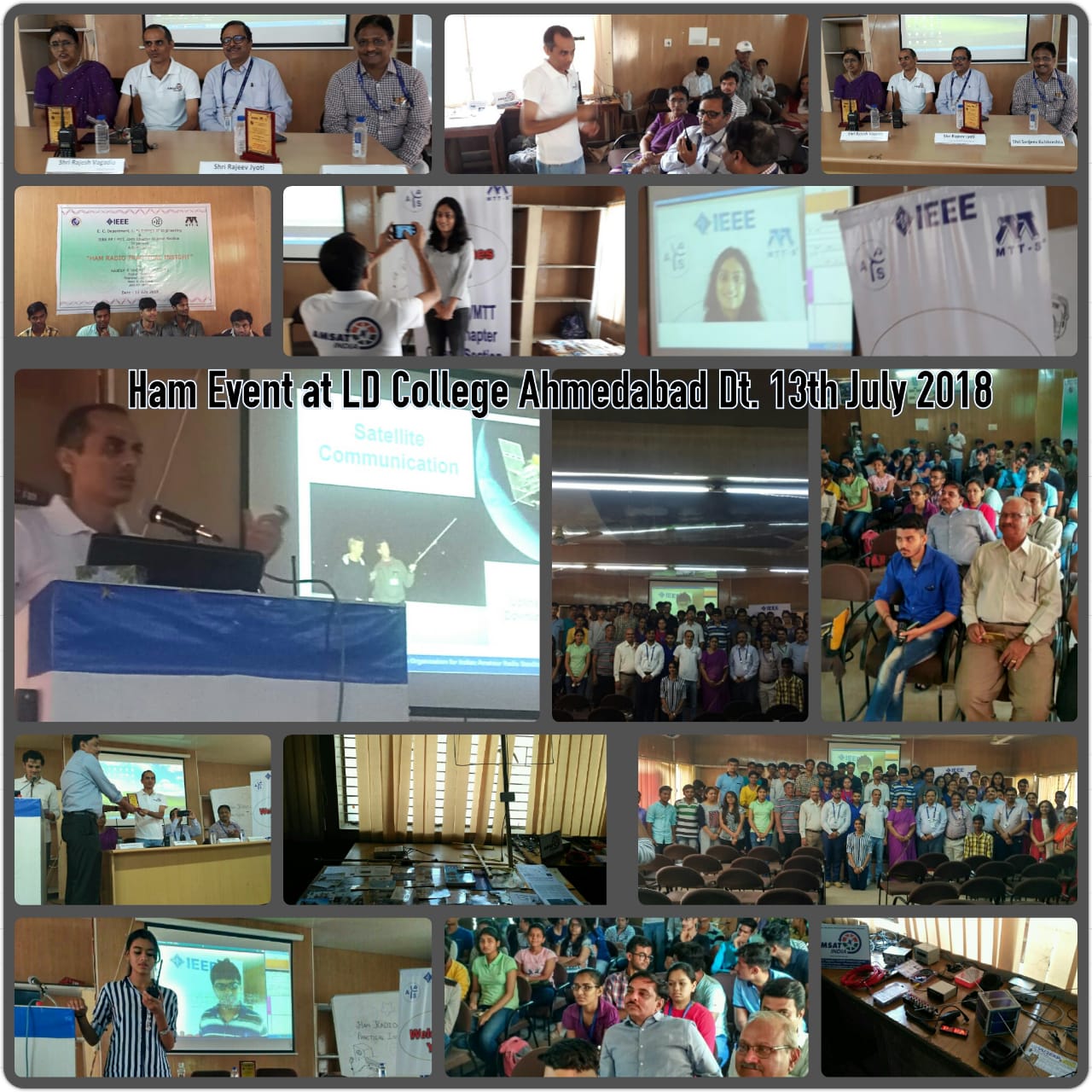
‘Ham Radio Practical Insight’ titled workshop was conducted at LD College Ahmedabad (Gujarat – India) on 13th July 2018 in afternoon session. More than 65 EC students + faculties participated.

Dignitaries from IEEE, ISRO, LD & AMSAT-INDIA inaugurated the workshop. It was our great pleasure to have chief guest presence of Shri Rajeev Jyoti Sir (Dy. Director SAC – ISRO) & Chair (IEEE) Gujarat chapter in this Ham Radio Workshop.

Rajesh Vagadia VU2EXP explained the latest technology/modes ham world uses & gave quick practical Demos for chief guest. Demo includes CW, Text, Image & Voice transmission/reception with simple VHF Radio sets. The simple experiment techniques used were described. Students were surprised to learn the potential of Amateur Radio & experts appreciate such public demos.

We got nice support from team members VU3EXP Sakshi, VU2UTZ Dinyarji, VU3PMT Mahendrabhai, VU3GLY Priyesh, SWL Ketanbhai during demo & whole event.

Thereafter detailed presentation was given on interesting ham events, digital communication, Satellite Communication, ARISS program, ASOC licencing procedure, APRS, SSTV witth RTL-SSDR etc.

Session remain very interactive with lots of queries which were answered very well by VU2EXP. Also mini Ham Radio exhibition was keenly enjoyed by the audience.

I am thankful to Prof. Usha Madam (HOD – EC), Prof. Arun Sir (EC), Mr. Nilesh Makwana (IEEE) to nicely coordinate & support the event.

Small spark of Ham Radio was ignited, hope we get good number of Hams from the participants, in the future.

Thanks & 73’s

VU2EXP
Rajesh P. Vagadia – Rajkot
Regional Coordinator
West India Zone
AMSAT-INDIA