FUNcube-1 (AO-73) Transmitting Again

AO-73 (FUNcube-1) - Image credit Wouter Weggelaar PA3WEG

AO-73 (FUNcube-1) – Image credit Wouter Weggelaar PA3WEG

FUNcube-1 (AO-73) is again transmitting telemetry. A restart took place during the 0930 UT pass over Europe.

The CubeSat had stopped transmitting at around 2018 UT on Wednesday, April 15.

The team is still investigating the situation, but have concluded from earlier telemetry analysis that it was safe to switch back to nominal operations.

During the 0930 UT pass over The Netherlands, Wouter PA3WEG commanded it back to nominal mode with full automatic mode switching.

At this time, there is no reason to believe this event was dangerous to the spacecraft, all systems were nominal and the battery is nearly full.

Many thanks for all the reports that the team have received.

FUNcube-1 (AO-73) Telemetry:
• Dashboard App http://funcube.org.uk/working-documents/funcube-telemetry-dashboard/
• Data Warehouse Archive http://warehouse.funcube.org.uk/
• Whole orbit data shows the effect http://warehouse.funcube.org.uk/wod.html?satelliteId=2

ISS Ham Radio SSTV Video

On the weekend of April 11/12 Randy Hall K7AGE used his Arrow dual band J-Pole antenna, FT-817, Signalink USB interface and MMSSTV software to capture some great amateur radio Slow Scan Television (SSTV) images from the International Space Station (ISS).

Watch SSTV Images from the International Space Station

ISS Slow Scan TV Active on Weekend of April 11 https://amsat-uk.org/2015/03/31/iss-sstv/

Using WebSDRs Worldwide for the ISS https://amsat-uk.org/2015/04/14/using-websdrs-for-iss/

ISS SSTV in the UK Press https://amsat-uk.org/2015/04/15/iss-sstv-in-the-press/

ISS SSTV in the Press

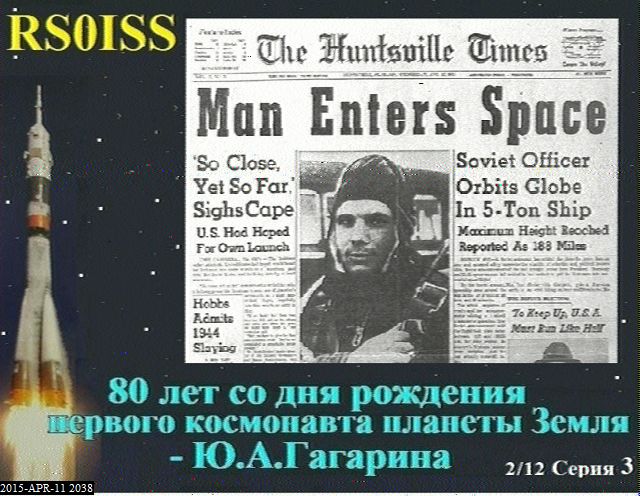
ISS SSTV Image 2 of 12 received by Andrew Garratt M0NRD April 11, 2015

ISS SSTV Image 2 of 12 received by Andrew Garratt M0NRD April 11, 2015

AMSAT-UK member Andrew Garratt M0NRD got some good publicity for Amateur Radio from the recent ISS Slow Scan Television transmissions.

The SSTV pictures were sent in celebration of Yuri Gagarin becoming the first human to reach space, on April 12, 1961. The Russian cosmonauts on board the station transmitted images from Gagarin’s life which were received by radio hams worldwide. Andrew said he hoped it would encourage more people to become interested in radio.

Read the full story at
https://web.archive.org/web/20160405015704/http://newarkadvertiser.co.uk/articles/news/A-message-from-space-picked-up-in-Newark

Local newspapers are generally only too glad to publish stories like this if someone takes the time to get in touch and tell them about it. Andrew made sure the newspaper was aware of his local clubs website URL and Facebook page enabling those reading the story to contact the club.

Follow M0NRD on Twitter http://twitter.com/nerdsville

ISS Slow Scan TV Active on Weekend of April 11 https://amsat-uk.org/2015/03/31/iss-sstv/

Note the ISS transmissions on 145.800 MHz FM use the 5 kHz deviation standard rather than the narrow 2.5 kHz used in Europe. If your transceiver has selectable FM filters try the wider filter.

The ISS Fan Club website will show you when the space station is in range http://www.issfanclub.com/

ISS SSTV information and links at https://amsat-uk.org/beginners/iss-sstv/

ARISS-SSTV Images http://ariss-sstv.blogspot.co.uk/

If you don’t have an amateur radio receiver you can still listen to the ISS by using an Online Radio, also known as a WebSDR. Select a Frequency of 145800.0 kHz and Mode FM:
• Farnham WebSDR when ISS is in range of London http://farnham-sdr.com/
• R4UAB WebSDR when ISS is over Russia

The RSGB produce a handy Media Guide and Template press release, see
http://rsgb.org/main/clubs/media-guide-for-affiliated-societies/

If you receive a full or partial picture from the Space Station your Local Newspaper may like to know http://www.southgatearc.org/news/2016/july/now-is-a-great-time-to-get-ham-radio-publicity.htm

Hacker at AMSAT/TAPR Dayton Banquet

Mike Ossmann AD0NR – Image Credit www.insinuator.net

Mike Ossmann AD0NR – Image Credit www.insinuator.net

Michael Ossmann, AD0NR, will give a talk “Adventures of a Hacker Turned Ham” to the AMSAT/TAPR Banquet at the Dayton Hamvention.

The ninth annual TAPR/AMSAT Banquet will be held on Friday night, May 15, at 1830 EDT. This dinner is always a highlight of the AMSAT (Radio Amateur Satellite Corp.) and TAPR (Tucson Amateur Packet Radio) activities during the Dayton Hamvention.

This year’s speaker will be Michael Ossmann, AD0NR, “Adventures of a Hacker Turned Ham”. Michael Ossmann, AD0NR, grew up as a computer nerd embracing the hacker ethos. Eventually Michael became very interested in the security of wireless systems such as remote keyless entry, garage door openers, Wi-Fi, and Bluetooth. He designed Ubertooth One, a Bluetooth sniffer that was successfully funded on Kickstarter.

Not one to rest, Michael later designed and successfully funded HackRF One, an open source SDR platform that attracted the attention of the amateur radio community. Michael will talk about his unique perspective on the community as an outsider looking in, why he resisted getting a license for years, and why he finally decided to join. Michael will also share his thoughts on what it means to be a hacker, what it means to be a ham, and what amateur radio may look like in the decades to come.

Tickets ($35 each) must be purchased online in advance on the AMSAT-NA website at http://www.amsat.org/ through the AMSAT Store tab. Tickets will not be sold at the Hamvention or at the door. Tickets purchased online may be collected at the AMSAT booth (433-435, 444-446).

The Banquet will take place at the Kohler Presidential Banquet Center, 4572 Presidential Way, Kettering, OH 45429 (just south of Dayton). The cash bar will open at 1830 EDT, with the dinner commencing around 1900 EDT.

Source ANS

Michael Ossmann AD0NR on Twitter https://twitter.com/michaelossmann

HamRadioNow: What’s a Whitebox? http://www.southgatearc.org/news/2014/june/hamradionow_whats_a_whitebox.htm

DEF CON 22 – Michael Ossmann – The NSA Playset: RF Retroreflectors https://www.youtube.com/watch?v=mAai6dRAtFo

AD0NR SDR Course videos http://www.southgatearc.org/news/2015/february/sdr_course_videos.htm

ACMA consults on removing 3400-3410 MHz

ACMA Logo 940x627The Australian regulator the ACMA is consulting on a number of changes to the amateur radio licence including removal of a key 3400 MHz allocation.

3400-3410 MHz is allocated to the Amateur Satellite Service in ITU Regions 2 and 3. It  is used by amateurs in many countries around the world for weak signal communications including moon bounce (EME).

The ACMA consultation closes on April 24.

The WIA announcement is at http://www.wia.org.au/newsevents/news/2015/20150314-2/

Consultation documents
http://www.acma.gov.au/theACMA/remaking-amateur-lcd-and-overseas-visiting-amateurs-class-licence

UK Microwave Group 3400 MHz page http://www.microwavers.org/3400mhz.htm

ISEE-3 Spacecraft on BBC World Service

BBC World Service Click Radio Show Audience - Credit Kate Arkless Gray

BBC World Service Click Radio Show Audience – Credit Kate Arkless Gray

Radio amateur Dennis Wingo KD4ETA along with freelance science writer and broadcast journalist journalist Kate Arkless Gray were on the BBC World Service Click radio show.

The show – Space and Citizen Science – was broadcast live from the BBC Radio Theatre, London on Tuesday, March 31, 2015.

Prior to the broadcast Kate Arkless Gray, who hopes to become an astronaut, tweeted:
“Goodness. Didn’t realise #BBCClickRadio was actually going out live. No pressure, says @billt [Bill Thompson], it’s only going to a third of the world. Ah”

Dennis KD4ETA described how in 2014 radio amateurs and other volunteers gained control of of the NASA-abandoned ISEE-3/ICE spacecraft. They even succeeded in firing the spacecraft thrusters. During the show Dennis managed to squeeze in a mention of amateur radio satellites and CubeSats.

The BBC description reads:

Our excitement over space has taken on new dimensions with nations such as India showing they too have the technical expertise and energy to mount a mission to Mars. Citizen Science has also shown how ordinary people can make important contributions to the space adventure.

Myriad groups of volunteers have launched their own ambitious projects: such as the team who decided to awaken a spacecraft, more or less forgotten by NASA; and another team who plan to build the first crowd-funded moon lander. In a special edition of Click, Gareth Mitchell and Bill Thompson are joined by a panel of experts to explore our fascination with Space, and to discuss how our knowledge of life beyond earth benefits from the input of volunteers and Citizen Science.

Listen to a recording of the show at http://www.bbc.co.uk/programmes/p02mnn3c

Podcast http://downloads.bbc.co.uk/podcasts/worldservice/digitalp/digitalp_20150331-2005a.mp3

Telegraph newspaper – Meet the British woman fighting to go into space
http://www.telegraph.co.uk/women/womens-life/9937173/Meet-the-British-woman-fighting-to-go-into-space.html

ISEE-3/ICE Thrusters Fired
https://amsat-uk.org/2014/07/09/isee-3ice-spacecraft-fires-thrusters-for-a-return-to-earth/

Watch the presentation on ISEE-3/ICE given to the AMSAT-UK International Space Colloquium in July 2014 https://amsat-uk.org/colloquium/colloquium-2014/presentation-videos/