Surrey Space Centre SME-SAT

SME-SAT - Surrey Space Centre

SME-SAT – Surrey Space Centre

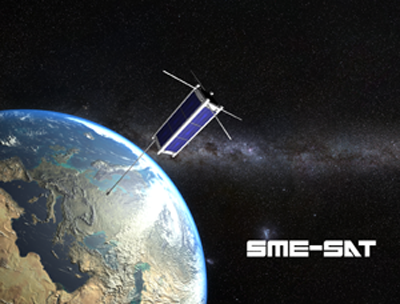
The Surrey Space Centre (SSC) are developing a 3U CubeSat SME-SAT expected to launch into a 550-620 km orbit using the ISIPOD CubeSat deployer.

The mission objectives are:
A: Outreach – The satellite will provide beacons for which amateur satellite users and ham radio users will be able to receive.
B: Space qualification and performance characterisation of sensors.
• High performance COTS Gyroscopes (x3).
• High precision MEMS accelerometers.
• 2 Aperture Star Camera, At a later point in the mission these will be used in conjunction with the ADCS to characterise the closed loop performance of the sensors.
C: Performance characterisation of Nano-Control Moment Gyros (CMGs) for agility. The mission is equipped with 4-Nano-CMGs in a pyramid configuration for ADCS. This part of the mission will evaluate the performance of this system on the ADCS and agility of the satellite.
D: Space qualification and performance characterisation of the EPS The EPS for this mission has heritage from the Delfi-C3 and other missions and includes additional improvements to be demonstrated on this mission.
E: Smart Thermal Radiation Devices (STRD tiles) SME-SAT is equipped with a number of STRD tiles on the outside faces of the satellite for passive thermal management of the internal structure.
F: Flux Gate Magnetometer The mission contains a scientific grade miniaturized flux gate magnetometer that sits on the end of a deployable boom to improve the performance of the sensor. This payload will be switched into the ADCS for evaluation of performance during parts of the mission but is not the primary magnetometer for ADCS.
G: GPS SME-SAT also contains an experimental GPS system that will be switched into the ADCS loop at stages in the orbit to evaluate the performance of the system.

Planning a 9k6 RC-BPSK UHF downlink using AX25.

Further information at http://www.surrey.ac.uk/ssc/research/space_vehicle_control/smesat/index.htm

IARU Satellite Frequency Coordination http://www.amsat.org.uk/iaru

Ham radio deep space launch postponed again

ARTSAT2:DESPATCH Internal Structure

ARTSAT2:DESPATCH Internal Structure

The launch of the amateur radio spacecraft Shin’en2 JG6YIG and ARTSAT2:DESPATCH JQ1ZNN has again been postponed and should now be 04:22:04 UT on Wednesday, December 3, 2014. The launch was broadcast live at https://www.youtube.com/watch?v=o5TmrQ_ySfg starting at 03:30 UT.

Update: Launch was successful http://global.jaxa.jp/press/2014/12/20141203_h2af26.html

Shin'en 2

Shin’en 2

The launch of the H-IIA Launch Vehicle No. 26 (H-IIA F26) which also carries the asteroid explorer “Hayabusa2” had been rescheduled from November 30 to December 1 due to a freezing layer in the clouds that exceeded the weather restrictions for launch. Strong winds have caused a further postponement to December 3.

ARTSAT2:DESPATCH carries a 7 watt CW transmitter on 437.325 MHz and the first sculpture to be carried into deep space.

Shin’en2 has a CW beacon on 437.505 MHz (0.1 watt) and telemetry on 437.385 MHz (0.8 watt) using a mode which Seiji JH6RTO describes as similar to WSJT but not the same.

The Shin’en2 English language Ground Station page mentions WSJT but the equivalent Japanese language page does not.

The Shin’en2 site indicates there is also a F1D digital transponder with an uplink of 145.942 MHz with 435.270 MHz (0.4 watt) downlink.

The two spacecraft will have an elliptic orbit around the Sun and travel to a deep space orbit between Venus and Mars. The inclination will be almost zero, which means the spacecraft should stay in the Earth’s equatorial plane. The distance from the Sun will be between 0.7 and 1.3 AU. An Astronomical Unit (AU) is 149,597,871 km.

ARTSAT2:DESPATCH http://despatch.artsat.jp/en/Main_Page

ARTSAT2:DESPATCH spacecraft prediction App
http://ji1izr.air-nifty.com/ham_satellite/in_english/index.html

Shin’en2 http://www.shin-en2.jp/index_E.html

Shin’en2 spacecraft prediction App
http://ji1izr.air-nifty.com/ham_satellite/2014/12/artsat2-despa-3.html

Weather restriction graphic showing clouds with freezing layer
http://global.jaxa.jp/press/2014/11/20141128_h2af26.html

Ham radio launches to deep space
https://amsat-uk.org/2014/11/19/ham-radio-launches-to-deep-space/

Japanese asteroid mission to carry amateur radio
https://amsat-uk.org/2014/09/01/japanese-asteroid-mission-to-carry-amateur-radio/

Thanks to Hideo JH3XCU/1 for posting news of the postponement on the AMSAT Bulletin Board.

Principia Mission Patch

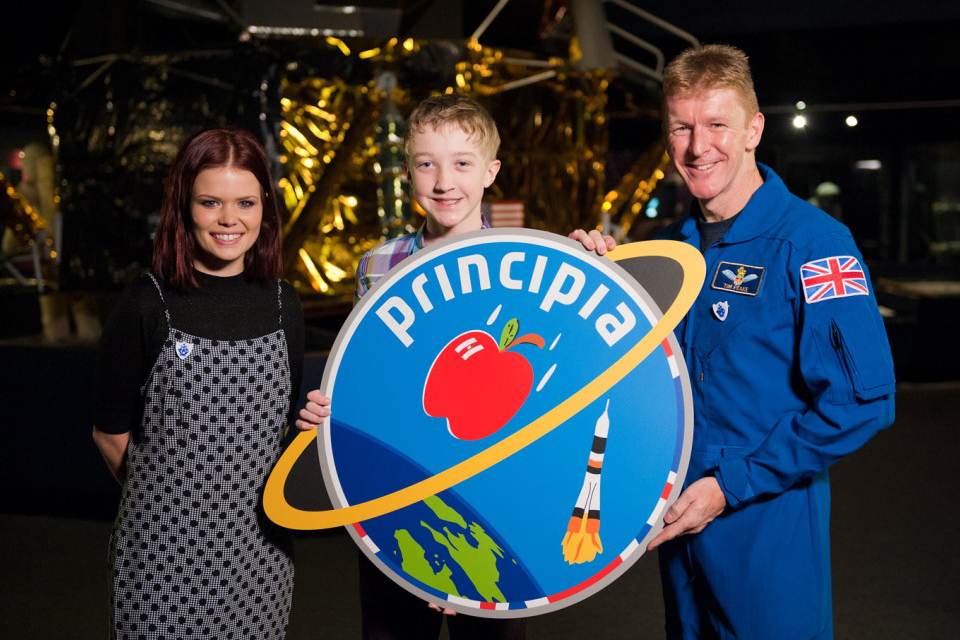
Blue Peter presenter Lindsey, competition winner Troy and UK astronaut Tim Peake KG5BVI with mission patch

Blue Peter presenter Lindsey, competition winner Troy and UK astronaut Tim Peake KG5BVI with mission patch

In partnership with the UK Space Agency, BBC TV’s Blue Peter show asked young people to design a mission patch for UK astronaut Tim Peake KG5BVI and received more than 3000 entries.

Principia Mission Patch

Principia Mission Patch

The judges from the UK Space Agency, Blue Peter and ESA together chose their two favorites in each of the three age groups of 6–8, 9–11 and 12–15 years. Important considerations for deciding on the final six were how a design would look as a patch, the colors used and whether the children drew everything on their own. The selection of the winning design out of the six came down to Tim himself.

The mission name Principia comes from Isaac Newton’s world-changing three-part text on physics, Naturalis Principia Mathematica, describing the principal laws of motion and gravity.

The winning entry was by 13-year-old Troy who used an apple to signify Newton’s law of gravity. Fittingly a stylized International Space Station (ISS) glints in the apple. The Soyuz rocket taking Tim into space flies over the UK as the colors of the Union Flag run along the border.

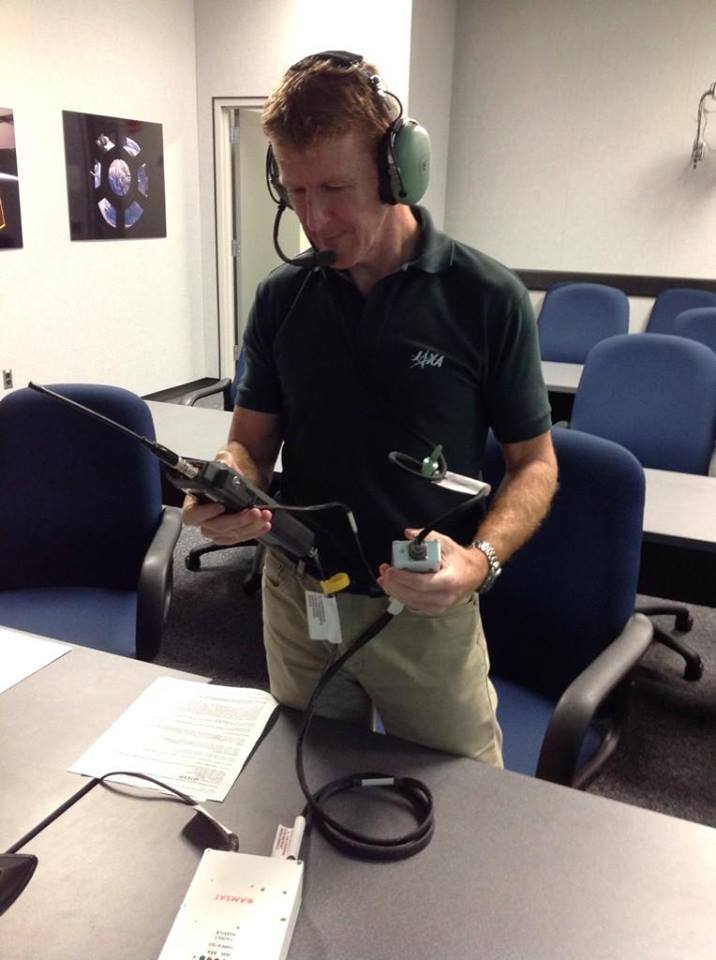
In September Tim Peake KG5BVI learned how to use the Ericsson 144 MHz handheld radio which is installed in the Columbus module of the ISS. On September 18 Tim said “Will be great to chat with schools next year from space using this ham radio on board the ISS.”

UK Space Agency announcement
https://www.gov.uk/government/news/tim-peakes-principia-mission-logo

GB1SS callsign for International Space Station
https://amsat-uk.org/2014/10/22/gb1ss-callsign-for-international-space-station/

Tim Peake KG5BVI training on ISS Amateur Radio Station Equipment

Tim Peake KG5BVI training on ISS Amateur Radio Station Equipment

Ofcom discuss Pocket Spacecraft

View of St Pauls from Ofcom office - Credit Michael Johnson M0MJJ

View of St Pauls from Ofcom office – Credit Michael Johnson M0MJJ

On Wednesday, November 26, Michael Johnson M0MJJ discussed the licensing of thousands of Pocket Spacecraft with the UK communications regulator Ofcom.

Pocket Spacecraft

Pocket Spacecraft

The plan is that a 3U CubeSat will carry Pocket Spacecraft known as ‘Scouts’ to the Moon. A ‘Scout’ is a disk with flexible electronics, smaller than a CD, containing a transceiver, antenna and solar cells. The CubeSat should first release a batch of the wafer thin Scout satellites into Earth orbit and then deploy another batch of the Scout satellites into Lunar orbit.

It is understood the mission plans to use the 435 MHz and 2400 MHz bands.

Pocket Spacecraft http://pocketspacecraft.com/

Follow Pocket Spacecraft on Twitter @mySpacecraft

UK radio ham’s Lunar CubeSat to go ahead
https://amsat-uk.org/2013/08/26/uk-radio-hams-lunar-cubesat-to-go-ahead/

BBC: ‘Pocket spacecrafts’ to become a reality
https://amsat-uk.org/2014/05/15/bbc-pocket-spacecrafts-to-become-a-reality/

Goonhilly tracking FUNcube

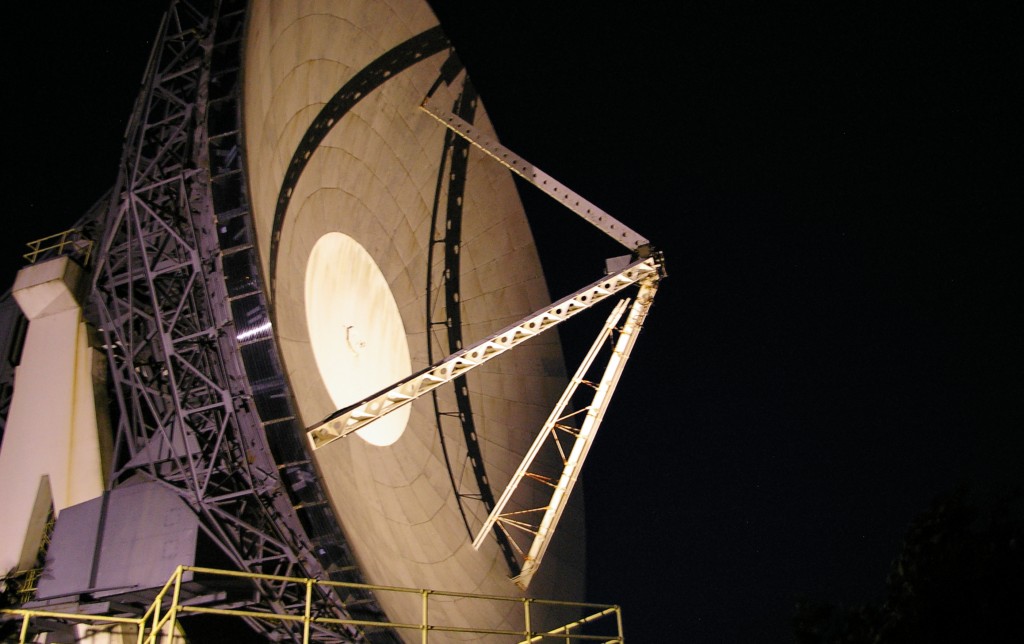
Goonhilly 1 "Arthur" - Credit GES Ltd

Goonhilly 1 “Arthur” – Credit GES Ltd

Goonhilly Earth Station (GES) Ltd are transforming the BT satellite communications site at Goonhilly into a new Space Science centre.

The Goonhilly Satellite Earth Station is located on the Lizard Peninsula in Cornwall. It’s famous for many reasons, but perhaps most notably, for receiving, the first ever trans-Atlantic satellite TV images, broadcast by Telstar, on July 11, 1962. The impressive 25.9m dish called Arthur was used for that historic event.

The Register has published an article by journalist SA Mathieson following a recent visit to the site. This included seeing the AMSAT-UK ground station used to track the satellites FUNcube-1 and UKube-1 which both carry educational payloads developed by radio amateurs from the voluntary satellite organisations AMSAT-UK and AMSAT-NL. The station comprises an Asus PC with FUNcube Dongle Pro+ Software Defined Radio (SDR) and a turnstile (crossed dipoles) antenna.

SA Mathieson also visited another recent addition to the site, the radome used by the imaging start-up Planet Labs Inc to communicate with its constellation of  “Dove” CubeSats.

Read Suffering satellites! Goonhilly’s ARTHUR REBORN for SPAAAACE
http://www.theregister.co.uk/2014/11/25/geeks_guide_goonhilly/

Goonhilly Earth Station http://www.goonhilly.org/

FUNcube Telemetry Receive Antenna System
http://shop.amsat.org.uk/shop/article_45/FUNcube-Telemetry-Receive-Antenna-System.html

FUNcube Dongle Pro Plus SDR http://FUNcubeDongle.com/

SpinSat Deployment from ISS

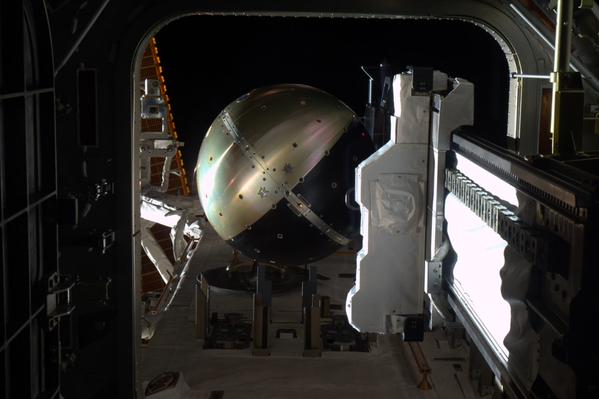
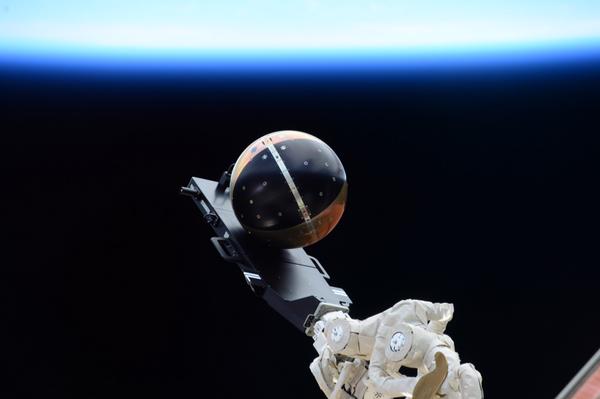
SpinSat extended from airlock

SpinSat extended from airlock

SpinSat was launched to the International Space Station (ISS) on September 21 in preparation for a subsequent deployment from the Japanese Experiment Module (JEM).

SpinSat - Credit Naval Research Laboratory

SpinSat – Credit Naval Research Laboratory

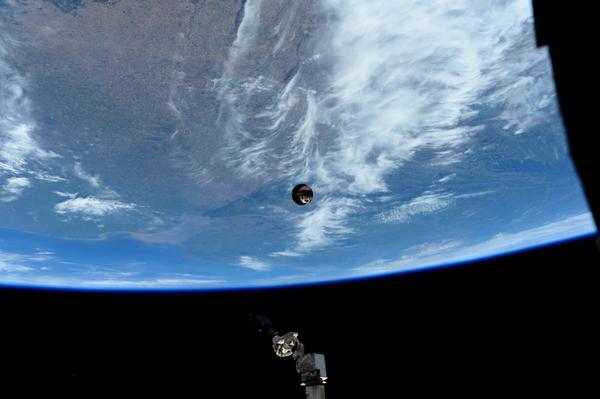
Masahiro Arai JN1GKZ reported that SpinSat would be deployed, using the Cyclops deployment system, from the airlock of the JEM. Successful deployment took place on Friday, November 28 at 14:30 UT into a 406 x 417 km x 51.65 deg orbit. SpinSat is cataloged as object number 40314.

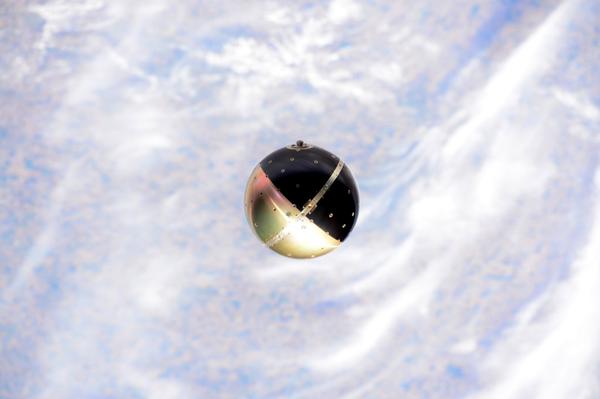
Developed by the Naval Research Laboratory (NRL) SpinSat is a 56 cm sphere weighing 57 kg that has 12 Electronically-controlled Solid Propellant (ESP) thrusters spread in pairs throughout the surface of the satellite. They will be fired in pairs to spin the spacecraft. With just primary batteries and only 4.8 grams of fuel this phase may last between three to six months.

The spacecraft will be used to calibrate the space surveillance network. Lasers will be fired at SpinSat from the ground, the light reflected back will be measured to determine where in time and space the satellite is passing overhead. SpinSat will also model the density of the atmosphere.

The IARU Satellite Frequency Coordination Panel report that SpinSat carries a 2 watt RF output 9600 bps AX.25 packet radio store and forward system on 437.230 MHz.

SpinSat just before deployment

SpinSat just before deployment

Listen for SpinSat on 437.230 MHz with the SUWS WebSDR located near London
https://amsat-uk.org/2014/08/15/suws-websdr-moves-to-new-site/

In the first few days after deployment SpinSat’s orbit will be similar to that of the International Space Station. To see when it’s in range use the ISS real-time tracker at http://issfanclub.com/

Read all about SpinSat at
http://www.nrl.navy.mil/media/news-releases/2014/with-spinsat-mission-nrl-will-spin-small-satellite-in-space-with-new-thruster-technology

SpinSat after deployment

SpinSat after deployment

NASA – SpinSat
http://www.nasa.gov/mission_pages/station/research/experiments/1019.html

Space Station Integrated Kinetic Launcher for Orbital Payload Systems (SSIKLOPS) – Cyclops
http://digitalcommons.usu.edu/smallsat/2013/all2013/76/

IARU Satellite Frequency Coordination Panel http://amsat.org.uk/iaru

SpinSat in orbit

SpinSat in orbit