Dave G4UVJ reports that on September 23 there will be an ARISS contact between students at Winter Gardens Primary School, Canvey, Essex and astronaut Alexander Gerst KF5ONO on the International Space Station (ISS).
Just confirming that our ARISS contact has been scheduled with Alexander Gerst KF5ONO, the ESA Astronaut on board the ISS for Tuesday, September 23, 2014 at 1037 UT which is 1137 BST.
For information, the ISS will actually be over Australia at the time and we will be making use of one of the amateur radio Australian Telebridge Ground Stations to actually make the link to the Space Station.
As you all know we have been in progress of organizing another Contact with the International Space Station as we did in 2005, this time its Winter Gardens Primary School , Canvey Island the day now been confirmed it will be the September 23, 2014 contact time is 11:37 BST. We will start 1 hour before contact time and finish 30mins after , changes may still occur if there are any emergencies on the station.
Issue 207 of the AMSAT-UK amateur radio satellite publication OSCAR News was released on September 11. E-members can download it here.
The paper edition is usually posted 2-3 weeks after publication of the electronic issue.
In this issue:
• Goonhilly Earth Station receives FUNcube-1 Equipment
• FUNcube-3/EO79
• FUNcube-1 demonstrated in the Faraday Lecture Theatre
• FUNcube-1 Spin Rate
• Sad News about HAMSAT VO-52
• IARU Region 1 General Conference Papers 20-27 Sep 2014
• ISS SSTV Active Again
• Report from the Region 1 Satellite Coordinator
• FUNcube-2 on UKube-1
• FUNcube-1 operations
• Active Satellites by Mile DK3WN
• AMSAT-UK accounts and AGM Minutes
• AMSAT-UK Colloquium 2014
• FUNcube-4 on ESEO
AMSAT-UK FUNcube Mission Patch
Membership of AMSAT-UK is open to anyone who has an interest in amateur radio satellites or space activities, including the International Space Station (ISS).
E-members of AMSAT-UK are able to download OSCAR News as a convenient PDF that can be read on laptops, tablets or smartphones anytime, anyplace, anywhere. Join as an E-member at Electronic (PDF) E-membership
ESTCube-1 at press conference in Tallinn before shipping January 21, 2013 – Image credit University of Tartu
I’m glad to announce that after more than a year of preparations on Tuesday, September 16, 2014, the team are starting to deploy the electric solar sail tether on-board ESTCube-1.
The process of burning the tether end-mass and spool locks and reeling out the first few centimeters of tether will start during the 09.06 – 09.19Z pass over Estonia. This is a high pass and should be visible over most of the Europe.
The next good passes listed below (all in UTC) will be used to download images the telemetry logs and the images:
10.43 – 10.56
18.39 – 18.51
20.15 – 20.28
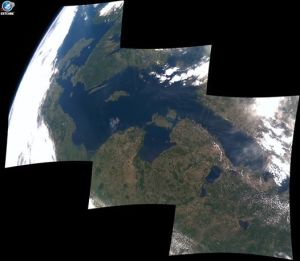
ESTCube-1 image of Estonia and its neighbours
During the locks release process and after reeling the tether out some centimeters, images will be taken.
The other shorter passes during the day will be used to download the experiment data as quickly as possible (in Estonia, all daily passes are visible, but lowest ones are just couple of degrees above the northern horizon).
If everything is OK with the tether, additional unreeling will take place in coming days.
If you are interested in receiving ESTCube-1 during those exciting passes, the UZ7HO 9600 bps packet softmodem and an Online Telemetry Decoder by Mike Rupprecht DK3WN can be used. But basically any 9600 bps G3RUH TNC or decoder can be used to receive ESTCube-1.
We are looking forward to receiving your reports on the address es5e AT estcube DOT eu, and we would really appreciate if you would also send received data in live, using Mike’s decoder.
The LuxSpace 4M amateur radio payload is expected to fly around the Moon at the end of October and you can upload a message to the 4M website that will be transmitted on 145.980 MHz using JT65B during the flight.
Full Moon 2010 – Credit Gregory H Revera
There is room for 2500 messages each up to 13 characters long. Your message could be your name/callsign or “73 de G0AUK”.
During the lunar flyby, the spacecraft will be about 399,636 km from Earth. The LuxSpace team wish to encourage radio amateurs around the world to receive the transmissions and send in data. There will be a number of Experiments and Contests with prizes to the winners in each experiment and category. Details are given on page 19 of 4M Mission: a Lunar FlyBy experiment.
4M stands for Manfred Memorial Moon Mission in memory of Professor Manfred Fuchs, founder and chairman of OHB group, Bremen who passed away on April 27, 2014.
Ofcom has published a public consultation setting out proposals for updating the terms and conditions of the amateur radio licence – Essex Ham summary here.
Ofcom say: These proposals include changes which would provide amateurs with access to some frequency bands previously available only through the variation of individual licences.
The consultation follows changes announced in our April statement on Public Sector Spectrum Release, where we set out our decision to remove access for amateur radio operators to certain frequencies in the 2300 MHz and 3400 MHz ranges in order to support the release of these bands by the Ministry of Defence.
This consultation, which is likely to be of interest to those in the amateur radio community, closes on October 20, 2014.
On Saturday, September 6, at 1000 GMT Paulo PV8DX emailed the news that the International Space Station (ISS) Slow Scan Television (SSTV) on 145.800 MHz FM had been active again.
At the end of the passage (ISS) in northern Brazil where I live. I heard the sound of early SSTV. So I went to the WEBSDR in your area [the SUWS WebSDR near London, UK] and I got two images.
The ISS has been transmitting photographs devoted to the life and work of the first cosmonaut Yuri Gagarin. They were sent in the PD180 SSTV mode with additional voice commentary.
On August 27, 2014 a test of the ISS Slow Scan Television (SSTV) experiment MAI-75 using the Kenwood TM-D710 transceiver and a new cable took place. Although a carrier was successfully transmitted on 145.800 MHz no SSTV audio tones were heard. It appears that the earlier problem has now been rectified. https://amsat-uk.org/2014/08/23/iss-sstv-august-27/
ISS SSTV received by Jan van Gils PE0SAT Sept 26. 2014 at 1402 GMT
The Kenwood TM-D710 was delivered to the ISS in the summer of 2012. The original TM-D700 in the Russian ISS Service Module had been experiencing problems with the PA after giving many years service in space, see ARISS minutes for March 2013. It is thought the Kenwood TM-D710 is set to run at just 5 watts output because convection cooling doesn’t work in zero gravity. http://www.ariss.org/meeting-minutes/archives/03-2013
David Barber G8OQW received some good images in Chelmsford, Essex which can be seen on the AMSAT-UK Facebook page.
Paul Turner G4IJE, co-developer of the SSTV PD modes, says regarding the PD180 mode: “Don’t forget to either enable “Always show RX viewer” or use the “Picture viewer” (magnifying glass icon) to show the picture at its real resolution of 640 x 496. If you just view as normal you will only see 320 x 248 resolution, which kind of defeats the object of using a high resolution mode.”
Tony Falla VK3KKP commented “I received a good picture from ISS on my iPad mid-Saturday evening [AEDT] on 145.800 MHz just using the microphone next to the rig.”
The APRS digipeater in the European Space Agency ISS Columbus module continued to be in operation on 145.825 MHz during the SSTV transmissions.
Watch a video of ISS SSTV reception by Dmitry Pashkov R4UAB
All you need to do to receive SSTV pictures direct from the space station is to connect the audio output of a scanner or amateur radio transceiver via a simple interface to the soundcard on a Windows PC or an Apple iOS device, and tune in to 145.800 MHz FM. You can even receive pictures by holding an iPhone next to the radio’s loudspeaker.
ISS SSTV received by Fabiano Moser CT7ABD on Sept 6, 2014 at 0910 GMT
The ISS puts out a strong signal on 145.800 MHz FM and a 2m handheld with a 1/4 wave antenna will be enough to receive it. The FM transmission uses the 5 kHz deviation which is standard in much of the world.
Many FM rigs in the UK can be switched been wide and narrow deviation FM filters. For best results you should select the wider deviation filters. Handhelds all seem to have a single wide filter fitted as standard.
On Windows PC’s the free application MMSSTV can be used to decode the signal, on Apple iOS devices you can use the SSTV app. The ISS Fan Club website will show you when the space station is in range.
You must be logged in to post a comment.