Asian Trek for B-47 Party Balloon

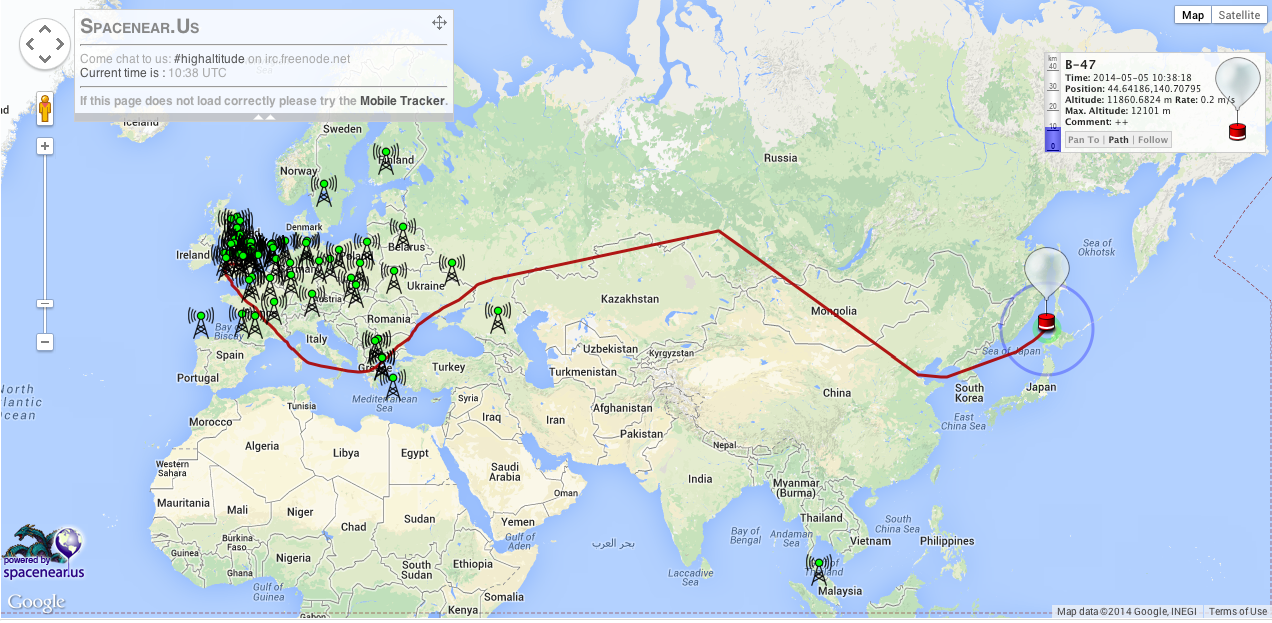
8-Day flight path of the B-47 party balloon

8-Day flight path of the B-47 party balloon

A solar-powered foil party balloon, B-47, transmitting telemetry on 434.500 MHz USB using the amateur radio data mode Contestia 8/250 was launched on Monday, April 28, 2014 from Silverstone in the UK by radio amateur Leo Bodnar M0XER.

The balloon’s eight-day journey took it over the United Kingdom, France, Italy, Greece, Bulgaria, Ukraine, Russia, Kazakhstan, Mongolia, China, North Korea before flying over Japan at an altitude of 11860 metres on Monday, May 5.

Typical 434 MHz solar powered payload - Image credit Leo Bodnar M0XER

Typical 434 MHz solar powered payload – Image credit Leo Bodnar M0XER

Depending on the altitude, the balloon can have a radio range of 300-500 km. See the current track of the balloon at http://spacenear.us/tracker/?filter=B-47
APRS backup: http://aprs.fi/#!call=a%2FM0XER-7

Balloon: 90cm Qualatex foil party balloon
Payload: 12 grams solar powered tracker

Telemetry: 434.500 MHz, USB, vertical polarisation, Contestia 8/250
Transmission contains two lines of telemetry every 4 minutes and lasts about 1 minute
Time between telemetry data is filled with beeps at 3 sec intervals.
Enable RxID (RSID) to automatically track the signal drift

Leo Bodnar M0XER balloons
http://www.leobodnar.com/balloons/

You can see online real time tracks and frequencies of balloons at http://spacenear.us/tracker/
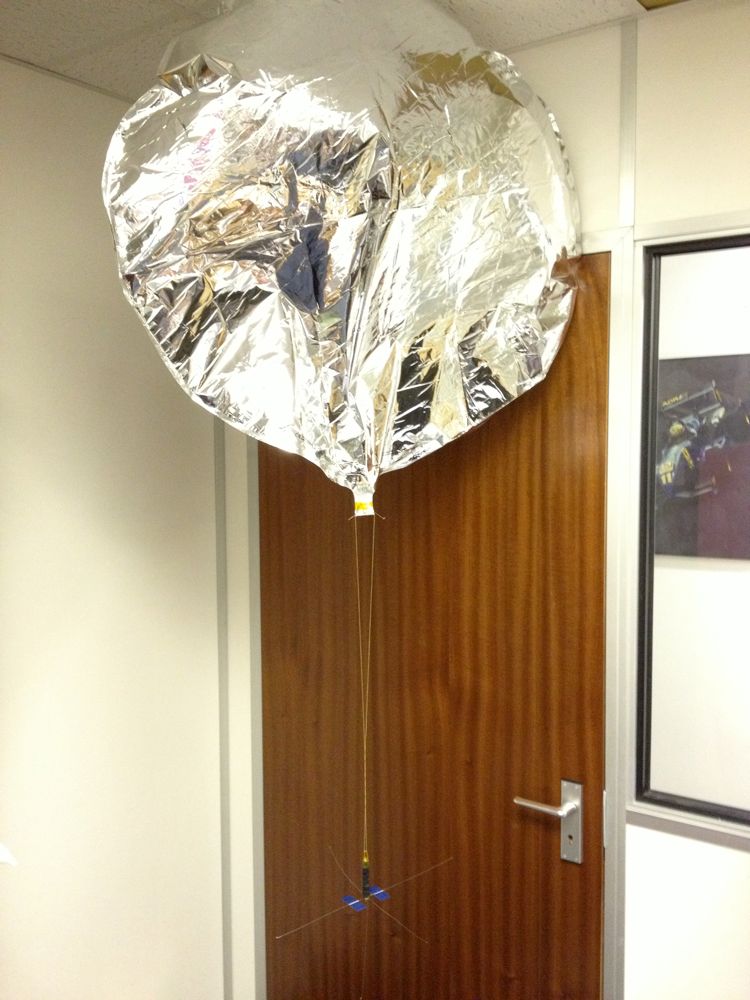
Typical party balloon with tiny solar powered 434 MHz transmitter - Image credit Leo Bodnar M0XER

Typical party balloon with tiny solar powered 434 MHz transmitter – Image credit Leo Bodnar M0XER

Download the dl-fldigi software from
http://ukhas.org.uk/projects:dl-fldigi

Listen to balloons online (when in range of south-east UK) from anywhere in the world with the SUWS 434 MHz WebSDR (select USB) https://amsat-uk.org/2013/12/28/websdr-for-434-and-1296-mhz/

Beginners Guide to Tracking using dl-fldigi http://ukhas.org.uk/guides:tracking_guide

Check the #highaltitude IRC channel for chat about launches. A web client is available at
http://webchat.freenode.net/?channels=highaltitude

To get up-to-date information on balloon flights subscribe to the UKHAS Mailing List by sending a blank email to this address: ukhas+subscribe@googlegroups.com

The Great British Space Dinner Competition

Heston Blumenthal and Tim Peake KG5BVI

Heston Blumenthal and Tim Peake KG5BVI

The UK Space Agency has launched a competition for school children between the ages of 7 and 14 to design a British-inspired, balanced and exciting meal for UK ESA astronaut Tim Peake KG5BVI to eat during his 6 month mission to the International Space Station (ISS).

Major Tim Peake KG5BVI

Major Tim Peake KG5BVI

The winning contestants will be invited to develop their ideas further with celebrity chef Heston Blumenthal, and these ideas will be turned into real space food that will be launched to the ISS. They will also be invited to an event that will include a live link up with Tim during his stay on the ISS.

Heston syas “I’m unbelievably excited to be designing a delicious meal for Tim to enjoy in space; there are some real challenges ahead, things aren’t quite the same up there! I’m really looking forward to seeing some incredible suggestions by the kids, and getting started on creating something that Tim will love up there in space.”

The challenge is open to classes, other groups (such as after-school clubs, Scouts, Guides, etc) and individuals. There are two categories, one for primary level children and one for secondary level children, with one winner in each category.

Children will need to design a British-inspired meal for Tim to eat in space, taking account of normal nutritional principles as well as the constraints of space (such as handling, packaging and preservation).

Watch this UK Space Agency video of Heston Blumenthal and Tim Peake KG5BVI

Rules and entry form available at https://www.gov.uk/government/news/the-great-british-space-dinner

Tim Peake recently passed the amateur radio exam and now has the ham radio call sign KG5BVI
https://amsat-uk.org/2014/05/04/tim-peake-is-now-kg5bvi/

Heston Blumenthal met another radio amateur David Akerman M0RPI when he launched a spud into space, see
https://amsat-uk.org/2014/05/02/radio-ham-launches-spud-into-space-for-tv-show/

Two QB50 satellites with ham radio payloads delivered

QB50p1 and QB50p2 - Image Credit ISIS

QB50p1 and QB50p2 – Image Credit ISIS

The QB50 project has reached another crucial milestone. The first two QB50 satellites have been delivered for shipment to the launch site after a successful flight acceptance test campaign. The satellites will form the QB50 Precursor mission that seeks to de-risk and validate key technologies of the QB50 main flight that will be performed in the coming years.

The launch is planned for June 19, 2014 from the Russian ICBM base at Dombarovsky near Yasny on a Dnepr rocket manufactured in Dnepropetrovsk, Ukraine. The satellites will be put into a 650 km Sun Synchronous Orbit (SSO).

A Dnepr Launch - Credit ISC Kosmotras

A Dnepr Launch – Credit ISC Kosmotras

The following payloads were integrated into the ISIS satellite platforms:

QB50p1
• INMS Payload from MSSL, UK
• QB50 ADCS system from SSC, UK
• Thermocouple experiment from VKI, Belgium
• AMSAT-NL 435/145 MHz linear transponder (FUNcube-3) from AMSAT-NL, The Netherlands

QB50p2
• FIPEX Payload, University of Dresden, Germany
• QB50 ADCS system from SSC, UK
• Thermocouple experiment from VKI, Belgium
• AMSAT-Fr 435/145 MHz FM voice transponder from AMSAT Francophone, France

QB50p1 (FUNcube-3) has a VHF 9600 bps BPSK telemetry downlink plus a linear U/V transponder similar to that already flying on FUNcube-1 with an output of 400 mW.
• 145.815 MHz 9600 bps BPSK telemetry beacon
• Inverting SSB/CW linear transponder 400 mW PEP
– 435.035 – 435.065 MHz Uplink LSB
– 145.935 – 145.965 MHz Downlink USB

QB50p2 has  a VHF 9600 bps BPSK telemetry downlink plus a separate RF payload from AMSAT-Francophone which will comprise of a FM voice transponder with UHF uplink and VHF downlink. It will also transmit FX25 telemetry at 9600 bps.
• 145.880 MHz 9600 bps BPSK telemetry beacon
• 145.840 MHz 9600 bps FSK FX25

QB50p CubeSats

QB50p CubeSats

The project was executed to an unprecedented timeline. Formal Kick-Off was in October 2013 and all hardware from the different partners was delivered for integration into the satellites in January  2014. This means that two satellites were delivered in just over 6 months. Furthermore, with a precursor launch scheduled in June, launch and operations will commence within 9 months of project Kick-Off.

This fast-track project shows how successful a close cooperation between academic institutes and experienced companies can be. With ISIS’ experienced team of engineers that design and build nanosatellites on a regular basis (ISIS remains on track to delivering 1 satellite system per month in 2014), throughput times of nanosatellite projects can be shortened significantly.

The upcoming launch of the QB50 precursor satellites will also be the first satellites to be launched that were funded through the EU’s FP7 space technology programme, in which a number of innovative small satellites will be launched in the coming years to demonstrate new European space technologies.

The lessons learned from the QB50 Precursor development and operations have already led to many recommendations to further improve and streamline the QB50 main flight. All teams involved in QB50 stand to benefit from the experiences gained over the last months.

Source https://www.vki.ac.be/index.php/component/content/article/249-news/latest/467-isis-delivers-the-first-two-qb50-satellites-as-part-of-the-eu-fp7-qb50-project

ISIS http://www.isispace.nl/

QB50 http://www.qb50.eu/

QB50 Precursor Flight https://www.qb50.eu/index.php/precursor-flight

AMSAT-UK Colloquium announcement
https://amsat-uk.org/2013/07/20/qb50-amateur-radio-transponder-payloads-to-launch-2014/

Tim Peake is now KG5BVI

Major Tim Peake KG5BVI

Major Tim Peake KG5BVI

UK ESA astronaut Tim Peake took the opportunity to sit his Technician amateur radio exam at the end of April while he was in Houston for astronaut training. He has now been issued the amateur radio callsign KG5BVI.

UK astronaut Major Tim Peake KG5BVI

UK astronaut Major Tim Peake KG5BVI

At the beginning of March Tim gave a presentation to the UKSEDS National Student Space Conference in Leicester. During the talk he expressed his enthusiasm about getting his amateur radio licence and operating from the International Space Station (ISS).

Tim is currently training for his 6 month mission, Expedition 46/47, to the ISS which is scheduled for November 2015. The UK communications regulator Ofcom has agreed in principle to issue the permanent Special Callsign of GB1SS to the ISS and it is expected Tim will use that callsign when operating the amateur radio station in the ESA Columbus module.

Facebook https://www.facebook.com/ESATimPeake

Twitter https://twitter.com/astro_timpeake

The UK’s first astronaut was Helen Sharman GB1MIR who launched into space 23 years ago on May 18, 1991, see https://amsat-uk.org/about/history/first-uk-astronaut-helen-sharman-gb1mir/

The USA Technician licence is the equivalent of the UK Foundation. The 35-question Technician exam covers topics such as radio theory, regulations and operating practices. 26 of the 35 questions need to be answered correctly to pass. Unlike the system in the UK there are no practical assessments for the USA exams just a single multiple choice exam paper. All the questions and answers for the US exams are available online and you can try a practice Technician exam at http://www.qrz.com/hamtest/

Technicians are allowed to use up to 1500 watts output on all the VHF, UHF and Microwave bands and 200 watts output on four HF bands. USA Technicians have full amateur privileges in the frequencies they are allocated, for example they can do set up beacons or repeaters, operate maritime mobile and design and build their own equipment.

KickSat Sprite deployment may not happen

KickSat

KickSat

An unexpected reset of the master clock on KickSat may mean that the deployment of the 104 Sprite satellites will not take place before the KickSat CubeSat burns up in the atmosphere.

Radio amateur Zac Manchester KD2BHC has posted this update:

First off, I’d like to sincerely thank all of you for your support over the past two years. KickSat has been a success up to this point because of you.

As those who’ve been keeping up with the telemetry data coming in from KickSat on our mailing list may have noticed, the packets we’ve been receiving have changed in the last couple of days. This was due to a hard reset of the “watchdog” microcontroller on KickSat – the sort of “reptile brain” of the satellite that manages turning on and off the rest of the subsystems and keeps the master clock. It appears the reset happened some time in the morning of Wednesday, April 30th. The reset doesn’t seem to be the result of power issues (the watchdog should run until the batteries reach 5.5 volts, and they’ve been holding steady around 6.5 volts). Instead, it seems the likely culprit was radiation.

KickSat Sprite satellites deployed - Image by Ben Bishop VK2FBRB

KickSat Sprite satellites deployed – Image by Ben Bishop VK2FBRB

One consequence of the watchdog reset on KickSat is that the spacecraft’s master clock was reset, thus also setting the deployment countdown for KickSat back to 16 days. That would put the deployment some time in the morning of May 16th. Unfortunately, it looks like KickSat will most likely reenter and burn up before the 16th. We’ve spent the last couple of days here at Cornell trying to think of every possible contingency, but it seems there aren’t very many options right now. KickSat’s uplink radio, which we could use to command the deployment, can’t turn on unless the batteries reach 8 volts, and it doesn’t look like they’ll reach that level in time.

KickSat 437 MHz Sprite Satellite

KickSat 437 MHz Sprite Satellite

While the situation looks a little bleak, there is still some hope that the batteries may recharge sufficiently to command the satellite. There is also a small chance that KickSat could remain in orbit until the 16th, at which point the timer would set off the deployment as originally planned. We’ll continue tracking KickSat over the next few days with the help of the ham community, so that we can keep track of its battery voltage and the Sprite deployment status. I’ll post updates here, as usual, but you can also see the latest data as it comes in on our mailing list.

Thank you again for your support. I promise that this won’t be the end of the KickSat project.

– Zac

Kicksat Wiki https://github.com/zacinaction/kicksat/wiki

KickSat mailing list https://groups.google.com/forum/#!forum/kicksat-gs

Kicksat Updates
https://www.kickstarter.com/projects/zacinaction/kicksat-your-personal-spacecraft-in-space/posts

Delfi-C3 celebrates 6 years in space

Delfi-C3_DO-64_Team

Delfi-C3 (DO-64) Team at the AMSAT-UK International Space Colloquium in Guildford

Delfi-C3 (DO-64) has celebrated its 6th birthday on April 28, 2014. The spacecraft is still operational, telemetry only, on 145.870 MHz USB

Delfi-C3Delfi-C3 has exceeded its mission lifetime by six times now, and on-board telemetry still does not indicate degradation in performance.

So far, our distributed ground station network (DGSN) has collected 2037513 frames as of today, received by 376 registered radio amateurs and many more on the guest account, using the free RASCAL software. This would not have been possible without your continued support.

Thank you!

Please note that the original team of students has long graduated, and Delfi-c3 operations are done by very few volunteers. We continue to monitor the live telemetry in our spare time.

73s

Wouter Weggelaar PA3WEG
Delfi-C3 ops-team

Receiving Delfi-C3 Transponder Signals at the AMSAT-UK Colloquium 2008

Receiving Delfi-C3 Transponder Signals at the AMSAT-UK Colloquium 2008