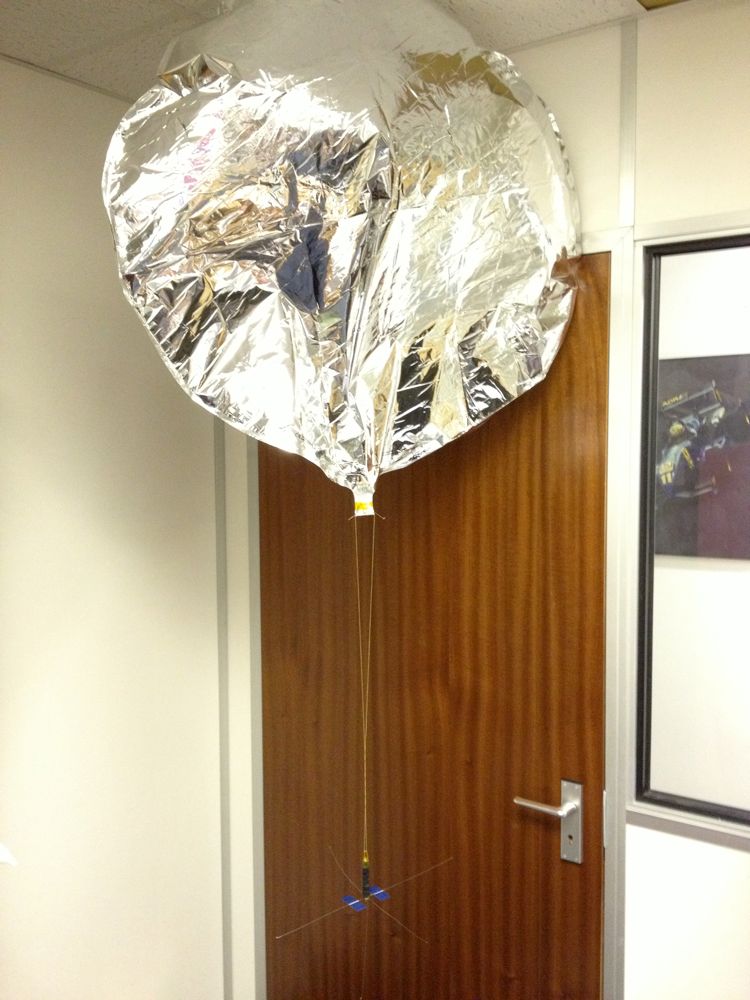
FUNcube-1 transponder to be active at weekends

FUNcube-1 (AO-73) - Image credit Wouter Weggelaar PA3WEG

FUNcube-1 (AO-73) – Image credit Wouter Weggelaar PA3WEG

Following the 48 hour test on April 5-6, the FUNcube-1 (AO-73) CubeSat team have concluded that the battery temperature does reduce slightly during full time transponder mode, but only by a degree C or so; it remains within specification. Hence it has been decided in future to switch the satellite into ‘forced eclipse mode’, i.e. full time transponder and low power beacon at weekends. The aim is to significantly increase the availability of the transponder to radio amateurs. This will continue until further notice.

The team plan to switch to full time transponder mode during the first suitable pass over the UK on Friday evenings, normally between 1930 and 2230 UT. If for some reason this is not possible, then the switch will be done on the first suitable pass on Saturday, normally between 0930 and 1200 UT. It is planned to switch the full time transponder mode off during a suitable pass on Sunday evenings, which normally occur between 1930 and 2230 UT. Again, if this is not possible the switch off will be made on Monday mornings, approx. 0930 to 1200 UT.

Do please note that this schedule is totally reliant on the availability of command stations, who will do their very best to ensure it is maintained. We will not normally announce successful full time transponder mode on/off commands, but if it proves not possible to make one of them, then we will make a note here and on the AMSAT Bulletin Board (AMSAT-BB).

So please do enjoy the transponder, and use it any time you hear it on. We are always pleased to hear of your activity, so either leave a comment below, or email g3wgm -at- amsat.org

Watch a recent FUNcube-1 contact made by Paulo PV8DX

Thanks for the report, Paulo!

There has been a small change to the data that’s presented on the FUNcube-1 Telemetry Upload Ranking page: http://warehouse.funcube.org.uk/ranking.html?satelliteId=2

The count column is now coloured to show the period in which the last data was received from the user:
Green – within the past 7 days
Yellow – within the past 14 days
Light-grey – longer than 14 days

If you would like it more granular, please start a discussion on the ‘forum’ at http://forum.funcube.org.uk/

Thai Amateur Radio Delegation Visit DARC

Thai Amateur Radio and Citizens Band Sub-Committee visit DARC

Thai Amateur Radio and Citizens Band Sub-Committee visit DARC

Thai radio amateurs are hoping to get a number of license improvements this year, including access to the Amateur Satellite Service band at 435-438 MHz as well as 146.0-146.5 MHz.

100 Watt Magazine Thida Denpruektham HS1ASC

100 Watt Magazine Thida Denpruektham HS1ASC

On Sunday, March 30, 2014 a delegation of the Thai National Broadcasting and Telecommunications Commission (NBTC) Amateur Radio and Citizen Band Development Sub-Committee (ARCB) visited the Deutscher Amateur Radio Club (DARC) amateur radio center in Baunatal.

Martin Köhler DL1DCT, Thilo Kootz DL9KCE, the DARC service team and Thomas Wrede DF2OO received the visitors and provided information on amateur radio topics in Germany and Europe, especially with regard to emergency radio activities and youth work.

The visit was organized by Thida Denpruektham HS1ASC. She is editor of the Thai “100 Watts Magazine” as well as a member of the ARCB.

The DARC expressed their thanks to Benji Klingler DJ5BK/HS6SSE. She acted as interpreter and ensured there were no problems communicating even in the more complex topics. At the end of the nearly three-hour visit, the guests visited the club station DF0AFZ.

In May 2012 Thailand had 246,959 radio amateurs holding the basic entry level VHF license and 717 Intermediate and Reciprocal HF license holders.

Benjamas Klingler DJ5BK / HS6SSE

Benjamas Klingler DJ5BK / HS6SSE

The reason for the low number of HF license holders seems to be because it’s impossible to sit an exam to upgrade. There appears to have only been one Intermediate exam for just 151 candidates held in almost 10 years, see
http://www.southgatearc.org/news/may2012/
thailand_holds_intermediate_exam.htm

It is hoped that the granting of 28.0 – 29.7 MHz to the basic entry license holders later this year should significantly increase HF activity from the country.

Thailand is also planning to introduce an Advanced license class equivalent to the USA Extra and UK Advanced.

100 Watts Magazine http://tinyurl.com/100WattsMagazine

100 Watts on Facebook https://www.facebook.com/100WattsMagazineOfficial

Radio Amateur Society of Thailand (RAST) http://www.qsl.net/rast/

DARC in Google English http://tinyurl.com/GermanyDARC

ISS HamTV moves to 2369 MHz


Front panel of the HamTV transmitter

Front panel of the HamTV transmitter

The Digital Amateur TV (DATV) system in the Columbus module of the International Space Station (ISS) has changed frequency to 2369 MHz.

BATC Webstream of ISS HamTV by Stefan VE4NSA March 8, 2014

BATC Webstream of ISS HamTV by Stefan VE4NSA March 8, 2014

Presently, Ham Video is transmitting permanently a “blank” image and no audio in configuration 5:
* ARISS antenna 43
* Frequency 2369 MHz
* Symbol rate 1.3 Ms/s

Reports on reception of blank transmissions are very welcome. Reports can be filed via this webpage:
http://www.spaceflightsoftware.com/ARISS_FSTV/submit.php

Participants using the Tutioune receiving software can record as well as stream detailed parameters of the received signal. Please see:
http://www.vivadatv.org/

Reports are available at
http://www.vivadatv.org/viewtopic.php?f=66&t=294&p=785#p785

Thank you for your participation to the Ham Video testing campaign.

73,
Gaston Bertels, ON4WF
ARISS Europe chair

Read the HamTV overview by Gaston Bertels ON4WF http://tinyurl.com/HamTVoverview

Join the ISS HamTV Yahoo Group http://groups.yahoo.com/group/HamTV

Webstream of the TV transmissions http://batc.tv/ch_live.php?ch=4

ARISS-EU HamTV Bulletins http://www.ariss-eu.org/

HamTV on Facebook https://www.facebook.com/Hamtvproject

UKSA 2013 CubeSat Workshop Recommendations Available

UKSA - UK Space Agency LogoOrganised by the UK Space Agency (UKSA) and held at the Open University, the 2013 workshop sessions included topics from over 100 contributors attending.

Key areas included:
• Fostering a stronger and wider UK CubeSat Community
• Overcoming Obstacles
• Developing Education/Outreach Benefits for the UK with the UKube X Program
• Accelerating Disruptive Technologies

The Recommendations & Notes from that workshop are now available at
http://www.cubesatforum.org.uk/wordpress/wp-content/uploads/2014/04/UKSA-CubeSat-Workshop-Recommendations-Notes-Jan-2013.pdf

Make sure you attend the free 2014 UK CubeSat Workshop at Harwell on May 13, see
https://amsat-uk.org/2014/02/28/free-uk-cubesat-workshop/

Register for this premier event on the Satellite Applications Catapult page
http://www.cubesatforum.org.uk/wordpress/2014-uk-cubesat-workshop/

FCC proposes giving more 5 GHz Spectrum to unlicensed devices

FCC 5 GHz Proposal ET Docket No. 13-49

FCC 5 GHz Proposal ET Docket No. 13-49

In a Notice of Proposed Rulemaking ET Docket 13-49 the FCC proposes making 195 MHz of spectrum at 5 GHz available for Part 15 unlicensed National Information Infrastructure (U-NII) devices to provide high data rate mobile and fixed communications for individuals, businesses, and institutions.

The Amateur Satellite Service has an uplink allocation at 5650-5670 MHz and a downlink allocation at 5830-5850 MHz.

Read the FCC Notice of Proposed Rulemaking ET Docket No. 13-49
http://apps.fcc.gov/ecfs/document/view?id=7022123531

Read the ARRL story
http://www.arrl.org/news/more-peanut-butter-and-jelly-fcc-drops-the-first-shoe-in-5-ghz-u-nii-devices-proceeding

Transponder Test: Jim Heck G3WGM talks to TX Factor

FUNcube-1 (AO-73) - Image credit Wouter Weggelaar PA3WEG

FUNcube-1 (AO-73) – Wouter Weggelaar PA3WEG

The FUNcube-1 (AO-73) satellite team plan to activate the transponder once again during the daytime over the weekend of April 5-6.

Project Manager Jim Heck G3WGM has given an exclusive audio interview to the TX Factor‘s Bob McCreadie G0FGX which explains what the tests are all about and the potential problems.

Will these tests lead to more time being made available to amateurs wanting to communicate via the satellite?

TX Factor htttp://www.txfactor.co.uk/