A Special EME Operation from QM06 Japan

A Japan-Broadcasting Corporation TV report from 2007 featuring Mike Watanabe JH1KRC has just been made available on YouTube.

The YouTube description reads:

KDDI, one of the Japanese telecommunication services companies, has assigned to make experimental cooperation with the Project BIG-DISH, composed of some forty Japanese moon bouncers, and JARL.

We will use the antenna IBA-4, which is the 4th antenna of Ibaraki Satellite Communications Center, KDDI Corporation, for the experimental moon bounce operation on 144, 432, 1296 and possibly 5760 MHz bands. IBA-4 is a 32-metre Cassegrain dish made by Mitshubishi Electric Corporation in 1980’s, and is located in the grid QM06.

The IBA-4 is fully rotable and the elevation is possible up to 90 degrees for automatic moon tracking. The largest problem we have is that we cannot remove the subreflector, 2.9-m in diameter, about 9 metres in front of the main reflector. Therefore we have to use this subreflector in some way for the EME operation.

Our EME operation license is still waiting for the four bands, 144, 432, 1296, and 5760 MHz. The 5760 MHz high power moon bounce transmission is still in discussion in the ministry. Other bands are sure to be licensed for the operation with 500 watts output. We will use callsign 8N1EME. The intensive operating modes are CW, SSB, and JT65 specially on 144 and possiby on 432 also. Fundamentally, we think that random QSOs are most important, although, some scheduled QSOs may be considered for any special reason. Antennas in use will be vertilac pol. on 144 and 432 MHz, the usual EME circular pol. on 1296, and 5760 MHz.

The operation took place late February and early March, in 2007.

Watch 8N1EME-NHK-NEWS(NHK(Japan-Broadcasting Corp.))

Project Big Dish http://8n1eme.jp/

New Frequencies for Polish Radio Amateurs

Poland’s national society the Polski Związek Krótkofalowców (PZK) has announced new frequency allocations for the Amateur and Amateur-satellite Services.

The frequency range 2400-2450 MHz has been allocated to the Amateur-satellite Service and it is understood that one of the  BRITE-PL amateur radio nanosats will be making use of this allocation.

In addition frequency allocations of 70.1-70.3 MHz and 3400-3410 MHz have been made available to the Amateur Service.

Some of the students who worked on the Amateur Radio CubeSat PW-SAT (launched January, 2012) went on to work on the development of the two BRITE-PL nanosats.

Polski Związek Krótkofalowców (PZK) in Google English
http://tinyurl.com/PolandPZK

BRITE-PL http://www.brite-pl.pl/index_en.html

BRITE Project http://www.utias-sfl.net/docs/LivePapersAsOfJan2011/BRITE-COSPAR2010-PaperSR-WW-REZ-SM-AS-TM.pdf

BRITE TV http://www.uk.amsat.org/3054

IARU Amateur Satellite Frequency Coordination pages hosted by AMSAT-UK http://www.amsat.org.uk/iaru/

IARU Announces Coordinated Frequencies for Two CubeSats

The IARU Amateur Satellite Frequency Coordination Panel have announced coordinated frequencies for two new CubeSats.

The downlink frequencies announced are:

TechEdSat  – 437.465 MHz
HumSAT-D  – 437.365 MHz

IARU Amateur Satellite Frequency Coordination Status http://www.amsat.org.uk/iaru/

To assist builders and prospective builders of satellites that will operate on frequencies allocated by the ITU to the Amateur Service, a comprehensive set of guidelines have been produced, see  http://www.iaru.org/satellite/

First-MOVE CubeSat Solar Panel Deployment Video

First-MOVE is a CubeSat being built by students at the Technical University of München.

MOVE stands for München Orbital Verification Experiment. The 1U CubeSat has two deployable solar panels carrying a new generation of solar cell. First-MOVE also carries a CCD camera.

Despite the narrow bandwidth data channel high quality pictures can be taken and transfered to Earth using a specially developed algorithm which filters the pictures due to content (Space, Earth horizon), compresses them, fragments them to small data packages and generates thumbnails for preview.

First-MOVE completed integration in April 2012.

Watch First-MOVE Flap Panel Deployment Test

Watch First-MOVE Complete Integration

MicroThrust Motor for Nanosats

Imagine reaching the Moon using just a tenth of a liter of fuel. With their ionic motor, MicroThrust, EPFL scientists and their European partners are making this a reality, ushering in a new era of low-cost space exploration.

Watch EPFL – A Couple Drops of Fuel to Get to the Moon with MicroThrust

The goal is to provide efficient propulsion systems for nanosatellites (1-100 kg), which are currently stuck in whatever orbit they were initially placed: the plan is to free them to allow nanosatellites to perform orbital maneuvering, and missions to the Moon, to Near Earth Objects, or even to Mars.

Read Micromachined Propulsion systems for very small satellites http://lmts.epfl.ch/microthrust

Around the World 28 MHz Balloon Launched

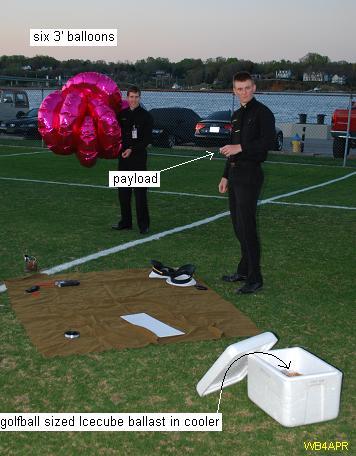
A long duration balloon mission that is using 6 Party Balloons to carry a 50 gram amateur radio 28.223 MHz CW beacon is hoping to go around the world.

The ballon was released at 2330 UT (1930 EDT) March 29, from Annapolis in Maryland and started its journey heading SE at 6 knots. By 0300 UT, March 30, it had reached a speed of 60 MPH (96 km/h).

It has no APRS, just the 28.223 MHz 100 milliwatt CW telemetry system and it is hoped to locate it by signal strength and beam headings only.

The mission is to give an insight into constant-pressure balloons and especially the use of common mylar party balloons as a fixed volume envelope. Unfortunately, these balloons have a high mass and so the theoretical maximum altitude no matter how many balloons are used is only about 26,000 feet and that is with no payload other than the fixed balloon mass.

The payload weighs about 50 grams. The team are targeting 6 party balloons 3′ in diameter which should give a float altitude around 16,000 feet.

The Telemetry will be in CW on 28.223 MHz (USB DIAL) and will contain Battery voltage, inside and outside temperatures, and surface luminosity of the ocean/clouds. It has no GPS. The team will rely entirely on DF bearings and signal reports.

EMAIL DF reports to W3ADO@homeside.to Be sure to include:
Your LAT/LONG
Time of observation
Quality of heading (subjective 1 to 10)
The CW string copied

If you have APRS you can uplink your beam heading via APRS.

Since the balloon is only flying at 16,000 feet or so it will be vulnerable to weather. The battery is expected to have a lifetime of about 10 days.

Further information including details of CW telemetry at http://aprs.org/balloons.html