
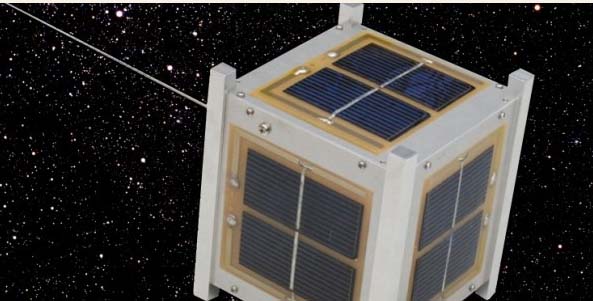
RS-39 Chibis-M
RS-39 has CW beacons on 435.315 and 435.215 MHz that can be received directly by schools and colleges for educational outreach purposes. It deployed from Progress M-13M into a 500 km orbit on January 24 at approximately 23:18:30 UT.
On November 2, 2011 cargo ship “Progress M-13M”, which also delivered microsatellite “Chibis-M”, was docked with ISS. The main purpose of “Chibis-M” is the study of physical processes in the vicinity of the lightning, during which the Terrestrial Gamma Ray Flashes (TGFs) are generated. TGFs are likely produced by beams of very energetic electrons, which are accelerated in the intense electric fields generated by large thunderstorm systems.
The deployment of “Chibis-M” in a circular orbit of 500 km will take place during the final phase of “Progress M-13M” operation. According to the plan of the Russian Space Control Centre, undocking of “Progress M-13M” will occur at January 24, 01:59 msk and after two corrections it will be positioned at 500 km orbit. At January 25, 03:14 msk “Chibis-M” will separate. Beside scientific data “Chibis-M” will transmit service telemetry (the housekeeping parameters) in the beacon format on 435.315 or 435.215 MHz CW (Doppler shift +/- 10 kHz) and has the designation of RS-39. The format of data is typical for RS satellites and can be downloaded here.
The telemetry of RS-39 can be easily received directly by schools and colleges for educational outreach purposes. This telemetry will give details of the spacecraft’s health – battery voltages and temperatures of critical units. In combination with orbital data such information will be useful as the curriculum for student lessons.
The team of RS-39 will very much appreciate any reception reports of “Chibis-M”. Special attention is requested for the first orbits as these are outside of control stations for “Chibis-M”. Each report will be confirmed by special QSL card. The email address is amateur-rs39@chibis.cosmos.ru
The RS-39 Chibis-M website managed the by Space Research Institute of the Russian Academy of Sciences (RAS) can be seen in Russian at http://chibis.cosmos.ru/ or in Google English at http://tinyurl.com/RS-39-Chibis-M
As well as measuring electromagnetic parameters of “space weather” in the spectrum 0.1 – 40 kHz the satellite also carries a receiver for the analysis of radio frequency signals in a frequency band of 26-48 MHz. http://www.energia.ru/en/iss/researches/geophis/19.html
RS-39 Morse Code telemetry format http://tinyurl.com/RS-39-Morse-Code-Telemetry
RS-39 Telemetry Decoder http://www.uk.amsat.org/4029
RS-39 Real Time Tracking Map http://chibis.cosmos.ru/cyclogr/prepare1/google/index.html
For Keps click on two gear wheels in top left-hand corner then click on Satellites.
It may be worth checking the AMSAT Bulletin Board (AMSAT-BB) for the very latest news. The 48-hour archive of the AMSAT-BB is at http://www.amsat.org/amsat/archive/amsat-bb/48hour/threads.html or you can join the bulletin board at http://www.amsat.org/amsat-new/tools/maillist/maillist.php



You must be logged in to post a comment.