ARISSat-1 Re-entry Date

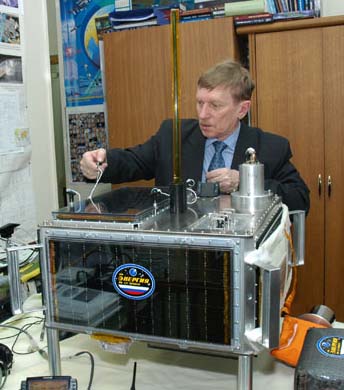
Sergey Samburov RV3DR with ARISSat-1

Sergey Samburov RV3DR with ARISSat-1

The latest prediction from Jim N8OQ is that the amateur radio satellite ARISSat-1 will re-enter the Earths atmosphere in January.

On the AMSAT bulletin board Jim says “Using solar data through 2011 Nov. 30 and updating the decay fit. I am getting a re-entry date of 2012 January 12 with a rule-of-thumb error estimate of +/- 10 days or so for ARISSat-1.”

Since deployment in August, ARISSat-1 has descended about 60 km, and is currently losing more than 1.5 km per day. The rapid rate is partially the result of the recent solar activity on the atmosphere, significantly increasing the drag.

AMSAT wishes to collect telemetry data from the satellite as it approaches re-entry and is running a competition to see who can copy the final telemetry frames. Further details of the Catch the Last ARISSat-1 Telemetry Contest at
http://www.uk.amsat.org/2011/11/09/catch-the-last-arissat-1-telemetry/

ARISSat-1 http://www.arissat-1.org/

Online pass predictions (select ARISSat-1) http://www.amsat.org/amsat-new/tools/

Download the Windows and Mac versions of the ARISSatTLM free ground station soundcard demodulator and display software from http://www.arissattlm.org/

ARISSat-1 Frequency Guide http://tinyurl.com/4t497t2
AO-51 End of Mission

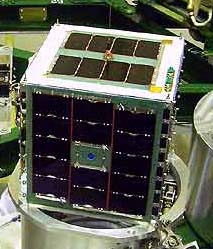
AO-51 on Launch Platform

It is with a heavy heart I report that AO-51 has ceased transmission and is not responding to commands. The last telemetry data indicated that the third of six batteries was approaching failure to short, and observations indicate the voltage from three cells is insufficient to power the UHF transmitters. The IHU may continue to be operative. Initial tests with the S band transmitter were also not positive, although more attempts are in order. We have tried leaving the satellite in an expected state where if voltages climb high enough, the 435.150 transmitter may possibly be heard.

The command team will regularly attempt communications with the satellite over the coming months (and years). There is always the possibility that a cell will open and we could once again talk to our friend while illuminated. Thanks to all who helped fund, design, build, launch, command, and operate AO-51. It’s 7 year mission has been extraordinary. Please support AMSAT’s Fox-1 project, and other AMSAT projects worldwide with your time and money.

For the AO-51 Command Team,

73, Drew KO4MA
AMSAT-NA VP Operations

AO-51 http://www.amsat.org/amsat-new/echo/

AMSAT Bulletin Board (AMSAT-BB)http://www.amsat.org/amsat-new/tools/maillist/

ARISSat-1 – Gould Smith WA4SXM Interview

ARRL Test Engineer Bob Allison, WB1GCM, discusses the Amateur Radio satellite ARISSat-1/KEDR with Project Manager Gould Smith, WA4SXM, and talks with Jan King VK4GEY/W3GEY about OSCAR-5.

Watch the Gould Smith, WA4SXM, interview recorded at the 2011 AMSAT Symposium in San Jose, California. Videography by Jerry Ramie, KI6LGY.

The grab handles on ARISSat-1 were provided by a member of AMSAT-UK.

Watch the Jan King VK4GEY/W3GEY interview

ARISSat-1/KEDR update on YouTube
http://www.southgatearc.org/news/november2011/arissat1_update_on_youtube.htm

Catch the Last ARISSat-1 Telemetry Contest
http://www.southgatearc.org/news/november2011/catch_the_last_arissat1_telemetry_contest.htm

AMSAT-UK publishes a colour A4 newsletter, OSCAR News, which is full of Amateur Satellite information.
Free sample issue at http://www.uk.amsat.org/on_193_final.pdf

Amateur Radio Assistance Requested: ISS Plasma Thrust Shadow Experiment

International Space Station

International Space Station

The Central Research Institute of Machine Building (TSNIIMASH) in Russia is conducting a series of space plasma experiments in order to evaluate the shape of previously observed “dead” zone, or shadowing due to the firing of an onboard arcjet plasma source.

Radio Amateurs are invited to participate in the Space plasma experiment “Shadow” onboard the International Space Station (ISS) taking place Nov 25-28 and Dec 2-5.

Integration of Electric Thrust (ET) onboard a spacecraft poses a certain set of problems including electromagnetic compatibility of ET. One matter of interest is that highly ionized exhaust plumes of ET may scatter RF-signals producing large “dead” zone for communications. Continue reading →

London Hackspace work on HackSat One

Hacksat One mission decal created by Nick Cramp

Hacksat One mission decal created by Nick Cramp

In September 2011 members of London Hackspace took an Amateur Radio Foundation course at their original Shoreditch venue. It was led by Chris Driver G6CMD of the Verulam Amateur Radio Club and all passed. It is hoped further courses will be held in the future.

The group are involved in a wide range of electronic projects, one of their latest is a tiny Amateur Radio satellite called HackSat One. This Sprite will have a downlink of 10 milliwatts on 437 MHz and is planned to be deployed into Earth orbit by KickSat in early 2014. Zac Manchester KD2BHC of the KickSat development team has said they are aiming for the Sprites to be receivable using an AMSAT-UK FUNcube Dongle SDR.

London Hackspace members build a wide range of electronic projects

London Hackspace members build a wide range of electronic projects

The Hack Space, with dedicated classrooms and workshops is in Hackney road, London, E2 9DY. It is open to members 24 hours a day. Regular free hack evenings and workshops are held which are open to everyone.

London Hackspace is a registered Amateur Radio exam centre http://www.rsgb.org/local/examcentres/region.php?id=9

Amateur Radio Training http://wiki.london.hackspace.org.uk/view/
Project:Amateur_Radio_Training

HackSat One http://wiki.london.hackspace.org.uk/view/Project:HackSat1

London Hackspace Project: Hoxton Space Centre

KickSat – a personal spacecraft of your own in space
http://www.kickstarter.com/projects/251588730/kicksat-your-personal-spacecraft-in-space

The BBC Radio 4 show Click On, broadcast November 14, visited London Hackspace. Download the Podcast at http://downloads.bbc.co.uk/podcasts/radio4/clickon/clickon_20111114-1700c.mp3

2009 BBC TV news on Hack Spaces http://www.southgatearc.org/news/june2009/diy_gadgetry.htm

There are Hack Spaces around the country where people meet up to carry out constructional projects see http://hackspace.org.uk/

UHF Station on ISS Columbus module

The amateur radio station located in the Columbus module is currently operational with the UHF Ericsson FM transceiver and AX.25 packet system using the frequency of 437.550 MHz.

To utilize the the packet system, operators need to set the UNPROTO path to ARISS (the id is RS0ISS) for digi relay or they may connect to the BBS using the callsign RS0ISS-1.  The packet beacon is set for 2 minute intervals so it may not appear to be active over many parts of the world but keep listening and mind the Doppler shift (+ or – 10 kHz).

To check when the ISS is in range see the real time tracking at  http://www.issfanclub.com/ (top left).

AMSAT-UK publishes a colour A4 newsletter, OSCAR News, which is full of Amateur Satellite information. A sample edition of the newsletter can be seen at http://www.uk.amsat.org/on_193_final.pdf
Join AMSAT-UK online here http://alturl.com/avuca