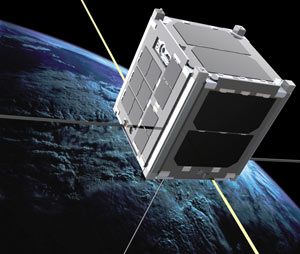
CPUT satellite HF beacon – a new tool for radio amateurs.

In this monthly feature, Hans van de Groenendaal ZS6AKV, executive chairman of the South African Amateur Radio Development Trust (SAARDT), looks at various technologies and activities that drive amateur radio. SAARDT is dedicated to the development of amateur radio in South Africa with a special interest in the youth. The organisation is funded by donations and supports the South African Radio League and SA AMSAT.

The two satellites being built by students of the Cape Peninsula University of Technology (CPUT) include a beacon operating in the 20 m amateur band. The first of the two is a single CubeSat 10 x 10 x 10 cm with a mass of one kilogramme.

While the single CubeSat will be dedicated to the Hermanus Magnetic Observatory science payload supporting the HMO operations in Antarctica, it will provide interesting antenna characterisation opportunities for radio amateurs.

The beacon operating on 14 099 kHz will be used for optimising the SuperDarn HF radar system operated by the National Space Agency Space Science (previously the Hermanus Magnetic observatory).

The electrically conductive upper layer of the Earth’s atmosphere (known as the ionosphere) sometimes connect directly to the solar wind. If there is a strong coupling then there is an increased chance that the space environment immediately surrounding our planet will be disrupted – the fast-moving solar wind blowing past the Earth can drag the polar ionosphere with it. Scientists use the SuperDARN radar system to measure how the ionosphere is moving above the polar cap by detecting echoes reflected by patches of electrically charged particles.

In our increasingly high-tech society, space research is becoming an important research area because some modern technologies, both in space and on the ground, are vulnerable to rapid changes in the space environment known as “space weather”.

Why satellite signals?

As with all radio systems phase characteristics change with time. The phase path through the system needs to be calibrated on a regular basis and this can be achieved by introducing another signal into the system and then measure the phase coming out.

As the CubeSat passes over the Antarctic it will be in full view of the radar antennas. Scientists will then measure the signal and determine what the phase difference is.

Ean Retief ZS1PR, a Cape Town radio amateur with a special interest in radio propagation, suggested that the signal be used for determining the coverage (beam) pattern of 20 m antennas. Currently obtaining a reasonable coverage pattern for an antenna takes a long time as testing with other radio amateurs introduces a number of variables such as variation in ionospheric propagation conditions (day to day, seasonal, time of the day and the stage of the sunspot cycle), different power levels of the distant stations and different antennas being used by the distant stations.

The CubeSat HF beacon will be a known unchanging (same output and same antenna) source and with a known flight path the angle and range of the cube-sat will be known for the entire traverse. Therefore the observer simply needs to note time and received signal strength every few moments.

A “lobe pattern” can be drawn for the particular path followed by the CubeSat during a pass. With three to six passes available daily a rough estimate of the antenna pattern can be estimated after only one day of monitoring.

After a week of observation it should be possible to draw quite a good “in situ” coverage pattern, as not only will the lobes of the antenna be recorded but also any local screening effects of mountains, hills and nearby buildings.

If the antenna is then modified in any way, the effects of such modifications will be easily detectable after observing a few passes.

Propagation research

The beacon signal can also be used for the study of various modes of propagation. Questions such as “how does an HF signal above the ionosphere behave during various times of the day and sunspot cycle” can be answered. Will it penetrate through the ionosphere as the layers change or will it travel along the upper layer before penetrating?

As monitoring of the CubeSat signal will only require a receiver with a “S” meter and an accurate clock, the possibility also exists for constructing simple antenna configurations at youth camps or schools. By re-orienting the antenna in direction or configuration (i.e. “straight” dipole versus “inverted-V”) the effect should be noticeable during the next pass of the CubeSat and will give quick “hands on” learning. Varying the height above ground will also show the change in pattern.

The beacon signal can also be used to demonstrate the different effects of different antennas. For instance it will show the difference in signal strength during different parts of a satellite pass between different antennas (i.e. dipole giving better results at higher elevation while vertical gives better result at lower elevation). Coupled with modern antenna modelling software it will give participants the “proof of the pudding” of what they saw on a computer screen.

A simple satellite beacon can be used for so many interesting experiments and activities and add new interest to amateur radio.

http://www.amsatsa.org.za/


AMSAT-UK FUNcube Dongle receiving HORYU-2 Satellite (video)

Decoding using FUNcube Dongle, MixW2 and the HORYU-2 Data Analysis software

Published on Jun 3, 2012 by

HORYU-2 Telemetry Competition http://www.uk.amsat.org/7474

Listen to HORYU-2 on the Web http://www.uk.amsat.org/7594

Further information on HORYU-2 is at http://www.uk.amsat.org/7404

HORYU-2 CW Telemetry Decoder by DK3WN http://tinyurl.com/SatSoftwareDK3WN/

AMSAT-UK FUNcube Yahoo Group http://groups.yahoo.com/group/FUNcube

The FUNcube Launch Fund

Please Help us launch our AMSAT-UK FUNcube-1 Cubesat.

Fund:  http://tinyurl.com/7t24yol


The FUNcube-1 micro-satellite (CubeSat standard size) will carry a UHF to VHF linear transponder that will have approx 500mW PEP output and which can be used by Radio Amateurs worldwide for SSB and CW communications.

AMSAT-UK  is working on this new amateur satellite project: FUNcube-1 is a complete educational single CubeSat project with the goal of enthusing and educating young people about radio, space, physics and electronics, will be launched with a number of other spacecraft from a DNEPR rocket sometime in the third quarter of 2012.

FUNcube Dongle Pro or “FCD” is a SDR Receiver! – The Pro version gives unlimited access to the frequency range 64MHz to 1.7GHz (1.1GHz – 1.27GHz omitted) – Similar to USB TV Dongle, the FUNcube Dongle simple fits into your computer’s USB port. It’s compatible with many radio reception programs … like the future FunSDR write by I2PHD (see below!) and it is uses standard USB drivers already integrated into the operating system! (…No drivers required!)

FUNcube Dongle Pro Prices: (for EC buyers Inc VAT at 20%): abaut £134.60/£137.22 inc. shipping! (http://www.funcubedongle.com/)


AMSAT-UK 80 Meter Net (Today 27th May)

The AMSAT-UK net is held every Sunday morning at 10am local time on a nominal frequency of 3.780 MHz. Due to interference the net may move either side of that frequency so tune around. Newcomers are most welcome to call-in.

You Dont have to be a AMSAT-UK member to join in with the chat.


So pop in and say hello.


Honeymoon Adventure

The Uncertainly Principle 1.1 litre Fiat Panda with AMSAT-UK Logo

Helen Woolnough and Neil Melville PA9N are setting off on a honeymoon with a difference, and they aim to make a difference by raising money for charity.

They are taking part in the Mongol Rally where participants drive, in no more than six weeks, from the UK to Ulaanbaatar in Mongolia, using a thoroughly unsuitable car of 1.2 litres or less.

Helen and Neil’s entry is called The Uncertainty Principle. They will be driving a 9 year old 1.1 litre Fiat Panda on their epic journey which starts July 14.

The challenging route will take them through the Gobi desert and over the Pamir Highway (the second highest road in the world). They aim to cover more than 10,000 miles through 19 countries, with no support, no mechanic, and no clue.

They’ll be raising money for the Lotus Children’s Centre Charitable Trust and UNICEF.

Over the years Neil PA9N has given many presentations to the AMSAT-UK International Space Colloquium in Guildford, and his first spacecraft project was XO-53.

One AMSAT-UK member who sponsored Neil, asked for the AMSAT-UK Logo, together with the caption which reads “You can have even more FUN in space”, to be displayed on the underside of the bonnet for maximum exposure!

The Uncertainty Principle http://theuncertaintyprinciple.co.uk/

Facebook: https://www.facebook.com/Uncertainty.Principle.2012

Twitter: https://twitter.com/UncertaintyP

Fundraising: http://uk.virginmoneygiving.com/team/theuncertaintyprinciple

Mongol Rally:  http://www.theadventurists.com/the-adventures/mongol-rally

XO-53: http://www.amsat.org/amsat-new/satellites/satInfo.php?satID=20

AMSAT Demonstration Station at 2012 Dayton Hamvention

The AMSAT demonstration station at the 2012 Dayton Hamvention in Ohio (grid EM79ut) working the SSB/CW satellite VO-52 on Friday, May 18, 2012. This video starts at approximately 1418 UTC (10.18am EDT) on a pass to the west that covered much of North America.

Working the microphone is Keith Pugh W5IU. Assisting Keith is Doug Papay KD8CAO, and Roger Ley WA9PZL is taking care of the antenna. Keith’s equipment is used for the demonstration station – two Yaesu FT-817s, two homebrew antennas (3-element 2m Yagi, 6-element 70cm Yagi), and a laptop running SatPC32 to control the radios. The radios and laptop are powered from a large 12V battery.

As the video starts, Keith is working Angelo N5UXT in New Orleans, Louisiana. Other stations are heard later in the video, as the satellite is moving away and toward the horizon.

This video was recorded by Patrick Stoddard WD9EWK/VA7EWK using a Sony DSC-H70 camera at 720p.

See a video by Simon 2E0HTS describing how to work the SSB amateur radio satellites such as VO-52 http://www.uk.amsat.org/2712

John Heath G7HIA wrote about operating through VO-52 in his article ‘Getting started on amateur radio satellites’ that was published by the Radio Society of Great Britain in the March 2007 edition of RadCom. Download the article at https://amsat-uk.org/wp-content/uploads/2011/05/satellites_radcom_mar07.pdf
Copyright 2007 Radio Society of Great Britain. For personal use only – no copying, reprinting or distribution without written permission from the RSGB.