Tweeting via the ISS

International Space Station - Image Credit NASA

International Space Station – Image Credit NASA

Harold Giddings KR0SIV describes how he Tweeted using amateur radio and the International Space Station.

He says: I sent a message to the International Space Station, it transmits it back down to groundstations in its view and those stations send the message to the APRS-IS network. My server then takes the message parses out useful data and posts it to Twitter as a tweet.

The ISS has two amateur radio stations. One is in the Russian Service Module and uses a Kenwood D710 and can do Slow Scan Television (SSTV) as well as FM voice. The other is in the Columbus Module and uses Ericsson handhelds for 145 and 435 MHz FM, the 2395 MHz HAM-TV system is also in this segment of the space station. In addition to voice contacts the 145 MHz Ericsson handheld is used to provide the APRS packet radio digipeater used by Harold.

Watch Twitter on the International Space Station

Ham Radio Tweets
http://hamradiotweets.com/
https://twitter.com/HamRadioTweets

How to hear the ISS https://amsat-uk.org/beginners/how-to-hear-the-iss/

How to work the ISS on APRS Packet Radio
https://amsat-uk.org/beginners/how-to-work-the-iss-on-aprs-packet-radio/

Help needed to track 144.390 MHz APRS Balloons

James Cutler KF6RFX and Benjamin Longmier KF5KMP - University of Michigan

James Cutler KF6RFX and Benjamin Longmier KF5KMP University of Michigan

Benjamin Longmier KF5KMP and his team are looking for stations in the Azores and Portugal to help track their balloons.

On the UK High Altitude Society (UKHAS) group he writes:

My team (Project Aether) launched a balloon recently that did a lap around the Midwest in the US, headed East past Nova Scotia and is still floating strong. We don’t have any contacts in the Azores or Portugal, and are requesting help in contacting some of these folks that might be able to decode our APRS packets.

Tactical callsign: Aeth21-9
APRS track: http://aprs.fi/#!mt=terrain&z=9&call=a%2FAETH21-9&timerange=259200&tail=259200
144.390 MHz FM

We also have two more experimental balloons that will be heading into the Atlantic within ~24hrs.
Tactical callsign: Aeth22-1
APRS track: http://aprs.fi/#!mt=terrain&z=7&call=a%2FAETH22-1%2Ca%2FAETH22-3&timerange=259200&tail=259200
144.390 MHz FM

Tactical callsign: Aeth22-3
APRS track: http://aprs.fi/#!mt=terrain&z=7&call=a%2FAETH22-1%2Ca%2FAETH22-3&timerange=259200&tail=259200
144.390 MHz FM

Thanks for any help!
-Ben
email: longmier at umich.edu

Links to balloon beginners guides and tracking information
https://amsat-uk.org/beginners/balloons/

Diwali Return for APRS Balloon Payload

Dhruva Space Balloon Payload

Dhruva Space Balloon Payload

The payload of the Indian amateur radio APRS balloon launched on October 13, 2013 has been successfully retrieved.

The balloon payload was returned to Dhruva Space on November 3 during Diwali (Festival of Lights).

The balloon had been launched from the Indian Institute of Astrophysics, Bangalore and drifted into the Arabian sea, off the coast of Udupi. Ham radio operators in Karnataka and Goa in India, and the Middle East and Africa were able to track the APRS signal, containing real time location, altitude and other operating conditions of the flight, for over 600 km into the Arabian sea.

The payload was found about 42.6 km off the coast of Gangoli, Karnataka on October 15 at 11 AM by the sailors of the fishing boat “Suvarna Lakshmi”.

It was only possible to trace the payload because one of the sailors used the sim card that was in one of the pieces of equipment in the payload.

Indian Record for Tracking Ham Radio Balloon
https://amsat-uk.org/2013/10/20/indian-record-for-tracking-ham-radio-balloon/

High Altitude Balloon to Study Comet ISON
https://amsat-uk.org/2013/09/28/high-altitude-balloon-to-study-comet-ison/

Ham radio operators set to help in tracking comet

Hindustan Times October 17, 2013

Hindustan Times October 17, 2013

After helping the Odisha government in disaster relief during cyclone Phailin, amateur radio operators will now help astrophysicists track a comet.

The Hindustan Times reports that astrophysics experts are joining hands with ham (amateur) radio operators to track and read data comet ISON, scheduled to pass nearest to the earth on November 28, 2013.

Scientists of Bengaluru-based Indian Institute of Astrophysics will send a balloon 40 km into the atmosphere to get data on the comet.

As the instruments drop with a parachute it will be a team of ham radio operators, who will track the APRS packet radio signal and retrieve the balloon.

Read the story at
http://www.hindustantimes.com/India-news/kolkata/Post-Phailin-relief-HAM-radio-operators-set-to-help-in-tracking-comet/Article1-1136224.aspx

TNC-Pi APRS packet radio review https://amsat-uk.org/info/tnc-pi-raspberry-pi-packet-radio-board/

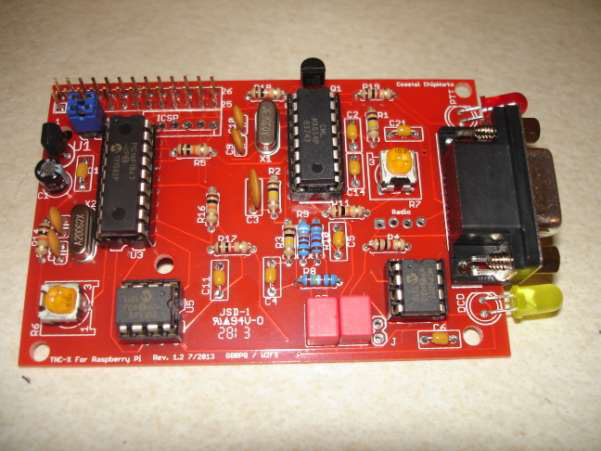
TNC-Pi Raspberry Pi Packet Radio Board

TNC-Pi kit built by Nick Bown 2E0CGW

TNC-Pi kit built by Nick Bown 2E0CGW

The TNC-Pi is a £22 ($40) KISS TNC board which is designed to connect to the GPIO port of the £25 ($35) Raspberry Pi computer board.

It provides a low cost means of using amateur radio AX.25 Packet Radio and APRS.

Nick Bown 2E0CGW has written a well illustrated review of the board. You can download the PDF from TNC-Pi by Nick Bown 2E0CGW

The TNC-Pi kit is available from http://tnc-x.com/TNCPi.htm

APRS destination address for ham radio satellites

APRS LogoAPRS has standardized an ID series for amateur radio OSCAR spacecraft – APOxxx

At the request of Juan Carlos, LU9DO, AMSAT-LU wanted a series of APRS designators for uniquely identifying AMSAT APRS applications.  He suggested those beginning with the letter O for OSCARS.

ALL APRS applications include this identifier in their packets so that the source of APRS data can be known.  See the list at

http://aprs.org/aprs11/tocalls.txt

Bob, WB4APR

APRS UK Yahoo Group http://groups.yahoo.com/group/APRSUK