ARISSat-1/KEDR activation planned

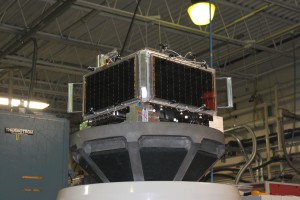
ARISSat-1/KEDR Project Manager Gould Smith, WA4SXM said this week the latest status, discussed during the International ARISS teleconference Sergey Samburov, RV3DR announced the ARISSat battery will be charged late July and a test of the system will be conducted on the ISS from 1915 UTC 30 July to about 1200-1400 UTC 31 July.

During the test ARISSat-1 will be in LOW power mode, this means that it will transmit about 40 seconds and then shut down for 2 minutes and then transmit for 40 seconds, etc.
The standard ARISSat-1/KEDR 2m downlink band plan should be
transmitted. Additionally, the FM signal also downlinked on 437.55 MHz.

As to the date of deployment, Gould summarized,
“The deployment date for ARISSat is still subject to change. As of July 14 we are looking at a 3 Aug 2011 date for EVA 29 and the ARISSat-1/KEDR deployment. The ARISSat/KEDR deployment is the first task of the EVA, so it will occur fairly soon after the EVA begins. We will let everyone know more as we know more.”
Continue reading

ARISSat-1/KEDR deployment information

ARISSat-1/KEDR deployment information

ARISSat-1

ARISSat-1

During the International ARISS teleconference Sergey Samburov, RV3DR announced that the ARISSat battery will be charged late July and a test of the system will be conducted on the ISS from 1915 UTC 30 July to about 1200-1400 UTC 31 July.

The standard ARISSat-1/KEDR 2m downlink band plan should be transmitted as well as the FM signal also downlinked on 437.55 MHz. More information as it becomes available.

Today we are looking at a 3 Aug 2011 date for EVA 29 and the ARISSat-1/KEDR deployment. This is all subject to change.

Gould, WA4SXM

Source: ANS

• Read the ARISSat-1 article from QST at
http://web.me.com/clintbradford/Work-Sat/
ARISSat-1_files/QST-ARISSat1.pdf

• July 30-31 is also the date for the AMSAT-UK International Space Colloquium that will be held in Guildford, further details at
http://www.uk.amsat.org/colloquium-2011/


ARISSat-1/KEDR deployment timeline driven by ISS schedules

ARISSat-1/KEDR deployment timeline driven by ISS schedules

ARISSat-1

ARISSat-1

ARISSat-1/KEDR Project Manager Gould Smith, WA4SXM provided the latest deployment information to the AMSAT News Service.

Gould said he and ARISS Hardware Engineer Lou McFadin, W5DID participated in a teleconference call this week with NASA to review the Roscosmos EVA procedures for the release of ARISSat-1/KEDR during Russian EVA 29.

Gould says the preparation procedures include the battery being charged and assembled into the satellite.
Also discussed were the procedures to remove the protective quilts from the solar cells and turning on the safety switches prior to deployment.

As to the date of deployment, Gould summarized, “The deployment date for ARISSat is still soft, a major factor is the shuttle launch. As of July 6 the EVA date is in early August, but the shuttle launch and docking are driving the timeline.

“During our discussion it was noted that the ARISSat/KEDR deployment is the first task of the EVA, so it will occur fairly soon after the EVA begins. Since we have no firm date or time for the EVA we cannot predict where the satellite will be heard first. We will let everyone know more as we know more.”


Amsat News, Gould Smith, WA4SXM


ARISSat-1 delayed until August?

ARISSat-1 delayed until August?


ARISSat-1

ARISSat-1

From the press office of Roscosmos:

Alexander Samokutiaev, flight engineer of the International Space Station’s expedition 28, informed about the planning for the upcoming Russian EVA in his blog in Roscosmos web.

According to Russian cosmonaut, the EVA is slated for August, pending the launch of the shuttle scheduled for July 8.

Alexander will work outside the ISS with his colleague Sergey Volkov. The cosmonauts are to perform several ISS RS refurbishing tasks, as well as to launch small satellite Kedr.

Russian cosmonauts onboard the International Space Station switched on small spacecraft Kedr on April 12, in order to commemorate the jubilee of Yury Gagarin’s mission.

Small spacecraft Kedr developed under the RadioSkaf experiment bears the name adopted by Yu.A. Gagarin call sign in his historical flight, namely Kedr. The satellite’s signal will be transmitted at radio amateur frequency of 145.95 MHz. Kedr has radio amateur call sign RS1S.

RadioSkaf is implemented in the framework of UNESCO’s student space education program.

Kedr will transmit different signals, images, including the talks of famous Russian scientist Kostantin Tsiolkovsky, rocket Chief Designer Sergey Korolev conversation with the first cosmonaut during his 108-min historical mission, and famous Gagarin’s “Go!” (Poekhali!), of course.


It's time to get ready for ARISSat-1

It’s time to get ready for ARISSat-1

A few weeks remain before the planned July deployment of ARISSat-1 from the ISS.

ARISSat-1

ARISSat-1

Here are some reminders to help you get your station ready for ARISSat-1 operation.

145.950 MHz FM Downlink:
FM transmissions will cycle between a voice ID as RS01S, select telemetry values, 24 international greeting messages in 15 languages and SSTV images. One of the messages will be a conversation between Yuri Gagarin and ground control. See the next news item for pointers to get your station ready to receive the SSTV images.

435 MHz – 145 MHz Linear Transponder:
The linear transponder will operate in Mode U/V (70 cm Up, 2m Down).
It is an 16 KHz wide inverting passband and the convention will be to TX LSB on the 435 MHz uplink and RX USB on the 145 MHz downlink. This mode is designed to work with low power transmitters and omni antenna.

145.919 MHz/145.939 MHz CW Beacon:
The CW transmissions will be callsign ID RS01S, select telemetry, and callsigns of people actively involved with the ARISS program.

Continue reading

It’s time to get ready for ARISSat-1

It’s time to get ready for ARISSat-1

A few weeks remain before the planned July deployment of ARISSat-1 from the ISS.

ARISSat-1

ARISSat-1

Here are some reminders to help you get your station ready for ARISSat-1 operation.

145.950 MHz FM Downlink:
FM transmissions will cycle between a voice ID as RS01S, select telemetry values, 24 international greeting messages in 15 languages and SSTV images. One of the messages will be a conversation between Yuri Gagarin and ground control. See the next news item for pointers to get your station ready to receive the SSTV images.

435 MHz – 145 MHz Linear Transponder:
The linear transponder will operate in Mode U/V (70 cm Up, 2m Down).
It is an 16 KHz wide inverting passband and the convention will be to TX LSB on the 435 MHz uplink and RX USB on the 145 MHz downlink. This mode is designed to work with low power transmitters and omni antenna.

145.919 MHz/145.939 MHz CW Beacon:
The CW transmissions will be callsign ID RS01S, select telemetry, and callsigns of people actively involved with the ARISS program.

Continue reading