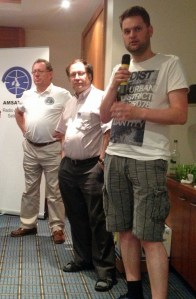
NASA EDGE: CubeSat Workshop Video

Student at the CubeSat Workshop - Image credit NASA

Student at the CubeSat Workshop – Image credit NASA

CubeSat pioneer Bob Twiggs KE6QMD is interviewed in this NASA EDGE video.

NASA EDGE and special guest host Tiffany Nail explore the latest developments in nanosat technology at the 10th Annual CubeSat Development Workshop. MagnetoStar-1, however, still won’t fly.

Watch NASA EDGE: CubeSat Workshop

10th Annual CubeSat Workshop – Cal Poly 2013 – Slides
http://www.cubesat.org/index.php/workshops/upcoming-workshops/128-2013summerworkshoppresentations

Videos of the presentations
http://mediasite01.ceng.calpoly.edu/Mediasite/Catalog/pages/catalog.aspx?catalogId=36b100d1-069a-4bac-b7e3-8a9512655e78

AMSAT Wants Amateur Radio Satellites Off US Munitions List

ITARThe ARRL report that AMSAT has asked the federal government to confirm that the Amateur Satellite Service will not be subject to International Traffic in Arms Regulations (ITAR), as a result of export control reforms now underway.

The ARRL news story says:

In May the US Department of State Directorate of Defense Trade Controls (DDTC) proposed changes to the US Munitions List (USML) Category XV (Spacecraft Systems and Related Articles). The changes redefine satellites that would remain under the USML. Satellites removed from USML would be transferred to the Department of Commerce Commerce Control List (CCL).

“We ask that the Directorate of Defense Trade Controls explicitly confirm that satellites, ground equipment, and associated technical data for items pertaining to the Amateur Satellite Service are not subject to the ITAR when the new Category XV provisions are implemented,” AMSAT said in comments filed earlier this month “Over the past 43+ years AMSAT has been integral to the development of Amateur Radio communications spacecraft based upon the model of an all-volunteer organization that follows ‘open source’ practices and creates spacecraft that are very low cost, which also reflects relatively low levels of sophistication compared to commercial satellites,” AMSAT said.

A related set of AMSAT comments went to the Department of Commerce Bureau of Industry and Security (BIS), which has proposed creating a separate CCL category for satellites formerly under ITAR. AMSAT asked that Amateur Satellite Service spacecraft and associated equipment be separately categorized and controlled, given the significant differences between commercial and Amateur Satellite Service spacecraft.

“We ask that the Department of Commerce recognize the relative impacts of regulatory oversight on small, not-for-profit scientific and education organizations such as AMSAT and to find ways to mitigate these impacts on both AMSAT and our volunteers,” AMSAT said. AMSAT suggested creating a separate category for Amateur Satellite Service; allow a license exception for “deemed exports” for Amateur Radio satellite design and construction, to permit a “free exchange of ideas, software, etc pertaining to Amateur Radio satellite design and construction when interacting with foreign nationals who are citizens of nations listed in the License Exception Strategic Trade Authorization Country List, and focus export licensing requirements only on the export of hardware.

AMSAT President Barry Baines, WD4ASW, and AMSAT Congressional Liaison Peter Portanova, WB2OQQ, took on the task of drafting comments in response to a combined 105 pages of bureaucratese drafted by the DDTC and the BIS. Former AMSAT President Bill Tynan, W3XO crafted initial comments as a starting point.

Source ARRL http://www.arrl.org/news/amsat-wants-amateur-satellites-off-us-munitions-list

April 2012 – ITAR and Amateur Radio – Progress Report
https://amsat-uk.org/2012/04/29/itar-and-amateur-radio-progress-report/

RIT AMSAT Fox-2 Maximum Power Point Tracker Time-Lapse and Final Presentation

AMSAT FOXA time-lapse video of the first of two Maximum Power Point Tracker channels being populated by the Rochester Institute of Technology senior design ground P13271.

The prototype maximum power point tracker used to optimize the power output of the solar panels on the amateur radio Fox-2 satellite was developed in this senior design project.

This time-lapse only shows one side being brought up for the first time, including initial testing and represents 13,739 images taken every 5 seconds by a GoPro HD Hero resulting in a 2.5 minute video showing 19 hours of work by P13271 team-members.

Watch the Time-Lapse video

Rochester Institute of Technology Multidisciplinary Senior Design program team P13271 consisting of electrical engineering students Bryce Salmi (KB1LQC), Brenton Salmi (KB1LQD), Ian MacKenzie (KB3OCF), and Dan Corriero conduct the final project review at the conclusion of Spring Quarter 2013. P13271 designed and built a 7 Watt Maximum Power Point Tracker prototype intended for use on the Radio Amateur Satellite Corporation (AMSAT) Fox-2 satellite, a 3U CubeSat.

Watch P13271 AMSAT Fox-2 MPPT RIT Senior Design Final Presentation

Fox-2 MPPT Team Selected In TI Design Contest
https://amsat-uk.org/2013/06/16/fox-2-mppt-team-selected-in-ti-design-contest/

Interns build a CubeSat

NASA Interns CubeSat

This video, released by NASA, shows a  group of interns who built a CubeSat.

Interns building a CubeSatInterns:
Anthony Yee, Christopher Erb, Jeffrey Sherwood, Tanzim Imam, Clayton Jacobs, Tiara Johnson, Liz Sauerbrunn, Alex Petrov, Marvin Cosare, Matthew Davis, Megan Robbett

Co-mentors:
Pat Kilroy, Joe Howard, Gary Crum, David Kim, Anisa Jamil, Eric Young, Pete Rossoni, Peter Ancosta, Victor Sank, Mark Steiner, Frank Kirchman, Jeff Didion, Franklin L. Robinson, Kenneth E. Li, Porfy Beltran, Dan Solomon, Leigh Janes, Gerardo Cruz-Ortiz

Watch NASA | Interns Build CubeSat

Interns Group Picture

UK STRaND-1 Amateur Radio Smartphone CubeSat is Back !

Dr Susan Jason working on STRaND-1 - Image credit Surrey Space Centre

Dr Susan Jason working on STRaND-1 – Image credit Surrey Space Centre

On July 23, 2013 at 1634 UT Mike Rupprecht DK3WN received signals from the UK STRaND-1 satellite after a near four month absence.

Built by volunteers from the Surrey Space Centre (SSC) and SSTL in Guildford STRaND-1 was launched on February 25, 2013 and was the World’s first Smartphone CubeSat to be put into orbit.

Dr Chris Bridges M6OBC and STRaND-1

Dr Chris Bridges M6OBC and STRaND-1

STRaND-1 unexpectedly stopped transmitting on March 30, 2013 and radio amateurs around the world have been listening for it ever since on a frequency of 437.568 MHz (+/- 10 kHz Doppler).

Radio amateurs are requested to email reports of reception of telemetry data from STRaND-1 to: strand.messages<at>gmail.com

See the report from Mike Rupprecht DK3WN at http://www.dk3wn.info/p/?p=35582

STRaND-1 information https://amsat-uk.org/satellites/strand-1/

How to decode the telemetry https://amsat-uk.org/satellites/strand-1/strand-1-telemetry/

Online real-time tracking of STRaND-1 http://www.n2yo.com/?s=39090&df=1

Watch the presentation on STRaND-1 given by Chris Bridges M6OBC to the AMSAT-UK International Space Colloquium on July 21, 2013 at http://www.batc.tv/streams/amsat1315. Download the video by right-clicking on http://www.batc.tv/vod/strand.flv

AMSAT-UK publishes a quarterly colour A4 newsletter, OSCAR News, that is full of Amateur Satellite information. A sample issue of OSCAR News can be downloaded here.
Join AMSAT-UK online at http://tinyurl.com/JoinAMSAT-UK/

QB50: Amateur Radio transponder payloads to launch 2014

Graham Shirville G3VZV, Gerard Auvray F6FAO and Wouter Weggelaar PA3WEG

Graham Shirville G3VZV, Gerard Auvray F6FAO and Wouter Weggelaar PA3WEG

It was announced during the QB50 presentation at the AMSAT-UK International Space Colloquium that two CubeSats, one carrying a linear transponder for SSB/CW, the other a FM voice transponder, should be launched into a 600 km orbit in the first half of 2014.

The QB50 project team has announced that on July 19, 2013 they signed a Memorandum of Understanding with AMSAT-UK, AMSAT-Francophone, and AMSAT-NL to enable two amateur radio payloads to fly on two 2-Unit CubeSats in the first half of 2014. These precursor CubeSats, which have still to be named, will be placed into a conventional 600 km 98o orbit in advance of the main mission. This allows for the testing of key satellite and payload components ahead of the full QB50 mission. In addition, the precursor mission allows for experimentation and validation of operational concept of the QB50 mission. Next to these objectives the amateur radio payloads will be operated as well. At the beginning of the mission, the various payloads onboard the spacecraft will be operated in an alternating fashion, whilst the amateur radio payloads will be operated as the primary payload of the spacecraft once all QB50 related experimentation has been concluded.

Typical QB50 CubeSatThe main mission of QB50 has the scientific objective to study in situ the temporal and spatial variations of a number of key constituents and parameters in the lower thermosphere (90-320 km) with a network of about 40 double and 10 triple CubeSats. These, university built, CubeSats will be launched into a 320km circular orbit, will be separated by a few hundred kilometres and carry identical science sensors. The sensors will monitor parameters that will greatly increase our knowledge and understanding of this little explored region of the E and F layers of the Ionosphere. QB50 will also study the re-entry process by measuring a number of key parameters during re-entry and by comparing predicted and actual CubeSat trajectories and orbital lifetimes.
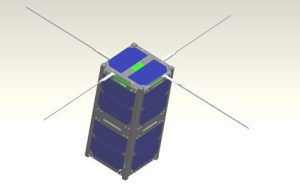
QB50The AMSAT-Francophone (AMSAT-F) payload for one of the satellites will be a U/V (435/145 MHz) FM transponder. It will also transmit FX25 telemetry at 9600 bps. This secondary payload will be also used in several satellites in the main constellation as their main receiver and transmitter.

The AMSAT-NL payload, on the other precursor satellite, will incorporate a linear U/V transponder core.

The QB50 spacecraft in the main, short duration, mission will, generally, have downlinks operating on frequencies in the 435-438 MHz Amateur Satellite Service allocation and some are expected to use 2.4 GHz. They will be notified to the ITU as a Belgian network after having been coordinated by the IARU Frequency Coordination Panel. Some of these will also, on occasions, act as FM voice relays during their missions.

Watch the video of the QB50 Presentation at the 2013 AMSAT-UK International Space Colloquium
http://www.batc.tv/streams/amsat1308
Direct video download http://www.batc.tv/vod/qb50.flv

More information about the QB50 project can be found at http://www.qb50.eu/

Webcast of International Space Colloquium this weekend
https://amsat-uk.org/2013/07/18/webcast-of-international-space-colloquium/