HumSAT Mission Concept
HumSAT-D is a 1U CubeSat mission developed by the University of Vigo. It is planning to use MSK telemetry and a CW beacon on UHF. The main mission is educational: to provide a hands-on experience to the students in the complete process of developing a space mission.
The other goal is to demonstrate the validity of the concept of HumSAT. A new subsystem to collect data from sensors located on the ground, store on-board and transmit it to ground stations will be developed and validated in orbit.
Universities and amateurs are invited to develop their own sensors compatible with HumSAT.
HumSAT-D is planning a launch from Russia into a Sun Synchronous Orbit (SSO) at 700km.
HumSAT System
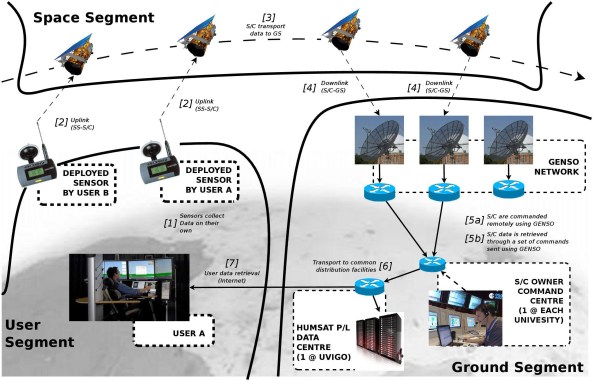
The main purpose of the HumSAT system is the development of a satellite-based system for connecting a set of users with a network of worldwide distributed sensors which they have previously deployed.
Sensors will be responsible for acquiring user data and for transmitting it to the satellites through an standard radio interface (SSI interface, definition of this interface is published here). Users will be able to define their own sensors, for monitoring different types of parameters; for example, water temperature or wind speed.
For retrieving data from the satellites, the GENSO network of ground stations will be one of the core components of the data distribution system. Several universities from different ESA member states, Japan and USA are coperating in this project, whose second release (R2) is expected to provide the functionalities that the HumSAT system will require. For more information about the GENSO project, please visit the www.genso.org website.
Once data has been transported by HumSAT satellites, authorized users will be able to access it through an Internet connection. Several security restrictions shall be applied for guaranteeing a correct access to the data gathered.
HumSAT http://www.humsat.org/
HumSAT: example for international cooperation in small satellite missions
http://www.oosa.unvienna.org/pdf/bst/ISU-SSP2011/Small-Sats-_v1-Graz-26-07-2011-ISU.pdf
IARU Amateur Satellite Frequency Coordination pages hosted by AMSAT-UK http://www.amsat.org.uk/iaru/


 Newsletter 26 March 2012
 A trio of CubeSats that will study the effects of space weather on the Earth’s radiation belts and magnetic field are being prepared for launch. TRIO-CINEMA is a collaboration between UC Berkeley, Kyung Hee University and Imperial College London. The first CINEMA CubeSat passed acceptance testing in January 2012 and will launch in mid-2012.
 AMSAT-UK
You must be logged in to post a comment.