FUNcube-1 / AO-73 Glitch and Commanded Reboot

AO-73 (FUNcube-1) - Image credit Wouter Weggelaar PA3WEG

AO-73 (FUNcube-1) – Image credit Wouter Weggelaar PA3WEG

On Sunday, June 21, there was an anomaly on FUNcube-1 that required the reboot of the satellite’s MCU (Microcontroller).

After a bus freeze, the databus watchdog did kick in as expected and rebooted the satellite. However, we did need to command the satellite back on to automatic mode.

When we did so on the 20:00 UTC pass, it came back up in the correct mode.

We envisage to switch back to autonomous mode either tonight or tomorrow morning local time.

FUNcube is still happy and healthy. This is the 4th reboot since launch, of which one was intentional. Thanks for your reports and concerns.

On behalf of the whole team best 73s,

Wouter Weggelaar PA3WEG
FUNcube team

FUNcube-1 (AO-73) Telemetry:
• Dashboard App http://funcube.org.uk/working-documents/funcube-telemetry-dashboard/
• Data Warehouse Archive http://warehouse.funcube.org.uk/
• Whole orbit data http://warehouse.funcube.org.uk/wod.html?satelliteId=2

KLETSkous Project Update

KLETSkous LogoThe South African Radio League (SARL) report at the pre-conference Engineering meeting held on Friday [June 19] members of the SA AMSAT CubeSat team made some tough decisions.

During the past few years, various options and subsystems have been experimented with.

The team has now set the launch date of KLETSkous at July 2017 with the first flight model to be ready by February 2016 for testing after which final integration will start. This requires that various module designs are locked down and built by October 2015.

It is planned to have all the modules wired together in a breadboard configuration for testing the interoperation of the various sub-units by December 2015. Some modules are at a more advanced stage than others, but in the next few months, the team expect to catch up and meet the deadline for the first breadboard test.

Frik Wolff, ZS6FZ, the League’s technical manager, has joined the team and is working on solar panels and stabilisation issues. Francois Oberholzer, an honours student at Stellenbosch University, is working on improving the weight/strength relationship of the space frame, a project that is part of his thesis. Nico van Rensburg, ZS6QL, as programme manager and the person responsible for documentation, will support the project manager, Hannes Coetzee, ZS6BZP.

There are many opportunities for radio amateurs to join the engineering team. If you have a particular expertise or passion to add value to the  KLETSKOUS project, please discuss your participation with Hannes Coetzee or any of the team members and send your details to saamsat@intekom.co.za

Source SARL http://www.sarl.org.za/

KLETSkous http://www.amsatsa.org.za/KLETSkous.htm

SA AMSAT Space Symposium June 20, 2015
http://www.amsatsa.org.za/SA%20AMSAT%20SPACE%20SYMPOSIUM%202015%20programme.pdf

QB50p2 FM Transponder Tested

QB50p1 and QB50p2 - Image Credit ISIS

QB50p1 and QB50p2 – Image Credit ISIS

AMSAT-Francophone report that the FM transponder on QB50p2 (EO-80) has been tested. A Google English translation of the post on their website reads:

On June 19, 2014, two 2U CubeSats QB50p1 and QB50p2 were launched as part of the QB50 precursor program into a polar orbit at an altitude of 680 km.

The satellite QB50p2 (object 40032) is equipped with a secondary FM transponder payload developed by AMSAT-F.

On Tuesday, June 16, 2015 almost 1 year after launch the AMSAT-F FM transponder on QB50p2 was activated by the main control station in The Netherlands for the duration of an orbit. At the Polytechnique in Palaiseau, we were able to receive telemetry in CW and put into action the FM transponder with an output of 1.5W.

A very strong signal was received at Palaiseau and by F6HCC in Brittany. The transponder was turned off at the end of the orbit.

In a few weeks, the transponder should be activated permanently. The signal is very strong, we will probably use a lower power level of 500 mW or 1 watt. We will inform you later.

QB50p1 (EO-79 / FUNcube-3) is equipped with a linear transponder for SSB and CW. The first tests were successfully completed in April and its transponder should also be enabled full-time in a few weeks.

Gérard – F6FAO

QB50 Amateur Radio Information https://www.qb50.eu/index.php/precursor-amateur-radio-operator

AMSAT-Francophone http://tinyurl.com/AMSAT-Francophone

The IARU Satellite Frequency Coordination Panel Status pages list these frequencies for the two satellites:

QB50p1 (FUNcube-3) has a VHF 9600 bps BPSK telemetry downlink plus a linear U/V transponder for SSB/CW communications similar to that already flying on FUNcube-1 with an output of 400 mW.
• 145.815 MHz 9600 bps BPSK telemetry beacon
• Inverting SSB/CW linear transponder 400 mW PEP
– 435.035 – 435.065 MHz Uplink LSB
– 145.965 – 145.935 MHz Downlink USB

QB50p2 has  a VHF 9600 bps BPSK telemetry downlink plus a separate RF payload from AMSAT-Francophone which will comprise of a FM voice transponder with UHF uplink and VHF downlink. It can also transmit FX25 telemetry at 9600 bps.
• 145.880 MHz 9600 bps BPSK telemetry beacon
• 145.840 MHz 9600 bps FSK FX25

To use the FM voice transponder Paul Stoetzer N8HM suggests programming these frequencies into your rig’s memories:

EO-80 AOS - TX 435.070 MHz 210.7 Hz CTCSS, RX 145.840 MHz
EO-80 2   - TX 435.075 MHz 210.7 Hz CTCSS, RX 145.840 MHz
EO-80 TCA - TX 435.080 MHz 210.7 Hz CTCSS, RX 145.840 MHz
EO-80 4   - TX 435.085 MHz 210.7 Hz CTCSS, RX 145.840 MHz
EO-80 LOS - TX 435.090 MHz 210.7 Hz CTCSS, RX 145.840 MHz

AOS = Aquisition Of Signal. TCA = Time of Closest Approach. LOS = Loss Of Signal

OSCAR Numbers for QB50p1 and QB50p2 CubeSats
https://amsat-uk.org/2014/07/02/oscar-numbers-for-qb50p1-and-qb50p2-cubesats/

Help needed to receive NanosatC-BR1

NanosatC-BR1 Engineering Model – Image CRS/CCR/INPE-MCT, UFSM

NanosatC-BR1 Engineering Model – Image CRS/CCR/INPE-MCT, UFSM

The first Brazilian CubeSat, NanosatC-BR1, is experiencing battery issues for the last several months and it now seldom emits a beacon in CW on 145.865 MHz.

For some time, Paulo PV8DX, was able to detect a beacon signal when the satellite was over the Caribbean sea during daylight. But now, no more signals have been detected.

We would like to request assistance from hams in the northern hemisphere to see if NanosatC-BR1 is still transmitting any signals.

Any help will be much appreciated.

73, Edson PY2SDR
Email: ewpereira<at>gmail.com

NanosatC-Br 1 https://amsat-uk.org/2014/02/23/brazilian-cubesat-nanosatc-br-1/

FUNcube at Goonhilly

AO-73 (FUNcube-1) - Image credit Wouter Weggelaar PA3WEG

AO-73 (FUNcube-1) – Image credit Wouter Weggelaar PA3WEG

On Thursday, June 11, BBC TV News featured radio amateur Dr Chris Bridges 2E0OBC who was explaining about the FUNcube-1 CubeSat and FUNcube Dongle SDR at the Goonhilly Space Operations training event.

Twenty-four delegates from across Europe and the United States are at Goonhilly Earth Station in Cornwall to learn about satellite communications, and how to control orbiting spacecraft.

The four-day course, which runs until Friday, June 12, is aimed at giving science graduates with an interest in working in the space industry a first-hand idea of operating satellites. Staff said they believed it was the only course of its type in Europe teaching how to operate such equipment.

Chris 2E0OBC appears at 0:33 into the BBC TV report. Watch the video at
http://www.bbc.co.uk/news/science-environment-33090284

Space missions course at Goonhilly takes off http://www.bbc.co.uk/news/uk-england-cornwall-33087598

Goonhilly Space Mission Operations 2015 event http://spaceops.uk/

AMSAT-UK
Web https://amsat-uk.org/
Twitter https://twitter.com/AmsatUK
Facebook https://facebook.com/AmsatUK
Flickr https://flickr.com/groups/AmsatUK
YouTube https://youtube.com/AmsatUK
FUNcube http://FUNcube.org.uk/
Yahoo Group http://groups.yahoo.com/group/FUNcube
Join us at https://amsat-uk.org/new-members/join-now/

Picture confirms Solar Sail deployment

LightSail Solar Sail Deployed

LightSail Solar Sail Deployed

An image taken by the LightSail CubeSat and downloaded on 437.435 MHz 9600 bps AX.25 packet radio has confirmed the deployment of its Solar Sail.

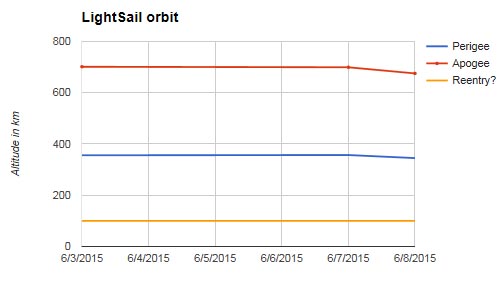
LightSail Altitude

LightSail Altitude

Bill Nye “The Science Guy” @BillNye tweeted – This just in: a complete image of ‪#‎LightSail‬ in space! The future of space travel…

The sail started deploying at 1947 UT on June 7, 2015. It is expected that LightSail’s orbit will now decay rapidly resulting in the satellite burning up in the atmosphere in a matter of days.

If you wish to try catching a glimpse of LightSail as it soars across the sky there are viewing tips at
http://www.planetary.org/blogs/jason-davis/2015/20150607-lightsail-deployment-initiatied.html

See a graph of the declining altitude

For the latest information read Jason’s blog on the Planetary Society website or follow him on Twitter
http://www.planetary.org/blogs/jason-davis/
http://twitter.com/@jasonrdavis

LightSail http://sail.planetary.org/missioncontrol

Bill Nye Boosts Science Guys and Girls: ‘Kids Are Natural Scientists’ on NBCNews.com
http://www.nbcnews.com/science/science-news/bill-nye-boosts-future-science-guys-girls-kids-are-natural-n370706