CCSDS Outreach Initiative and Competition

CCSDS Outreach Initiative and Reference Implementation Development Competition

ESA is presenting a pilot programme on behalf of The Consultative Committee for Space Data Systems (CCSDS) and is pleased to announce a new outreach initiative aimed at strengthening engagement with the European amateur satellite and academic communities. This initiative supports the wider objective of promoting the adoption and practical application of CCSDS space communication standards.

CCSDS invites European amateur satellite operators, students, educators, and academic researchers to participate and to help advance open, interoperable space communication technologies.

ESA, in partnership with Goonhilly Earth Station, CCSDS, AMSAT-UK, and AMSAT-DL, are launching a competition to develop high-quality reference implementations of selected CCSDS protocols.
This competition is sponsored by the European Space Agency (ESA).

About the Competition

This programme invites participants to:

  • Develop open, standards-compliant reference implementations of CCSDS protocols
  • Contribute to a shared technical resource for amateur satellite operators, universities, and research groups
  • Gain recognition within both the CCSDS community and the broader space communications field

An in-person hackathon at Goonhilly Earth Station will be available to interested participants, providing a unique environment for collaboration, expert guidance, and accelerated development.

Goonhilly Earth Station is coordinating the competition and will not assert any ownership over Hackathon/Competition outputs.

Prize

Winners of the competition will receive an invitation to attend a CCSDS conference in the United States, where they will present their results to the international CCSDS community.

Protocols Featured in the Competition

These are the outlines of the two CCSDS protocols selected for this competition:

  • LunaNet Signal-In-Space Recommended Standard – Augmented Forward Signal (LSIS – AFS)
    • The LSIS–AFS standard defines how lunar orbiters or surface systems broadcast a unified navigation and timing signal to support future missions on and around the Moon. It provides a framework for creating an enhanced, interoperable “forward signal” that spacecraft, rovers, and astronauts can use for more accurate positioning, timing, and situational awareness.
  • The CCSDS 235.1 standard defines how space missions establish, manage, and conclude communication sessions between spacecraft and ground systems. It provides a common framework that ensures reliable coordination when exchanging data, sending commands, and transitioning between communication states.

Participants may choose either to develop a functional concept or prototype that demonstrates how the LSIS–AFS signal could be designed, transmitted, interpreted, or applied to support future lunar missions, or to create a practical, interoperable reference implementation of Space Communications Session Control aligned with the CCSDS 235.1 standard.

A Long-Term Vision: Toward a Cislunar Amateur Radio Payload

CCSDS is pleased to highlight a longer-term aspiration linked to this initiative. In close cooperation with its partners—particularly ESA, which is proposing a future cislunar amateur radio payload—CCSDS intends to support the preparation of the most successful protocol implementations for potential consideration for flight.

This offers an exceptional opportunity for community-developed CCSDS-compliant software to be demonstrated in a deep-space operational environment.

This prospective mission is subject to funding and programme approval.

Contact and Expressions of Interest

For enquiries or to express interest in participating, please contact:

📧 esa-competition@amsat-uk.org

Further Information

Additional details—including eligibility criteria, protocol specifications, submission requirements, evaluation processes, and timelines—will be released soon.

Word doc CCSDS – Outreach and Competition Anouncement
 

FUNcube Patch on ESA PFC 71


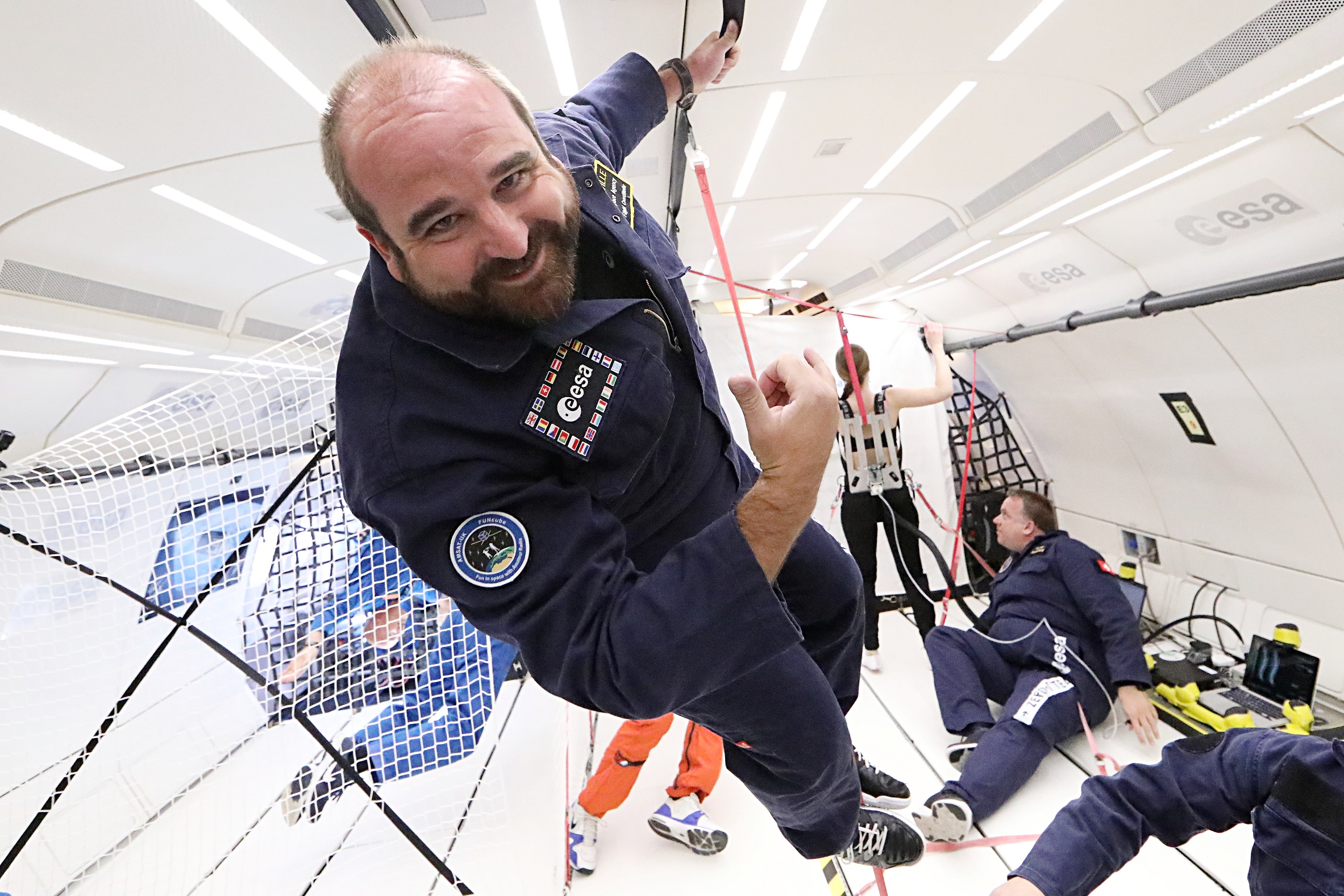
Neil Melville-Kenney PA9N wearing FUNcube Patch on ESA PFC 71 - Credit Novespace and ESA

Neil Melville-Kenney PA9N wearing FUNcube Patch on ESA PFC 71 – Credit Novespace and ESA

Neil Melville-Kenney, PA9N, has been a long time supporter of amateur radio space since the days of the SSETI Express mission. He is presently the ESA Parabolic Flight Coordinator and today took the opportunity to fly a FUNcube patch during the ESA PFC 71 microgravity mission.
https://www.esa.int/Our_Activities/Human_and_Robotic_Exploration/Research/Science_on_a_plane_ESA_s_next_parabolic_flight_campaign

FUNcube Mission Patch

Neil presented an account of his activities during the 2018 AMSAT-UK Colloquium and the three FUNcubes, AO73, EO88 and JO97 continue to provide a 24/7 service with their 2 metre downlinks.

You can follow Neil on Twitter at https://twitter.com/NMK_ZeroG

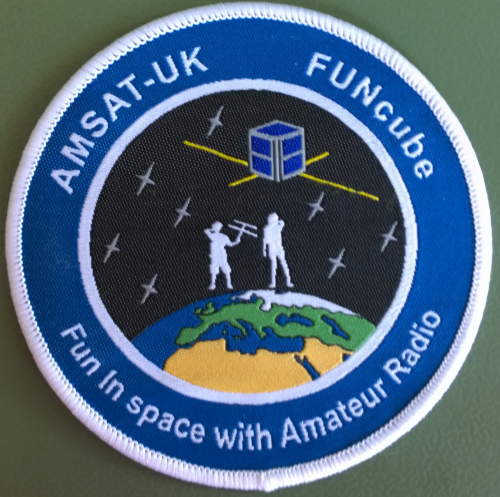
The FUNcube Mission Patch is available from the AMSAT-UK shop at
https://shop.amsat-uk.org/FUNCube_Mission_Patch/p3815740_15628523.aspx

ESA Announces Winning Radio Amateurs

12-year-old Matteo Micheletti from Belgium received a special mention from ESA for receiving the OUFTI-1 CubeSat

12-year-old Matteo Micheletti from Belgium received a special mention from ESA for receiving the OUFTI-1 CubeSat

On April 21, 2016, ESA’s Education Office set a challenge for the worldwide radio amateur community to start listening out for three new orbiting CubeSats. The results have now been released.

ESA’s Education Office published the transmission frequencies of the student-built satellites that were about to be launched as part of the Fly Your Satellite! Programme, and invited the radio amateur community to listen out for them.

The first three radio amateurs to send a recorded signal from AAUSAT4, e-st@r-II or OUFTI-1 would receive a prize from ESA’s Education Office. Hundreds of radio amateurs from around the world joined in the friendly competition.

The CubeSats started sending signals after their release from the Soyuz VS-14 rocket and the triggering of their automatic activation sequence. Participants from Russia, USA, Poland, France, Belgium, Netherlands, Brazil, Italy, Denmark, and more tuned their receivers and listened.

Thanks to skill and patience on the ground, the winners come from Russia, the United States of America, Germany, and the Netherlands.

Contact with the first CubeSat came at 00:53:51 UT on April 26, 2016, within an hour of its separation from the launcher. Dmitri Paschkow R4UAB, Russia, heard the signal from OUFTI-1 using two receiving stations, in Kemerovo and Ruzaevka. Upon hearing OUFTI-1, he communicated the news immediately. “I understand that the students are worried [to hear from their satellite] and decided to please them!” says Paschkow.

Just over an hour after the first signal from OUFTI-1 was recorded, the next CubeSat checked in.

AAUSAT-4 was heard over California, US, by Justin Foley KI6EPH of California Polytechnic State University. He had a personal interest in the mission because some of his colleagues had developed the P-POD deployer that was used to eject the CubeSats into orbit.

He was ready at the receiver from the moment of deployment but heard nothing on that first pass, probably because the activation sequence had not yet completed. The signal came through on the second pass, arriving at 02:02 UT.

“It was extremely exciting to see signals from the newly launched satellite, and witness the beginning of a space mission”, says Foley.

Then the wait began for e-st@r-II. At 05:40:58 UT, something dimly lit the screen of Mike Rupprecht DK3WN in Germany.  But something was not quite right. It certainly looked like a signal from the last remaining CubeSat, but why was the message so faint?  It galvanized the amateur radio community to look harder.

Jan van Gils PE0SAT had to wait until May 2 at 16:38:05 UT to receive a signal from e-st@r-II  that was strong enough to be decoded. Why e-st@r-II was only transmitting weak signals is under investigation, but the most important news is that all three CubeSats are functioning and transmitting, and their signals can be decoded.

A special mention goes to a young radio amateur who scored a personal best. Twelve year-old space enthusiast Matteo Micheletti from Belgium caught the OUFTI-1 signal with a portable log periodic antenna and a portable receiver. His triumph occurred on May 1, 2016 between 17:34 and 17:39 UT.

To mark their success, the radio amateur winners will each receive a Fly Your Satellite! Poster, a goodie bag and a scale 1:1 3D printed model of a CubeSat from ESA’s Education Office.

Read the full ESA story at http://www.esa.int/Education/CubeSats_-_Fly_Your_Satellite/CubeSats_competition_winners

Three new CubeSats now in orbit https://amsat-uk.org/2016/04/26/three-new-cubesats-now-in-orbit/

D-STAR satellite to launch from Kourou https://amsat-uk.org/2016/04/05/d-star-satellite-to-launch-from-kourou/

D-STAR satellite to launch from Kourou

The entire Fly Your Satellite 2016 delegation with CubeSats in P-Pod

The entire Fly Your Satellite 2016 delegation with CubeSats in P-POD

The ESA Education Office Fly Your Satellite! (FYS) programme is designed to train the next generation of aerospace professionals. Three chosen student teams have each developed 1U CubeSats carrying amateur radio payloads which are expected to launch at 2102 UT on Monday, April 25, 2016 on a Russian Soyuz-STA Fregat-M rocket from Kourou in South America into a 453 by 644 km 98.2 degree inclination orbit.

The satellites designed and built by the student teams, arrived in South America on Friday, March 25. Upon arrival, they were given a security escort from the airport to the Guiana Space Centre, near Kourou. The student teams arrived on March 28.

The satellites themselves are CubeSats. This class of small satellites have helped revolutionise access to space. Made of standard components, as the name suggests they come in modular dimensions of just 10x10x10cm in size.

On March 30 the students removed the so-called Remove Before Flight pins and successfully verified that the CubeSats were ready for launch. Afterwards, the lateral access ports of the P-POD were put back in place.  The next time the students will have contact with their respective CubeSats will be through the communication link after the satellites are deployed into orbit. The next activities consist in completing the application of a special thermal-optical tape on the outside of the P-POD, which will ensure the unpowered CubeSats are shielded from extreme thermal radiation during the launch phase. Finally, the planning for the next weeks will consist in integrating the P-POD with the rest of the launcher.

OUFTI-1 from the University of Liege, Belgium, will be the first satellite to carry a D-STAR Digital Voice transponder. The article ‘D-STAR digital amateur communications in space with OUFTI-1 CubeSat’ by Jonathan Pisane ON7JPD, Amandine Denis ON4EYA and Jacques Verly ON9CWD can be seen in the June 2013 Edition 202 of the AMSAT-UK publication OSCAR News.

e-st@r-II from the Polytechnic of Turin, Italy, will demonstrate an attitude control system using measurements of the Earth’s magnetic field; and AAUSAT4 from the University of Aalborg, Denmark, will operate an automated ocean vessel identification system.

ESA Press Release
http://www.esa.int/Education/CubeSats_-_Fly_Your_Satellite/Launch_campaign_started_CubeSats_arrived_at_Kourou_spaceport

Download OSCAR News OUFTI-1 D-STAR article

IARU coordinated frequencies http://www.amsat.org.uk/iaru/
OUFTI-1 – 145.950 MHz FSK AX25 and D-STAR (uplink 435.045 MHz) – CW beacon 145.980 MHz
e-st@r-II – 437.485 MHz CW and 1k2 AFSK
AAUSAT-4 – 437.425 MHz

OUFTI-1 Telemetry Decoder App https://amsat-uk.org/2016/04/20/oufti-1-telemetry-decoder-app/

Detailed information on the hunt for XO53

SSETI Express LogoFollowing on from the brief notes provided earlier, AMSAT-UK now have been given exclusive access to the full SSETI Express Phase E 400-800 THz Downlink Report. This report provides a clear insight into the work carried out during their recent campaign and to methods and equipment used.

It is worthy of note that ten years ago there was only one radio amateur in the launch team and that, since then, four of the other five team members have now obtained their licences.

Read the EXPRESS_E_ESA_2015-11-14_-_400-800_THz_Downlink_Report

As the report states, further observations will be much appreciated!

Radio ham helps ESA with tracking widget

ESA_03_logo_dark_blueThanks to radio amateur Chip Sufitchi N2YO the European Space Agency’s new satellite tracking widgets are live.

The tracking widgets are fed with the latest orbital tracks for ESA missions, or missions with significant ESA participation. The default track shows the ISS.

Track ESA missions http://blogs.esa.int/rocketscience/track-esa-missions/

ESA tracking widgets are powered by http://www.n2yo.com/