Monitoring AO-73 with Minimalist Equipment

In this video Clint Bradford K6LCS demonstrates that a simple antenna is all you need to get a signal the FUNcube-1 (AO-73) telemetry beacon.

Clint writes: AO-73 just passed to the West over Southern California. With just a tape measure beam and a Yaesu FT-60R, it was received. AO-73 is transmitting at about 30 mW on 145.935 MHz today in the sun, and was never closer than about 450 miles.

Watch Monitoring AO-73 – Minimalist Equipment

In the video Clint was also using an  iPod touch, running the satellite tracking App PocketSat3 from http://www.pocketsat.com/

The AO-73 beacon uses BPSK modulation. To demodulate and decode the telemetry data you need a SSB receiver (FT-817, RTL-SDR, FUNcube Dongle, etc)  and the free Dashboard software. Clint made the video at the weekend when the beacon was in low power mode running just 30 mW. During the daylight hours on Monday-Friday the beacon runs 300 mW output so would be an even stronger signal.

WB2HOL 2m tape measure beam http://theleggios.net/wb2hol/projects/rdf/tape_bm.htm

Tape measure beam kit http://www.west.net/~marvin/wb2hol.htm

More fun with satellites at … http://www.work-sat.com/
FUNcube items now in the AMSAT-UK shop

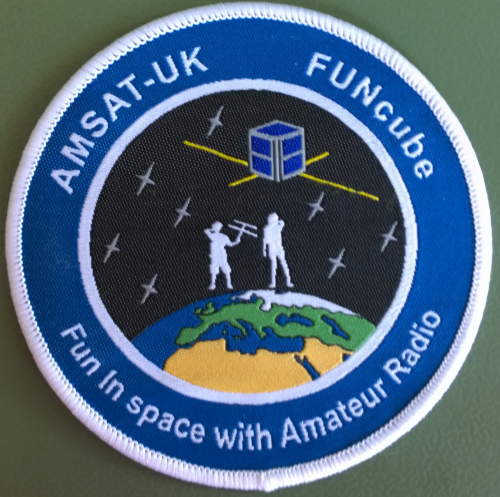
FUNcube Mission Patch

FUNcube Mission Patch

A range of FUNcube products are now available from the AMSAT-UK shop.

The FUNcube items available are:
• Badges
• Mission Patch
• Polo Shirt
• Telemetry Receive Antenna System

You can order them from the shop at
http://shop.amsat.org.uk/shop/category_fun/FUNcube.html

The STELAR Project 2014

STELAR Logo SmallThe education and science charity STELAR has been active in promoting radiocommunications in schools and colleges for over 20 years, as part of curriculum enrichment and personal and professional development for teachers.

Through its specialist courses, it has achieved much notable success in establishing radio clubs in schools and inspiring young people to seek careers in science, electronics and industry. It has played a major role in space and satellite communications in schools.

In 2013 it provided opportunities for satellite experiment by offering SDR receivers to schools allowing them to participate in the current series of FUNCUBE satellite experiments.

Now in 2014 STELAR is offering a new challenge to educators both professional and Amateur. The phenomenal success of the Raspberry Pi computer has opened up new opportunities and stimulated demand for educational projects linking communications systems, via computers.

This year STELAR is seeking to support the very best of those ideas by making available grants to educational groups, with projects designed to stimulate experiments with radio linked computing.

Typically these might take the form of:
• Radio systems linked to but not exclusively, a Raspberry Pi, computer.
• A detailed Teachers guide to the use and benefits of FUNCUBE or similar satellite systems in schools,
• The creation of radio-science projects to aid teachers personal and professional development.

Educational groups can apply for funding to develop a project of their choice, by submitting ideas for consideration by June 30, 2014. Groups should set out their aims and giving as much detail as possible. Successful entries will be notified during the Autumn term.

Interested ? then make contact by visiting the STELAR website http://www.stelar.info/

FUNcube-1 transponder to be active at weekends

FUNcube-1 (AO-73) - Image credit Wouter Weggelaar PA3WEG

FUNcube-1 (AO-73) – Image credit Wouter Weggelaar PA3WEG

Following the 48 hour test on April 5-6, the FUNcube-1 (AO-73) CubeSat team have concluded that the battery temperature does reduce slightly during full time transponder mode, but only by a degree C or so; it remains within specification. Hence it has been decided in future to switch the satellite into ‘forced eclipse mode’, i.e. full time transponder and low power beacon at weekends. The aim is to significantly increase the availability of the transponder to radio amateurs. This will continue until further notice.

The team plan to switch to full time transponder mode during the first suitable pass over the UK on Friday evenings, normally between 1930 and 2230 UT. If for some reason this is not possible, then the switch will be done on the first suitable pass on Saturday, normally between 0930 and 1200 UT. It is planned to switch the full time transponder mode off during a suitable pass on Sunday evenings, which normally occur between 1930 and 2230 UT. Again, if this is not possible the switch off will be made on Monday mornings, approx. 0930 to 1200 UT.

Do please note that this schedule is totally reliant on the availability of command stations, who will do their very best to ensure it is maintained. We will not normally announce successful full time transponder mode on/off commands, but if it proves not possible to make one of them, then we will make a note here and on the AMSAT Bulletin Board (AMSAT-BB).

So please do enjoy the transponder, and use it any time you hear it on. We are always pleased to hear of your activity, so either leave a comment below, or email g3wgm -at- amsat.org

Watch a recent FUNcube-1 contact made by Paulo PV8DX

Thanks for the report, Paulo!

There has been a small change to the data that’s presented on the FUNcube-1 Telemetry Upload Ranking page: http://warehouse.funcube.org.uk/ranking.html?satelliteId=2

The count column is now coloured to show the period in which the last data was received from the user:
Green – within the past 7 days
Yellow – within the past 14 days
Light-grey – longer than 14 days

If you would like it more granular, please start a discussion on the ‘forum’ at http://forum.funcube.org.uk/

Transponder Test: Jim Heck G3WGM talks to TX Factor

FUNcube-1 (AO-73) - Image credit Wouter Weggelaar PA3WEG

FUNcube-1 (AO-73) – Wouter Weggelaar PA3WEG

The FUNcube-1 (AO-73) satellite team plan to activate the transponder once again during the daytime over the weekend of April 5-6.

Project Manager Jim Heck G3WGM has given an exclusive audio interview to the TX Factor‘s Bob McCreadie G0FGX which explains what the tests are all about and the potential problems.

Will these tests lead to more time being made available to amateurs wanting to communicate via the satellite?

TX Factor htttp://www.txfactor.co.uk/

Spring Issue of OSCAR News

AMSAT-UK OSCAR News March 2014E-members of AMSAT-UK can now download the PDF of the Spring edition of the OSCAR News magazine here (as well as previous issues).

The paper edition should be posted to members in 2-3 weeks.

In this issue
• FUNcube-1 Status
Other FUNcubes
• Academy’s radio club enters the space race
• The Pragmatic Guide for Using the FUNcube Materials Science Experiment in the Classroom
KiwiSAT report
• ZAcube/TshepisoSat pictures South Africa on a clear day
• OFCOM announces new VHF Consultation
• Active Satellite Status
KickSat Ground Station
• HamTV on the ISS – Progress Report
Es’Hail-2 Geostationary transponder payload
• Amateur radio satellite operation from Isle of Lewis
• Colloquium 2014
• OSCAR-11 Report
• Shorts

AMSAT-UK FUNcube Mission Patch

AMSAT-UK FUNcube Mission Patch

Membership of AMSAT-UK is open to anyone who has an interest in amateur radio satellites or space activities, including the International Space Station (ISS).

E-members of AMSAT-UK are able to download OSCAR News as a convenient PDF that can be read on laptops, tablets or smartphones anytime, anyplace, anywhere. Join as an E-member at Electronic (PDF) E-membership

There are two rates for the paper edition to cover the extra postage costs:
UK
Rest of the World (Overseas)

PDF sample copy of “Oscar News” here.

Join AMSAT-UK using PayPal, Debit or Credit card at
http://shop.amsat.org.uk/shop/category_9/Join-Amsat-UK.html

E-members can download their copies of OSCAR News here.