RSGB LoRa Repeater Balloon Launch September 20

RSGB LoRa High-Altitude Balloon Repeater GB1HABThe launch of the RSGB High-altitude balloon carrying the LoRa Repeater GB1HAB will take place around 11am BST (10:00 GMT) on Saturday, September 20.

As part of the RSGB’s National Coding Week activities this year, the RSGB Outreach Team has been working closely with Hi-Impact to launch a hot air balloon equipped with a LoRa digipeater.

The LoRa Repeater uses Spreading Factor (SF) 12, and Coding Rate (CR) 5 with a bandwidth of 125 kHz. The frequencies are:
Uplink 439.850 MHz use no more than 200 mW EIRP
Downlink 433.850 MHz

Further information at https://rsgb.org/main/coding-and-amateur-radio/lora-balloon-project/

Watch the launch on YouTube from 10am BST (09:00 GMT) https://www.youtube.com/watch?v=iGIYx5oamkE

Real-time tracking of amateur high-altitude balloons https://amateur.sondehub.org/

Follow Mark Harper MW1MDH on X https://x.com/HiImpactMarkH

Follow Hi-Impact Tech on X https://x.com/hiimpacttech

Follow AMSAT-UK on X https://x.com/AmsatUK

AMSAT Argentina to launch transponder balloon

AMSAT-LU Launching a High Altitude BalloonOn May 26, at 1300 GMT AMSAT-LU plans (weather permitting) to launch a balloon carrying a linear multimode transponder V➤U, CW, SSB, FM, APRS LU7AA-11 and VIDEO.

It could last 9 hours if it reaches 82,000 feet height landing in Uruguay, or 6 hours landing at Gualeguaychú. The flight has been approved by ANAC/EANA.

Flight forecast: http://lu7aa.org/pronostico.asp?callsign=LU7AA-12

An attempt will also be made to launch LU8YY PicoBalloon emitting WSPR at 20m, if the winds help it could go around the world.

In Merlo, from May 24 to 26, presentations will be made to schools and universities. Depending on the weather it could be launched on May 25.

This experience will provide 4 FM channels + 3 CW + 3 SSB + 1 digital channel and 1 SSTV, all simultaneous. It will allow field testing on a balloon the future satellite platforms planned by AMSAT Argentina.

For latest updates check http://amsat.org.ar/?f=merlo

AMSAT-LU PicoBalloons travel the around the globe

AMSAT-LU Picoballoon Payload

AMSAT-LU Picoballoon Payload

The WSPR Picoballoon on 14.0956 USB released August 31 is about to complete its first circumnavigation of the globe after traveling 33,000 km in 12 days.

AMSAT-LU appreciate any WSPR stations that help to receive it, AMSAT-LU will recognize with a certificate to stations that capture its 25 mW beacon.

Trajectory at http://lu7aa.org.ar/wspr.asp
(slow access but with lot of information)

Info: http://amsat.org.ar?f=buoy

WSPR program at http://amsat.org.ar/wspr.exe

Also the APRS PicoBalloon (145.825 via Sat 1W) will be returning this Friday to S.America
http://aprs.fi?call=lu7aa-11

73, LU7AA, AMSAT Argentina

Talks by radio amateurs at UKHAS Conference London Sept 7

SSDV picture from a PIE balloon - Image credit Dave Akerman M0RPI

SSDV picture from a PIE balloon – Image credit Dave Akerman M0RPI

The 2019 UK High Altitude Society Conference is taking place in White City, London on Saturday, September 7. Ticket sales close August 31.

The conference takes place at The Invention Rooms, 68 Wood Lane, White City, London, W12 7TA, and attracts those interested in learning about building and flying High Altitude Balloons or in tracking their 434 MHz signals.

Some of the radio amateurs giving talks on high altitude balloon communications are:

• AutoRX by Mark Jessop VK5QI

• Citizen space exploration & inflatable spacecraft by Michael Johnson M0MJJ

• The Apollo Flight – model-making and tech behind the dashboard by Dave Akerman M0RPI

• Insurance & UKHAS Server Support by Steve Randall G8KHW

• Recovering, Reprogramming and Re-flying Radiosondes by Andrew Mulholland MI0BPB

• Hwoyee NSL-45 Experiences by Dave Akerman M0RPI and Steve Randall G8KHW

There will be helium and foil balloons available for the pico launch at the end of the conference.

UKHAS conference information is at https://ukhas.org.uk/general:ukhasconference2019

Tickets are at https://www.imperialcollegeunion.org/shop/club-society-project-products/space-society–products/27226/uk-high-altitude-society-conference-ticket

434 MHz balloon launch from Goonhilly

Goonhilly GHY-1 "Arthur"

Goonhilly GHY-1 “Arthur”

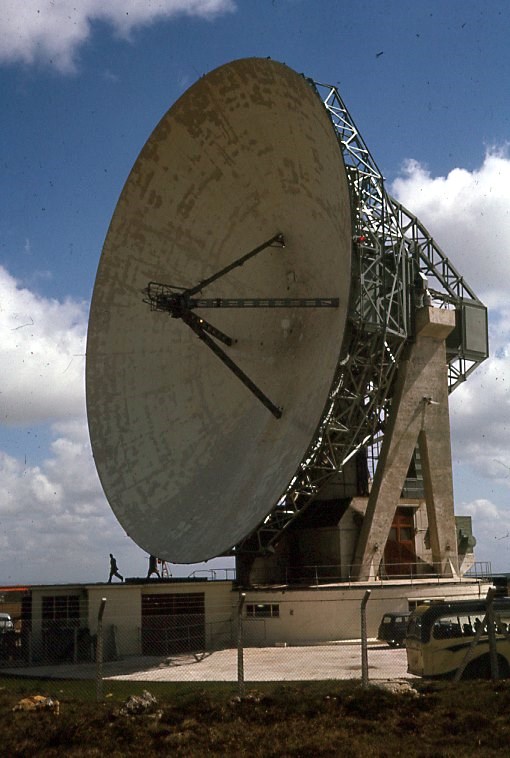
Phil M0DNY is planning to launch a high altitude balloon or two on Tuesday, July 10 from the Goonhilly Earth Station on the Lizard in Cornwall, nearby to the Marconi Wireless Testing Station.

Any help with tracking would be greatly appreciated!

We’re currently undecided between morning or late-afternoon. If we go for morning then we may also launch a second later near-identical balloon later in the day. 5m/s ascent, ~35km burst.

Two Trackers:

• Callsign: 1900 (year of construction of the Marconi Wireless Station)
– Calling Beacon: 433.650MHz.100 LoRa Mode 5
– Telemetry: 434.300 MHz LoRa 20.8K SF10 4/5 Explicit

• Callsign: 1901 (year of first over-the-horizon transmission received at the Wireless Station, from the Isle of Wight)
– 434.100 MHz USB RTTY 50bd 7n2 480Hz

I’ll post updates in #highaltitude on the day when I can.

For tuning in on the pi-in-the-sky LoRa gateway, the config you need is:

CallingTimeout=60
frequency_<x>=433.650
mode_<x>=5
AFC_<x>=y

Thanks, Phil M0DNY

The 434.100 MHz FSK RTTY balloon signal should be receivable across most of the British Isles using a radio capable of SSB reception in 434 MHz. Online tracking at https://tracker.habhub.org/

No radio? Use the SUWS online radio to receive signals from 434 MHz High Altitude Balloons when they are range of London (select USB mode) http://farnham-sdr.com/

Links to #highaltitude IRC chat, UKHAS mailing list, Online Radio and Tracking information at
https://amsat-uk.org/beginners/balloons/

UBSEDS25 balloon has Slow Scan Digital Video

UBSEDS18 Solar Powered Balloon

Bristol students plan to transmit 434 MHz Slow Scan Digital Video (SSDV) from the UBSEDS25 solar powered high altitude balloon planned to launch on Saturday, July 1.

On the UKHAS Google Group Richard Meadows M0SBU from University of Bristol Students for the Exploration and Development of Space (UBSEDS) writes:

We’re planning a launch from Bristol this Saturday, July 1 between 0500 and 0530 BST. This is weather permitting, but the forecast currently looks okay.

This flight is similar to the previous UBSEDS24, except with some bug fixes and adjustments. It’s using a 1.9m envelope and longer payload train, and so there’s a NOTAM in place. This tracker has a Raspberry Pi Zero V1.3 attached, which transmits images when solar power is available. It’s a different design to our launch last August; in this case the tracker will continue to operate even if the pi fails. For the curious the ‘pi status’ telemetry values are: 0 = off, 1 = on, 2 = PITS started, 3 = SSDV started).

There will hopefully be a cutdown mounted between the balloon and the tracker. We’ll be testing the 434MHz uplink whilst it’s still in range of Bristol; if it returns over the UK at a convenient time and place we will attempt to trigger the cutdown.

The tracker has a variety of transmissions:

• 434.635 MHz USB Telemetry:
– Contestia 16/1000 with pips and RSID, transmitting telemetry. Once per minute below 8km altitude and every two minutes otherwise.

• 434.637.5 MHz SSDV:
– Usually 300 baud RTTY, 850Hz shift, 8N2.
– GMSK within 100km of Bristol and Farnham as marked on the attached map:
– GMSK at 12 ksymbol/s. 4×4 interleaved, R=1/2 convolutional K=5, HDLC framing, whitened etc as per the AX5043 manual. Concatenated with RS(255,223) to mop up some burst errors.

If you are listening to the RTTY, remember to turn off the ‘RxID’ button on the top right of dl-fldigi.

Rather than the usual JPEG SSDV, this is transmitting Better Portable Graphics (BPG) images. This is experimental, and ssdv.habhub.org doesn’t support it just yet. Hence receivers should instead upload to
http://ssdv.bristol-seds.co.uk/

Please read the instructions on this site. You’ll need dl-fldigi release 3.2, as explained on the site. The dl-fldigi release can be found here:
https://github.com/jamescoxon/dl-fldigi/releases/tag/3.2

The flight is expected to head south-east towards France. Many thanks to everyone who attempts to track this.

Richard Meadows M0SBU
Bristol SEDS http://www.bristol-seds.co.uk/

Launch date/times are always subject to last-minute changes, check the UKHAS Google Group for updates.

Useful High Altitude Balloon links for tracking etc https://amsat-uk.org/beginners/balloons/