 The IARU Administrative Council meeting in Bali, Indonesia has stressed the importance of antenna systems for Amateur Radio and agreed in principle to new guidelines for amateur satellite coordination.
The Administrative Council (AC) of the International Amateur Radio Union (IARU) held its annual meeting on 9 & 10 October 2015 in Bali, Indonesia in association with the IARU Region 3 Conference. The AC is responsible for the policy and management of the IARU and consists of the three IARU international officers and two representatives from each of the three IARU regional organizations.
Here is a summary of the discussions and actions.
Recognizing that an antenna is an integral part of any radiocommunications system, the AC adopted a new Resolution which urges IARU Member Societies to use their efforts to encourage their national governments to recognise the importance of the Amateur Radio Service and an amateur radio antenna; to advocate for planning and development regulations that properly recognise the importance of an amateur radio antenna and do not place undue restrictions on erection of antennas; and to discourage fees for the use of an amateur antenna, particularly in view of the non-pecuniary nature of amateur radio and its popularity in the student and senior communities.
The AC completed preparations for the representation of amateur radio at the World Radiocommunication Conference to be held in Geneva during November 2015. The final composition of the IARU WRC-15 team was confirmed. The IARU positions and strategies for each of the WRC-15 agenda items that may impact amateur radio were reviewed, including proposals for a secondary amateur allocation near 5.3 MHz. Possible future agenda items for the next WRC, anticipated in 2019, include an amateur allocation at 50 MHz in Region 1 and global harmonization of the 1800 – 2000 kHz allocation. It is anticipated that a significant effort by IARU will be needed in preparation for WRC-19 to defend the amateur allocations between 137 and 960 MHz in light of the pressure for spectrum for small non-amateur satellites. Close coordination of regional efforts will be required.
The growing demand for coordination of satellites in the amateur bands led the AC to adopt revised Terms of Reference for the IARU Satellite Adviser and to agree in principle to new guidelines for satellite coordination. A Deputy Satellite Adviser has been appointed to assist with the work.
The AC agreed that a more proactive approach is needed to international standards bodies in order to achieve IARU objectives to reduce radio spectrum pollution from unwanted radio frequency emissions.
The President updated the AC on the actions of the Board of the ITU’s Smart Sustainable Development Module of which the IARU is a founding member. The Board recently released its final report which contains a number of references to the amateur services and the role they play in emergency communications. A copy of the report can be found at the ITU website: http://www.itu.int/
The IARU Member-Society Relations Project Team reported on its work to date. The AC determined that the next step is to draft possible revisions to the IARU Constitution and By-Laws to introduce some degree of flexibility in dealing with second societies. Any revision will require approval of the Member Societies.
A group consisting of a representative of each regional organization was established to work with a member of the International Secretariat (IS) staff to recommend how to create a more consistent image and clearer expression of the mission of the IARU.
The strategic plan for the development of support for amateur radio frequency allocations and the 2014 version of the IARU Spectrum Requirements working document were reviewed and updated. Further updating will be required after WRC-15.
The AC received the report of the International Beacon Project, which included some thoughts on how the beacon system might be combined with other means of assessing HF propagation in real time. The AC will consider the implications of the technological advances that have occurred in this field in recent years.
In a departure from recent practice, the AC decided to adopt a continuing theme for the annual World Amateur Day of “Celebrating Amateur Radio’s Contribution to Society.” If appropriate in future, a special theme may be adopted for any given year.
The budget for the years 2016-2018 as presented by the IS was reviewed and adopted. The budget is based upon anticipated financial contributions from the three regional organizations to defray a portion of the expenses, in accordance with previously adopted policy.
A plan to collect consistent data on amateur radio licensing from Member Societies was formulated and agreed.
The AC discussed the environmental impact and burden on the international QSL Bureau system of unsolicited and unwanted QSL cards and will revisit the issue at a future meeting.
Attending the meeting were IARU President Tim Ellam, VE6SH/G4HUA; Vice President Ole Garpestad, LA2RR; Secretary Rod Stafford, W6ROD; regional representatives Don Beattie, G3BJ, Faisal Al-Ajmi, 9K2RR, Reinaldo Leandro, YV5AM, José Arturo Molina, YS1MS, Gopal Madhavan, VU2GMN, Shizuo Endo, JE1MUI and recording secretary David Sumner, K1ZZ. Also present as observers were Jay Bellows, K0QB, from Region 2 and Wisnu Widjaja, YB0AZ and Ken Yamamoto, JA1CJP, from Region 3.
It was determined that a virtual meeting will be held early in 2016. The next scheduled in-person meeting of the AC will be held in the vicinity of Viña del Mar, Chile, in October 2016 in conjunction with the IARU Region 2 Conference.
Source IARU http://iaru.org/
IARU Region 3 Conference papers
http://iaru-r3.org/16th-triennial-conference-of-the-iaru-r3-documents/
IARU Region 3 to act on band plan satellite allocations
https://amsat-uk.org/2015/08/21/iaru-region-3-act-on-band-plan-satellite/
Amateur Radio and Antennas – Parity Act
http://www.southgatearc.org/news/2015/october/now_clarity_on_parity_the_video.htm
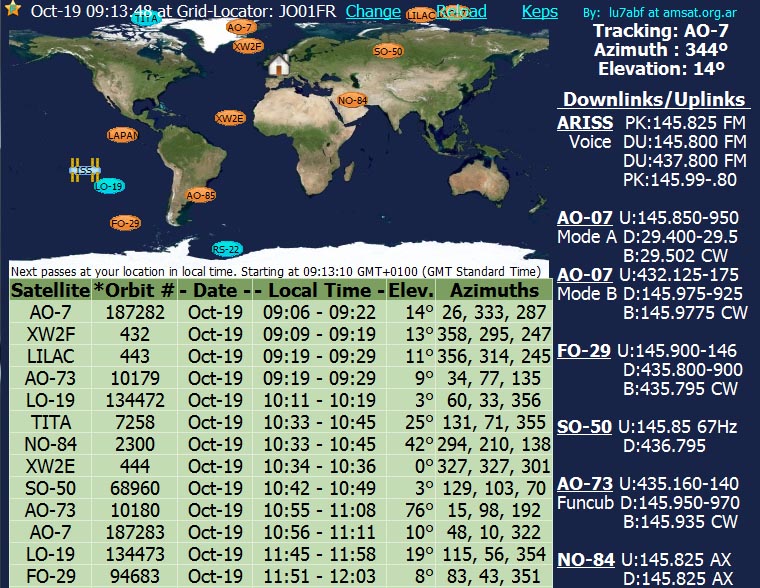 On the AMSAT Bulletin Board Pedro Converso LU7ABF has posted the following information about his online satellite orbital pass prediction app.



 AMSAT-UK
You must be logged in to post a comment.