FUNcube at Goonhilly

AO-73 (FUNcube-1) - Image credit Wouter Weggelaar PA3WEG

AO-73 (FUNcube-1) – Image credit Wouter Weggelaar PA3WEG

On Thursday, June 11, BBC TV News featured radio amateur Dr Chris Bridges 2E0OBC who was explaining about the FUNcube-1 CubeSat and FUNcube Dongle SDR at the Goonhilly Space Operations training event.

Twenty-four delegates from across Europe and the United States are at Goonhilly Earth Station in Cornwall to learn about satellite communications, and how to control orbiting spacecraft.

The four-day course, which runs until Friday, June 12, is aimed at giving science graduates with an interest in working in the space industry a first-hand idea of operating satellites. Staff said they believed it was the only course of its type in Europe teaching how to operate such equipment.

Chris 2E0OBC appears at 0:33 into the BBC TV report. Watch the video at
http://www.bbc.co.uk/news/science-environment-33090284

Space missions course at Goonhilly takes off http://www.bbc.co.uk/news/uk-england-cornwall-33087598

Goonhilly Space Mission Operations 2015 event http://spaceops.uk/

AMSAT-UK
Web https://amsat-uk.org/
Twitter https://twitter.com/AmsatUK
Facebook https://facebook.com/AmsatUK
Flickr https://flickr.com/groups/AmsatUK
YouTube https://youtube.com/AmsatUK
FUNcube http://FUNcube.org.uk/
Yahoo Group http://groups.yahoo.com/group/FUNcube
Join us at https://amsat-uk.org/new-members/join-now/

The Generation of VLF Emissions by Meteors

VLF Pulses and Meteor Echos on the same Screen - Credit Dr David Morgan 2W0CXV

VLF Pulses and Meteor Echos on the same screen – Credit Dr David Morgan 2W0CXV

Radio amateur Dr David Morgan 2W0CXV has published an article about the possibility of the generation of Very Low Frequency (VLF) emissions in the range 1 to 10 kHz by an ionised meteor trail. He used a FUNcube Dongle SDR as part of the equipment for his experiments.

This article reviews the interesting, but not widely known, possibility that an ionised meteor trail can generate Very Low Frequency (VLF) emissions in the range 1 to 10 kHz. The work of several academic authors is referenced to describe the phenomenon and explore the physical mechanism that may be involved.

In this article he discusses the possibility of amateur radio astronomers being able to detect meteor radar echoes and simultaneous Very Low Frequency (VLF) signals in an attempt to establish a causal connection.

Download the article from
http://www.britastro.org/radio/downloads/The_Generation_of_VLF_Emissions_by_Meteors.pdf

Join the BAA-RAG Yahoo Group at http://groups.yahoo.com/group/baa-rag

BAA Radio Astronomy Group http://www.britastro.org/radio/

Radio Astronomy and SDR Dongles https://amsat-uk.org/2015/02/12/radio-astronomy-and-sdr-dongles/

AMSAT-UK
Web https://amsat-uk.org/
Twitter https://twitter.com/AmsatUK
Facebook https://facebook.com/AmsatUK
Flickr https://flickr.com/groups/AmsatUK
YouTube https://youtube.com/AmsatUK
FUNcube http://FUNcube.org.uk/
Yahoo Group http://groups.yahoo.com/group/FUNcube
Join us at https://amsat-uk.org/new-members/join-now/

Picture confirms Solar Sail deployment

LightSail Solar Sail Deployed

LightSail Solar Sail Deployed

An image taken by the LightSail CubeSat and downloaded on 437.435 MHz 9600 bps AX.25 packet radio has confirmed the deployment of its Solar Sail.

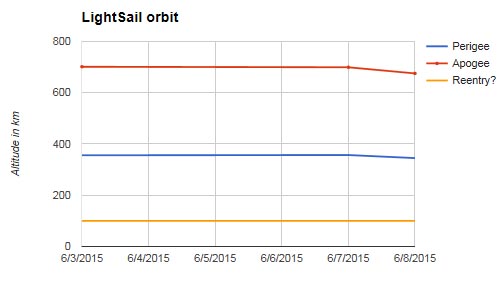
LightSail Altitude

LightSail Altitude

Bill Nye “The Science Guy” @BillNye tweeted – This just in: a complete image of ‪#‎LightSail‬ in space! The future of space travel…

The sail started deploying at 1947 UT on June 7, 2015. It is expected that LightSail’s orbit will now decay rapidly resulting in the satellite burning up in the atmosphere in a matter of days.

If you wish to try catching a glimpse of LightSail as it soars across the sky there are viewing tips at
http://www.planetary.org/blogs/jason-davis/2015/20150607-lightsail-deployment-initiatied.html

See a graph of the declining altitude

For the latest information read Jason’s blog on the Planetary Society website or follow him on Twitter
http://www.planetary.org/blogs/jason-davis/
http://twitter.com/@jasonrdavis

LightSail http://sail.planetary.org/missioncontrol

Bill Nye Boosts Science Guys and Girls: ‘Kids Are Natural Scientists’ on NBCNews.com
http://www.nbcnews.com/science/science-news/bill-nye-boosts-future-science-guys-girls-kids-are-natural-n370706

OSCAR Numbers Assigned for BRICsat (NO-83) and PSAT (NO-84)

PSAT PSK31 Transponder received by Peter Goodhall 2E0SQL May 26, 2015

PSAT PSK31 Transponder received by Peter Goodhall 2E0SQL May 26, 2015

The following message has been sent by the OSCAR Number Administrator Bill Tynan W3XO to Bob Bruninga WB4APR and the team at the US Naval Academy.

You have requested OSCAR numbers for BRICsat and PSAT built by you and your associates at the U.S. Naval Academy.

From everything I can determine, these satellites meet all of the requirements for OSCAR designations.

Therefore, by the authority vested in me by the AMSAT-NA President, I hereby confer the designation, Naval Academy OSCAR 83 on BRICsat and Naval Academy OSCAR 84 on PSAT These designations can, of course, for convenience, be shortened to NO-83 and NO-84.

I, and the entire amateur satellite community, hope for successful missions for both NO-83 and NO-84 and congratulate you and the rest of the Naval Academy team who designed, built and tested these two OSCAR spacecraft.

73,
William A. (Bill) Tynan, W3XO
OSCAR Number Administrator

NO-84 PSAT, a student satellite project named in honor of USNA alum Bradford Parkinson, of GPS fame, contains an APRS transponder for relaying remote telemetry, sensor, and user data from remote users and Amateur Radio environmental experiments or other data sources back to Amateur Radio experimenters via a global network of Internet-linked ground stations.

PSAT is another APRS satelliite that can digipeat user packets just like the original PCSAT (NO44) and the packet system on the ISS. PSAT also supports the same digipeating alias of ARISS so that users do not have to change any parameters when using any of these three APRS transponders.

See http://www.aprs.org/psat.html

NO-83 BRICsat-P (Ballistic Reinforced Communication Satellite) is a low cost 1.5U CubeSat built by the US Naval Academy Satellite Lab in  collaboration with George Washington University, that will demonstrate on-orbit operation of a Micro-Cathode Arc Thruster (µCAT) electric propulsion system and carries an Amateur communication payload.

see http://space.skyrocket.de/doc_sdat/bricsat-p.htm

Frequencies
PSAT: 145.825 – 1200 baud AX.25 telemetry – digi off
PSAT PSK31-5: 435.350 FM down, 28.120 SSB PK31 uplink – Brno University
Transponder

BRICsat: 437.975 – 9600 baud telemetry evry 20s
BRICsat PSK31-6 – same as PSAT but PSK TLM on 375 Hz (PSAT on 315 Hz)

How to work the PSK31 satellites https://amsat-uk.org/beginners/how-to-work-psk31-satellites/

OSCAR Numbers Policy http://www.amsat.org/?page_id=2478
IARU Amateur Radio Satellite Frequency Coordination http://www.iaru.org/satellite.html

[thanks to ANS and Bill Tynan, W3XO for the above information]

Fox-1C Update Video

AMSAT FOXAMSAT-NA Vice President-Engineering Jerry Buxton N0JY has released a video update on the AMSAT Fox-1C engineering model testing.

The Fox-1C CubeSat is planned to fly on the SHERPA deployer
https://amsat-uk.org/2014/07/18/fox-1c-cubesat-to-fly-on-sherpa/

The FundRazr for AMSAT Fox-1C is at https://fundrazr.com/campaigns/6pz92/sh/561Zd

Fox CubeSats http://www.amsat.org/?p=4143

Watch Fox1C EM

Tracking & Receiving the LightSail CubeSat

Artists impression of LightSail

Artists impression of LightSail

Jason Davis @jasonrdavis reports that LightSail, call sign KK6HIT, is operational again. Nine beacon packets on 437.435 MHz (AX.25, 9600 bps FSK) were received during 2:14 pm EDT pass on June 6, 2015.

Update: The sail started deploying at 1947 UT on June 7, 2015. A fully deployed sail would result in LightSail’s orbit decaying rapidly and burning up in the atmosphere potentially within a matter of days. Amateur radio operators around the world are encouraged to listen for LightSail and submit data. Details can be found at http://sail.planetary.org/missioncontrol

If you wish to try catching a glimpse of LightSail as it soars across the sky there are viewing tips at
http://www.planetary.org/blogs/jason-davis/2015/20150607-lightsail-deployment-initiatied.html

For the latest information read Jason’s blog on the Planetary Society website http://www.planetary.org/blogs/jason-davis/

Watch Tracking & Receiving the LightSail CubeSat using the free software Orbitron