Dnepr Launch Planned for October

Dnepr Launch November 21, 2013 - Credit ISC Kosmotras

Dnepr Launch November 21, 2013 – Credit ISC Kosmotras

According to an ITAR-TASS report the launch of a Russian-Ukrainian conversion rocket Dnepr (RS-20) with Japanese satellites, should take place in early October from the Orenburg region, southern Urals.

On Wednesday, August 13, when asked by ITAR-TASS whether the plans had not been affected by Japanese sanctions against Russia a source in the Russian Military Industrial Commission said “The launch is scheduled for the beginning of October. There have been no cancellations so far”.

The rocket will orbit five Japanese satellites, including four micro ones. “The satellites will be brought to Russia on August 20,” the source said, adding that this year’s third Dnepr launch was scheduled for December.

The Dnepr rocket conversion programme was initiated in the 1990s by the presidents of Russia and Ukraine to convert RS-20 Voyevoda ICBMs for civilian uses.

Dnepr rockets are launched from Baikonur, Kazakhstan, and the Yasny Launch Site of the Russian Strategic Rocket Forces in the Orenburg region under a joint project commenced by Russia, Ukraine and Kazakhstan.

The Dnepr rocket is a three-stage liquid-engine vehicle. Its takeoff mass is 210 tones. The first two stages are the regular stages of the RS-20 rocket and have not been changed. The third stage has been worked on to improve its flight control system.

The rocket is injected from an RS-20 silo by propellant gases. Its engine turns on after the whole vehicle has come out of the silo. The rocket is made by the Ukrainian company Yuzhmash in Dnepropetrovsk.

Source ITAR-TASS http://en.itar-tass.com/non-political/744861

The five satellites are understood to be:
• ASNARO 1
• ChubuSat 1
• Hodoyoshi 1
• QSAT-EOS
• Tsubame

23 cm band and WRC-2018

IARU_Region_1_logopaper to be discussed at the IARU Region 1 Conference in Varna-Albena, Bulgaria, September 21-27, 2014 highlights the threat to continued amateur radio usage of our 23 cm allocation which is now being used by the Galileo GPS system. The amateur 23 cm allocation includes a key Amateur Satellite Service uplink band at 1260-1270 MHz.

Michael Kastelic OE1MCU, Chair of the IARU R1 VHF/UHF/Microwave Committee has written the paper VA14_C5_36 which says:

After the last reports and slides received by the author, it seems that radio amateurs will lose the 23 cm band in the near future. That is the reason for this late proposal.

We can be optimistic, but more than a small piece of spectrum for near band communication will not survive. Also the enthusiastic testing with ATV on 70 cm is not a replacement for 23 cm, because this will cause disturbance to our amateur satellites and all cars will stay locked if the ISM band is used.

GNSS - Credit Microwave Journal

GNSS – Credit Microwave Journal

Proposal:
Radio amateurs need a new allocation (like 1300 -1310 MHz) for the agenda of the World Radio Conference 2018 (WRC2018) so that amateurs get back spectrum near the existing 23 cm band.

Further it is proposed to engage the EC after WRC-2015 to bring this theme to the
agenda for WRC-2018 with high priority

Read the paper at http://tinyurl.com/IARU-VA14-C5-36

Potential Interference To Galileo From 23 cm Band Operations
http://www.southgatearc.org/articles/galileo.htm

Up until now there have only been four Galileo test satellites in orbit which have been used to validate the system. The first two satellites of the operational Galileo GPS constellation were launched on August 22, 2014, they will be followed by further launches over the next 3 years. 

During the initial test phase two German ATV repeaters were shutdown due to interference to a user’s Galileo receiver, they were:
• DB0QI which was 18 km from the receiver
• DB0ITV which was 55 km from the receiver
It is thought both repeaters were running an ERP of just 15 watts, but the ERP figure has not been confirmed.

It appears that all 23 cm repeaters in Austria have been shutdown.

Alessio Sacchi IZ4EFN posted the following information regarding the situation in Italy on the AMSAT Bulletin Board:
Few weeks back I spoke with a member of the Italian CC, as our club was going to add a 1296 MHz port to a local repeater. He said Alenia Space has submitted strong warnings regarding possible interference with Galileo and he anticipated it could be hard to get a frequency assigned in that portion of the spectrum in the near future.

IARU R1 VHF/UHF/Microwaves discussion forum
http://www.thersgb.org/forums/index.php?forums/vhfmicrowave/

Other VHF/UHF/Microwave papers for the Conference can be downloaded from
http://www.iaru-r1.org/index.php?option=com_remository&Itemid=&func=fileinfo&id=522

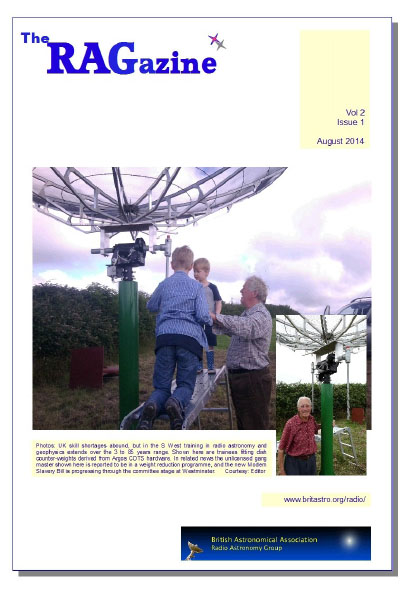
RAGazine now available for download

RAGazine August 2014 Front CoverVolume 2 issue 1 of the free BAA-RAG radio astronomy publication RAGazine is now available for download.

In this edition:
– VLF quarterly observing report
– Simple equipment for SID observations
– Intro. to radio objects that can be detected by the amateur radio astronomer
– The man who made maps of the moon (poetry)
– UKRAA update
– Long baseline interferometry with unmatched SDRs
– Diurnal variation of VLF signals
– Hydrogen Line Obs. Group (HLOG)
– SIDI, the Simple Digital Interferometer
– Receiving moon-bounce signals from the GRAVES radar

Download this and previous issues of RAGazine from
http://www.britastro.org/radio/downloads.html

Join the BAA-RAG Yahoo Group at http://groups.yahoo.com/group/baa-rag

Ham radio goes around the Moon

Full Moon 2010 - Credit Gregory H Revera

Full Moon 2010 – Credit Gregory H Revera

Towards the end of the year radio amateurs will have the opportunity to receive what must be the ultimate DX from a ham radio payload transmitting the data mode JT65B as it flies around the Moon.

Beijing plans to send a lunar orbiter around the Moon carrying a 14 kg battery powered payload known as 4M-LXS which was developed at LuxSpace. The amateur radio payload will transmit a JT65B signal on 145.990 MHz which can be decoded by radio amateurs using the free WJST software.

The orbiter is one of the test models for Beijing’s new lunar probe Chang’e-5, which will be tasked with landing on the moon, collecting samples and returning to Earth. The launch, planned for 4th quarter 2014, is aimed at testing the technologies that are vital for the success of Chang’e-5. The orbiter will be launched into Lunar Transfer Orbit (LTO) then will perform a flyby around the Moon and re-enter the Earth’s atmosphere after 9 days.

Delivery convoy - Image credit Xinhua

Delivery convoy – Image credit Xinhua

The orbiter arrived by air in Xichang, Sichuan on Sunday, August 10 and was then transported to the Xichang Satellite Launch Center.

Beijing to test recoverable moon orbiter
http://news.xinhuanet.com/english/china/2014-08/10/c_133546027.htm

IARU Satellite Frequency Coordination Pages http://amsat.org.uk/iaru

Free WSJT Software http://physics.princeton.edu/pulsar/K1JT/

Join AMSAT-UK

AMSAT-UK_Bevelled_Logo

AMSAT-UK Logo

Founded in 1975 AMSAT-UK is a voluntary organisation that supports the design and building of equipment for amateur radio satellites.

AMSAT-UK initially produced a short bulletin called OSCAR News to give members advice on amateur satellite communications. Since those early days OSCAR News has grown in size and the print quality has improved beyond recognition. Today, OSCAR News is produced as a high-quality quarterly colour A4 magazine consisting of up to 40 pages of news, information and comment about amateur radio space communications.

The new lower-cost E-membership provides OSCAR News as a downloadable PDF file giving members the freedom to read it on their Tablets or Smartphones anytime, anyplace, anywhere.

An additional advantage is that the PDF should be available for download up to 2 weeks before the paper copy is posted.

AMSAT-UK FUNcube Mission Patch Rev4 20100609

AMSAT-UK FUNcube Mission Patch

The Membership year lasts for 12 months starting on January 1 each year.

If you join after July 31 of any particular year, then you will receive complimentary membership for the whole of the following year, i.e. join on August 10, 2014, and you have nothing more to pay until Dec 31, 2015.

Take out an Electronic membership here http://shop.amsat.org.uk/shop/category_9/Join-Amsat-UK.html

E-members can download their copies of OSCAR News from http://www.amsatuk.me.uk/on

A sample issue of OSCAR News can be downloaded here.

D-STAR satellite repeater test 437.050 MHz

TabletSat-Aurora in Space - Credit Sputnix

TabletSat-Aurora in Space – Credit Sputnix

A test of the D-STAR Parrot Repeater on the TabletSat-Aurora satellite is expected to take place during Monday, August 11 on 437.050 MHz (+/- 10 kHz Doppler shift).

TabletSat-Aurora - Credit Sputnix

TabletSat-Aurora – Credit Sputnix

TabletSat-Aurora launched with 11 other satellites carrying amateur radio payloads from Dombarovsky near Yasny on Thursday, June 19, 2014.

The D-STAR GMSK Parrot (Store and Forward) Repeater can store up to 8 seconds of voice message and runs 0.8 watts to a whip antenna.

There are two other transceivers on the satellite, they transmit GMSK telemetry data on 435.550 MHz and 436.100 MHz. Their power can be varied by command from the ground station between 0.8 and 2.0 watts. TabletSat-Aurora is also a downlink on 8192 MHz.

Dmitry Pashkov R4UAB reports the test on his website at http://r4uab.ru/?p=7160

Description of TabletSat-Aurora in Google English http://tinyurl.com/TabletSat-Aurora-Description

Facebook https://www.facebook.com/SPUTNIX.ltd/

Dnepr Launch for D-STAR Satellite https://amsat-uk.org/2014/06/18/dnepr-launch-for-d-star-satellite/

Satellite Tracking https://amsat-uk.org/beginners/satellite-tracking/