Online WebSDR for VHF Satellites

144 MHz prototype helix antenna

144 MHz prototype helix antenna

You can use the free online SUWS Web Software Defined Radio (WebSDR) from your PC or Laptop to receive the International Space Station (ISS) and the many amateur radio satellites transmitting in the 145.800 – 146.000 MHz band.

Martin Ehrenfried G8JNJ has equipped the SUWS WebSDR with omni-direction helix antennas for both 144 and 432 MHz which have proved effective for both high altitude balloon and satellite reception.

The SUWS WebSDR is located at Farnham not far from London, listen to it at http://websdr.suws.org.uk/

Martin says this about the special satellite antennas “I had been experimenting with single turn ‘twisted halo’ design, and decided to try stacking them to see if I could achieve more gain. Modelling suggested that a stretched 3 turn helix with a helix circumference of approx 1/2 wave length and an overall length of 1/2 wave at 70cm, and fed with a gamma match at the centre would offer reasonable gain, an omni-directional pattern and mixed polarisation.”

Full details of the antennas are available at
http://g8jnj.webs.com/currentprojects.htm

WebSDR for 144, 432, 1296 and 10368 MHz
https://amsat-uk.org/2013/12/28/websdr-for-434-and-1296-mhz/

Reception of UKube-1 FUNcube-2 Beacon

FUNcube Dongle Pro+ Software Defined Radio

FUNcube Dongle Pro+ Software Defined Radio

Many stations, who have their FUNcube Dongle Software Defined Radio (SDR) setup to automatically receive telemetry signals from FUNcube-1, will have noticed that they are now also seeing the telemetry from the FUNcube-2 sub-system which is flying on-board the UKube-1 CubeSat.

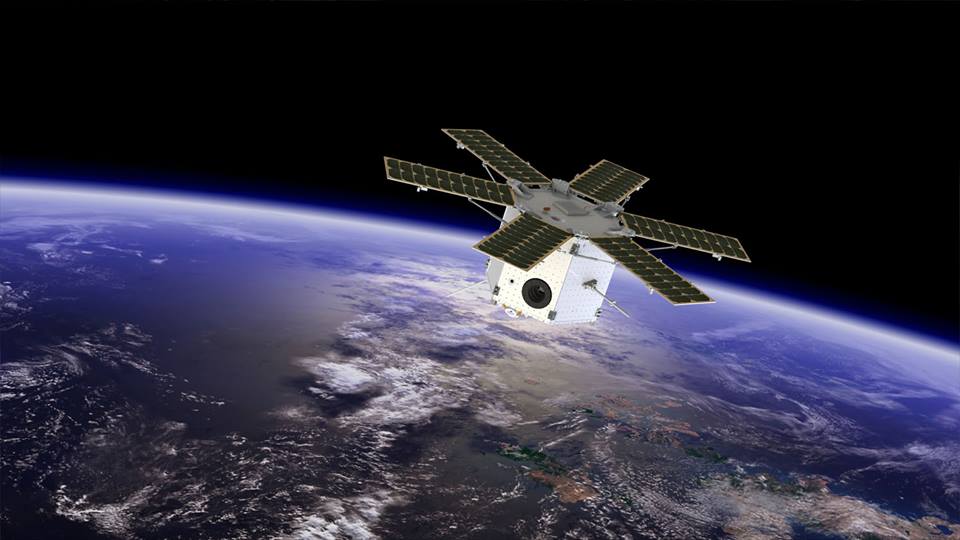
UKube-1 CubeSat (with FUNcube-2 sub-system) - Image credit Clyde Space

UKube-1 CubeSat (with FUNcube-2 sub-system) – Image credit Clyde Space

The FUNcube telemetry transmitter has been enabled on 145.915 MHz (+/- Doppler) as part of the commissioning program for UKube-1 which is presently underway.

Whilst the existing FUNcube-1 Dashboard does not correctly display the FUNcube-2 telemetry, it is forwarding the data correctly to the Warehouse and this is greatly appreciated by the team.

The FUNcube team are not yet able to release a FUNcube-2 specific Dashboard App, they are, however, working to provide a fully functional FUNcube-2 page on the Data Warehouse as soon as possible.

In the meantime please continue to listen and, where you are able, to keep the data flowing to the Data Warehouse – many thanks for your support.

Dashboard App – Telemetry Decoder http://funcube.org.uk/working-documents/funcube-telemetry-dashboard/

Data Warehouse – Telemetry Archive http://warehouse.funcube.org.uk/

FUNcube Dongle LF/MF/HF/VHF/UHF Software Defined Radio http://FUNcubeDongle.com/

UK Space Agency UKube-1 update August 26, 2014 https://www.gov.uk/government/news/ukube-1-update

Satellite Today, August 26, 2014: Communications Anomaly Hampers UK SmallSat
http://www.satellitetoday.com/technology/2014/08/26/communications-anomaly-hampers-uk-smallsat/

AMSAT to use FundRazr Crowdfunding

AMSAT FOXAMSAT have announced that they are using the FundRazr crowdfunding platform to raise donations for the Fox-1C CubeSat.

AMSAT is excited to announce a launch opportunity for the Fox-1C Cubesat. AMSAT has teamed with Spaceflight Inc. for integration and launch utilizing Spaceflight’s SHERPA system to a sun-synchronous orbit in the third quarter of 2015.

Fox-1C is the third of four Fox-1 series satellites under development, with Fox-1A and RadFXsat/Fox-1B launching through the NASA ELANA program. Fox-1C will carry an FM repeater system for amateur radio use by radio hams and listeners worldwide. Further details on the satellite and launch will be made available as soon as released.

AMSAT has an immediate need to raise funds to cover both the launch contract and additional materials for construction and testing for Fox-1C. Please help us to continue to keep amateur radio in space.

Fox-1C Fundraiser https://fundrazr.com/campaigns/6pz92/sh/561Zd

Amateur Radio Exams at UKHAS Conference Greenwich

Dan Bowen K2VOL

Dan Bowen K2VOL

Make sure you book for this years International UKHAS conference at the University of Greenwich in London on Saturday, August 16. There is an impressive line up of presentations by radio amateurs.

The UK High Altitude Society (UKHAS) conference attracts those interested in learning about building and flying High Altitude Balloons or in tracking their 434 MHz signals.

The conference is open to all, you don’t have to have flown a High Altitude Balloon, you’ll probably get more out of it as a total beginner as there will be a huge wealth of experience in the room you can speak to.

There is an impressive line-up of speakers in addition to which there will be workshops, demonstrations along with amateur radio exams.

Morning Sessions

09:30 Assembly – Coffee / Tea + Biscuits
10.10 Introduction – James Coxon M6JCX and Anthony Stirk M0UPU
10.20 Predictor – Daniel Richman M0ZDR/2E0DRX/M6DRX and Adam Greig M0RND/2E0SKK/M6AGG
10.50 Advanced superpressure balloon technology – Dan Bowen K2VOL
11.30 WebSDR – Philip Crump M0DNY
11.45 Break
12.00 $50SAT Low cost satellite- Stuart Robinson GW7HPW
12.45 Batc.tv Introduction – Noel Matthews G8GTZ
13.00 Lunch / Show and Tell

Afternoon Sessions

Combination of workshop/lectures.

Main Lecture
14.30 STM32+DSP – Adam Greig M0RND, Jon Sowman M0JSN, Matt Brezja M6VXO

Side Room
14:30 Pi In The Sky – Anthony Stirk M0UPU and Dave Akerman M0RPI

Main Lecture
15.30 UKHASNET – James Coxon M6JCX

Side Room
15.30 Amateur Radio Exams

Further information and tickets at http://ukhas.org.uk/general:ukhasconference2014

Amateur Radio Village at EMF 2014

EMF 2012 badge of attendee Graham Shirville G3VZV

EMF 2012 badge of attendee Graham Shirville G3VZV

There will be an amateur radio village and special event station GB2EMF at the Electromagnetic Field EMF 2014 event taking place August 29-31 at Bletchley near Milton Keynes.

EMF 2014 is a festival for anyone interested in radio, electronics, space, homebrewing, robots, UAVs, 3D printing, DIYBio, Internet culture or pretty much anything else you can think of. It is a volunteer effort by a non-profit group, inspired by European and US hacker camps like Chaos Communication Camp, HAR, and toorcamp.

Imagine a camping festival with a power grid and high-speed internet access; a temporary village of geeks, crafters, and technology enthusiasts that’s lit up by night, and buzzing with activity during the day. Over a thousand curious people will descend on the friendly open space to learn, share, and talk about what they love.

Over a long weekend, you can expect to see a huge variety of talks across three stages, a slew of workshops, as well as music, games, and installations dotted around the site.

Attendees are invited to set up their own villages — camps within the camp — where like-minded people can camp together and put on their own activities. The hard-working EMF team of volunteers will supply you with power and internet to your tent.

The special event station GB2EMF will be run from the Amateur Radio Village, it had been hoped to have a 70cm/2m crossband FM repeater operational during the event but it looks as though Ofcom licensing issues may preclude this.

At each EMF event the organisers try and give the attendees a great camp badge. Not just a ‘Hello my name is” sticker but a nice fun piece of technology that they can take away and use after the event.

EMF 2014 takes place August 29-31 near Newton Longville, just South of Bletchley, Milton Keynes, MK17 0BU. Talks include:
• High Altitude Ballooning by Adam Greig M0RND
• Amateur Radio – Practical Sign offs by Paul
• Amateur Radio: The Original Nerd Hobby! by Ryan Sayre 2E0RYS
• An Operator’s Guide to the Enigma Cipher Machine by Simon Singh
• Back to Basics Radio – build a self-powered solderless receiver by Iain Sharp
• InfraRed Communications by Michael Turner
• Surface Mount Soldering – SMD by hand isn’t hard, build your own Persistence of Vision kit to prove it! by Edinburgh Hacklab
Other talks https://www.emfcamp.org/talks/

Announcing TiLDA MKe, the incredible EMF 2014 camp badge
http://blog.emfcamp.org/post/94157161753/announcing-tilda-mke-the-incredible-emf-2014-camp

EMF 2014 https://www.emfcamp.org/
Twitter @emfcamp
Facebook https://www.facebook.com/emfcamp

Report on the EMF 2012 event https://amsat-uk.org/2012/09/01/emf-2012-milton-keynes/
NASA Announces Next Opportunity for CubeSat Space Missions

SpaceX Dragon grappled by ISS  Canadarm2 2012-10-10

Space X Dragon Spacecraft

NASA is opening the next round of its CubeSat Launch Initiative, part of the White House Maker Initiative, in an effort to engage the growing community of space enthusiasts that can contribute to NASA’s space exploration goals.

The CubeSat Launch Initiative gives students, teachers and faculty a chance to get hands-on flight hardware development experience in the process of designing, building and operating small research satellites. It also provides a low-cost pathway to space for research in the areas of science, exploration, technology development, education or operations consistent with NASA’s Strategic Plan.

Applicants must submit their proposals electronically by 4:30 p.m. EST, Nov. 25. NASA will select the payloads by Feb. 6, 2015, but selection does not guarantee a launch opportunity. Selected experiments are slated to be flown as auxiliary payloads on agency rocket launches or be deployed from the International Space Station beginning in 2015 and running through 2018. NASA does not provide funding for the development of the small satellites and this opportunity is open only to U.S. non-profit organizations and accredited educational organizations.

One goal of the CubeSat Launch Initiative is extend the successes of space exploration to all 50 states by launching a small satellite from at least one participant in each state in the next five years. To this end, NASA is particularly focused this round on gaining participation in the District of Columbia, Puerto Rico, and 21 states not previously selected for the CubeSat Launch Initiative. These states are: Arkansas, Delaware, Georgia, Idaho, Iowa, Kansas, Maine, Minnesota, Mississippi, Nebraska, Nevada, New Hampshire, New Jersey, North Carolina, Oklahoma, Oregon, South Carolina, South Dakota, Washington, West Virginia, and Wyoming.

CubeSats are in a class of research spacecraft called nanosatellites. The base CubeSat dimensions are about 4x4x4 inches (10x10x11 centimeters), which equals one “Cube,” or 1U. CubeSats supported by this launch effort include volumes of 1U, 2U, 3U, and 6U. CubeSats of 1U, 2U and 3U size typically have a mass of about three pounds (1.33 kilograms) per 1U Cube. A 6U CubeSat typically has a mass of about 26.5 pounds (12 kilograms). The CubeSat’s final mass depends on which deployment method is selected.

To date, NASA has selected 114 CubeSats from 29 states, 17 of which have already been launched. Nine more CubeSats are scheduled to go into space in the next 12 months

For additional information about NASA’s CubeSat Launch Initiative program, visit:

http://www.nasa.gov/cubesats

Joshua Buck
Headquarters, Washington
202-358-1100
jbuck@nasa.gov