WRC-2015 draft recommendations may impact 10 GHz

Logo WRC RA 2015The ARRL report the FCC has invited comments by February 18 on the latest batch of draft recommendations of its Advisory Committee for World Radiocommunication Conference 2015 (WRC-2015).

At its January 27 meeting, the Advisory Committee (WAC) approved draft recommendations on a number of issues that will be considered by WRC-2015. Some items, including one which could possibly lead to changes to 60 meters in the long term, could affect the Amateur and Amateur-Satellite services. ARRL Chief Technology Officer Brennan Price, N4QX, is a member of the WAC, which is chartered to allow non-federal government entities to “provide to the [FCC] advice, technical support, and recommended proposals for the 2015 World Radiocommunication Conference.”

WRC-2015 will consider a number of issues that could impact amateur allocations above 420 MHz, including a possible extension of the current worldwide allocation to the Earth Exploration-Satellite service in the band 9300 to 9900 MHz by up to 600 MHz “within the frequency bands 8700 to 9300 MHz and/or 9900 to 10500 MHz” Incumbent services in the 9900 to 10500 MHz range include the Radiolocation, Fixed, Mobile, Amateur, and Amateur-Satellite services.

The Amateur Service is secondary at 10000 to 10500 MHz worldwide, and the Amateur-Satellite Service is secondary at 10450 to 10500 MHz worldwide.

Comments should reference IB Docket 04-286 and specific recommendations by WAC document number. Interested parties may file comments via the FCC’s Electronic Comment Filing System (ECFS).

Read the full ARRL story at
http://www.arrl.org/news/fcc-opens-brief-window-for-comments-on-wrc-2015-draft-recommendations

Draft WRC-2015 recommendations
http://transition.fcc.gov/Daily_Releases/Daily_Business/2014/db0128/DA-14-88A2.pdf

IB Docket 04-286 http://apps.fcc.gov/ecfs/proceeding/view?name=04-286

FCC’s Electronic Comment Filing System (ECFS) http://apps.fcc.gov/ecfs/

FUNcube Data Warehouse: Fitter Messages

FUNcube-1 (AO-73) - Image credit Wouter Weggelaar PA3WEG

FUNcube-1 (AO-73) – Image credit Wouter Weggelaar PA3WEG

The FUNcube team have made a few changes to the way Fitter Messages are handled / displayed on the Data Warehouse:
– Only the last 7 days of fitter messages are displayed (list is truncated at midnight UT, each day)
– To help the command stations, the ‘Slot’ number shown.
– Only the last received DATE is shown

The team are working on a process to prepare a text file which will contain ALL the Fitter Messages that have been captured by groundstations, which can be downloaded. This will be run once per day.

73 Dave G4DPZ, FUNcube

Data Warehouse Telemetry Archive http://warehouse.funcube.org.uk/

Updated FUNcube-1 Dashboard Software

FUNcube-1 last test dashboard frame

The FUNcube Team are pleased to announce the latest version of the Dashboard Software.

Version 820 can be downloaded from http://funcube.org.uk/working-documents/funcube-telemetry-dashboard/

The major change in Version v820 centres on improved decoding routines which give better results, especially with weak signals at low elevations and simpler antennas.

FUNcube-1 (AO-73) - Image credit Wouter Weggelaar PA3WEG

We would appreciate comments to the FUNcube forum on your experiences with this new version of the Dashboard.

We thank everyone for their interest and reports of the success of FUNcube-1/AO73 and we look forward to continued operations.

73 The FUNcube Project Team

Data Warehouse Telemetry Archive http://warehouse.funcube.org.uk/

QB50 CubeSat Launch Contract Signed

First two stages of Cyclone-4 - Image credit Alcantara Cyclone Space

First two stages of Cyclone-4 – Image credit Alcantara Cyclone Space

The 7th QB50 workshop opened on Tuesday with the announcement that on Monday, January 27, 2014, the Von Karman Institute of Belgium signed the launch contract with Alcantara Cyclone Space for the launch of the QB50 constellation of 50 2U CubeSats into a 350 km low earth orbit for scientific research. The QB50 project is funded via the FP7 programme of the European Commission.

Launching Facility - Image credit Alcantara Cyclone Space

Launching Facility – Image Alcantara Cyclone Space

Alcantara Cyclone Space is a joint venture between the governments of Ukraine and Brazil for the development of the Cyclone 4 launch vehicle and launch site facilities in Brazil. The Alcantara launch site is located near the Atlantic coast just 2.3 degrees south of the equator.

Cyclone 4 is the successor to the previous Ukrainian Cyclone (Tsyklon) launch vehicles which have a record of more than 200 successful launches since 1969. The three stage rocket has a launch mass of 198 tonnes and a maximum payload of 5.685 tonnes to a 500 km Equatorial Orbit. To a Sun Synchronous Orbit (SSO) at 400 km altitude the maximum payload will be 3.910 tonnes. The launch vehicle will also have a capability to deliver 1.600 tonnes to Geostationary Transfer Orbit (GTO). The first and second stages are from existing designs and the third stage is new and has enhanced performance with a 4 metre diameter fairing.

The precise QB50 launch date is still to be confirmed but the launch window is defined as being between December 2015 and November 2016.

Cyclone-4 - Image credit Alcantara Cyclone Space

Cyclone-4 – Image Alcantara Cyclone Space

In July 2013 the QB50 project team signed a Memorandum of Understanding with AMSAT-UK, AMSAT-Francophone, and AMSAT-NL to enable amateur radio payloads to fly on two QB50 precursor spacecraft in advance of the main launch. These are expected to be launched in April or May this year to a 600 km Sun Synchronous Orbit (SSO) on a Dnepr launch vehicle from Dombarovsky near Yasny. One will carry a FUNcube based U/V linear transponder from AMSAT-NL and AMSAT-UK and the other will be a U/V FM transponder with AX25 telemetry from AMSAT-Francophone.

QB50: Amateur Radio transponder payloads to launch 2014
https://amsat-uk.org/2013/07/20/qb50-amateur-radio-transponder-payloads-to-launch-2014/

QB50 satellites apply for frequency coordination
https://amsat-uk.org/2013/10/13/qb50-satellites-apply-for-frequency-coordination/

QB50 UNSA-SAT1 – The first 3.4 GHz CubeSat
https://amsat-uk.org/2014/01/08/unsa-sat1-the-first-3-4-ghz-cubesat/

QB50 10 GHz CubeSat ESTELLE to carry Cold Gas Thruster
https://amsat-uk.org/2013/12/10/10-ghz-cubesat-estelle-to-carry-cold-gas-thruster/

Alcantara Cyclone Space http://www.alcantaracyclonespace.com/

$50SAT Effect of temperature on battery

Yaesu handheld and $50SAT 1.5U PocketQube

Yaesu handheld and $50SAT 1.5U PocketQube

The following information was posted to the $50SAT (437.505 MHz) PocketQube Yahoo Group:

This is the data from a pass a couple of weeks ago. By noting the audio frequency of the Morse audio, you know what the battery voltage is, so this can be used together with the RTTY to monitor the change in battery voltage as the temperature rises.

The temperature sensor in on the radio\processor PCB, not the battery, so its likely the battery temperature is lagging behind a bit.

The seconds are the time since $50SAT came out of Eclipse and should have therefore started warming up.

Pass Starting 10:55:04 10/01/2014
Time out of Eclipse in Seconds Mode Temp mVolts
463 RTTY -22 3662
534 Morse 3662
568 RTTY -19 3662
642 Morse 3683
725 Morse 3683
744 RTTY -13 3683
850 Morse 3683
915 Morse 3702
945 RTTY -8 3702
995 Morse 3702
1024 RTTY -3 3702

$50SAT is one of the smallest amateur radio satellites ever launched at 5x5x7.5 cm and weighs only 210 grams. Transmitter power is just 100 mW on 437.505 MHz (+/-9 kHz Doppler shift) FM CW/RTTY. It uses the low cost Hope RFM22B single chip radio and PICaxe 40X2 processor.

The electronics of the $50SAT PocketQube cost about $50 which is where the name came from. It also required solar panels which cost a further $150.

$50SAT has been a collaborative education project between Professor Bob Twiggs, KE6QMD, Morehead State University and three other radio amateurs, Howie DeFelice, AB2S, Michael Kirkhart, KD8QBA, and Stuart Robinson, GW7HPW.

Further information in the $50SAT Dropbox https://www.dropbox.com/sh/l3919wtfiywk2gf/-HxyXNsIr8

There is a discussion group for $50SAT http://groups.yahoo.com/groups/50dollarsat/

50DollarSat http://www.50dollarsat.info/

$50SAT PocketQube two months after launch
https://amsat-uk.org/2014/01/22/50sat-pocketqube-two-months-after-launch/

ISS Ham Video Commissioning – Blank Transmissions

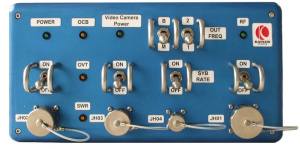
Front panel of the HamTV transmitter

Front panel of the HamTV transmitter

As announced December 22, 2013 the Ham Video transmitter is onboard the International Space Station (ISS) and stored in the Columbus module. It is slated to be installed February 5, 2014 by Michael Hopkins KF5LJG. Hopkins will also install the camera and the supporting Bogen arm.

The Ham Video transmitter will be connected to the ARISS 41 antenna and to the KuPS power supply. The installation procedure comprises a check of the electrical connections. The transmitter will be powered on and will transmit a signal on 2.422 GHz. This check will be very limited in time, just enough to verify that the control LEDs are nominal. Then Ham Video will be powered off, ready for the first Commissioning Step.
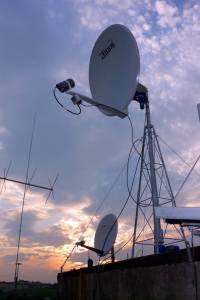
New HamTV Antennas for ARISS Telebridge Station IK1SLD at Casale Monferrato, Italy

New HamTV Antennas for ARISS Telebridge Station IK1SLD

January 23 and 24, Commissioning Simulations were again performed by ESA, in collaboration with ARISS. The ARISS Team, in charge of receiving the signals during the Commissioning, worked with B.USOC, simulating the four scheduled Commissioning Steps. The procedure was an update of the Simulations performed 5-6 September 2013, as reported in HamTV Bulletin #2.
( All HamTV Bulletins are archived at http://www.ariss-eu.org/ ).

The four Commissioning steps are scheduled February 8, 15 and 16 and March 5. These dates are still to be confirmed and this depends on the signature of the Flight Rules relative to Ham Video (see HamTV Bulletin #4).

Blank Transmissions will start immediately at the conclusion of Commissioning Step 1 and will continue till Commissioning Step 4. This means that the Ham Video transmitter will operate continuously during 25 days.

The DATV signal parameters will be:
* Downlink frequency: 2.395 GHz
* DVB-S standard (QPSK modulation)
* Symbol rate: 1.3 Ms/s
* FEC : ½
* Video PID = 256
* Audio PID = 257
* RF radiated power : approximately 10 W EIRP
Ham Video will operate with a Canon XF-305 camera, but the camera will be turned off during the Blank Transmissions.
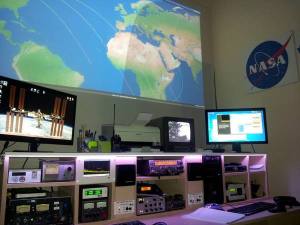
ARISS Telebridge Station IK1SLD at Casale Monferrato, Italy

ARISS Telebridge Station IK1SLD at Casale Monferrato, Italy

Blank Transmissions

A « blank » DVB-S signal contains all the data of normal DVB-S. The information tables describing the content and the content itself, i.e. the video (black) and the audio (silence), are the same as for the image and the sound produced by a camera.
Receiving a black image and silent sound may seem uninteresting but, from a technical perspective, the digital signal offers an important source of information.

The decoded signal provides many data :
* the video stream can be measured (Tutioune + TS reader)
* the audio stream can be measured (Tutioune + TS reader)
* the DVB tables can be decoded (satellite receiver (Set Top Box) or Tutioune or TS reader or VLC …)

The DVB tables mention the PIDs (content identification numbers) as well as the SDT (Service Description Table) with the TV channel name, which will be « HAMTV »

Even without decoding, several measurements of the received signal provide valuable information:
* analogic HF signal strength  (dBm)
* analogic Signal/Noise ratio (dB)
* digital Signal/Noise ratio = MER (dB)
* error/correction ratio = Vber, Cber …
* validation of the received transport stream = TS

Reception Reports

Ground stations with S-band capability can provide valuable information, which will be much appreciated. Basic data such as:
* noise level without signal
* AOS time (UTC)
* maximum signal level during pass
* LOS time (UTC)
can be reported by ground stations without the need of special DATV hardware and software.

ARISS is preparing a Ham Video Internet Reporting Program for collecting reception data from volunteering ground stations. These most needed reception reports will be gratefully accepted.

Basic DATV receiver

A “Set Top Box” or a Television receiver with satellite tuner can be used for receiving Ham Video signals during a pass of the ISS.

When scanning the 2.395 GHz frequency, the DVB stream can be decoded. When this is successful, the channel name « HAMTV » will appear on the TV screen.

Windows computer with TechnoTrend TT S2-1600 card and Tutioune software

A Windows computer with TT S2-1600 receiver card can be used for Ham Video reception. See appended Block Diagram of N6IZW Station.

The Tutioune software, developed by Jean Pierre Courjaud F6DZP, measures and records the Ham Video signals second by second:
* HF signal level
* digital Signal/Noise level = MER (dB)
* error/correction = Vber
* validation of the received transport stream = TS

The recorded file can be examined and forwarded to ARISS.

Better even, the data can be forwarded during an ISS pass to the TiouneMonitor on the http://www.vivadatv.org/ website. In other words, the data can be observed worldwide, real time.

Tutioune also shows the constellations during signal reception (see HamTV Bulletin #4). The TS stream can be recorded, but this is less interesting since richer information is already available.

Tutioune also decodes the DVB tables and provides the PIDs and the channel name  (« HAMTV ») recovered from the SDT table.

73,

Gaston Bertels, ON4WF
ARISS-Europe chair

Annex: http://www.ariss-eu.org/N6IZW_Station.pdf

ARISS minutes regarding ISS HAMTV frequencies http://www.ariss.org/1/post/2013/05/may-18-2013.html

ARISS-Europe http://www.ariss-eu.org/