In this video Professor Bob Twiggs KE6QMD talks about a decade of CubeSats.
The presentation was given to the 1st International Workshop on LunarCubes November 13, 2012 Palo Alto, California.
In this video Professor Bob Twiggs KE6QMD talks about a decade of CubeSats.
The presentation was given to the 1st International Workshop on LunarCubes November 13, 2012 Palo Alto, California.
In this video Rob Staehle discusses the communication and propulsion challenges involved in getting a CubeSat to the Moon.
The presentation was given to the 1st International Workshop on LunarCubes November 13, 2012 Palo Alto, California.

Altitude of the five CubeSats compared with ARISSat-1/Kedr – Image credit Masahiro Arai JN1GKZ
WE-WISH, one five CubeSats deployed from the International Space Station (ISS) on October 4, 2012. burnt up in the Earth’s atmosphere on Monday, March 11. On the AMSAT Bulletin Board Nico Janssen PA0DLO suggested it burnt up at 02:59 UT near 48 degrees North, 119 degrees East. He says TechEdSat is likely to be the next of the five to re-enter sometime in April.
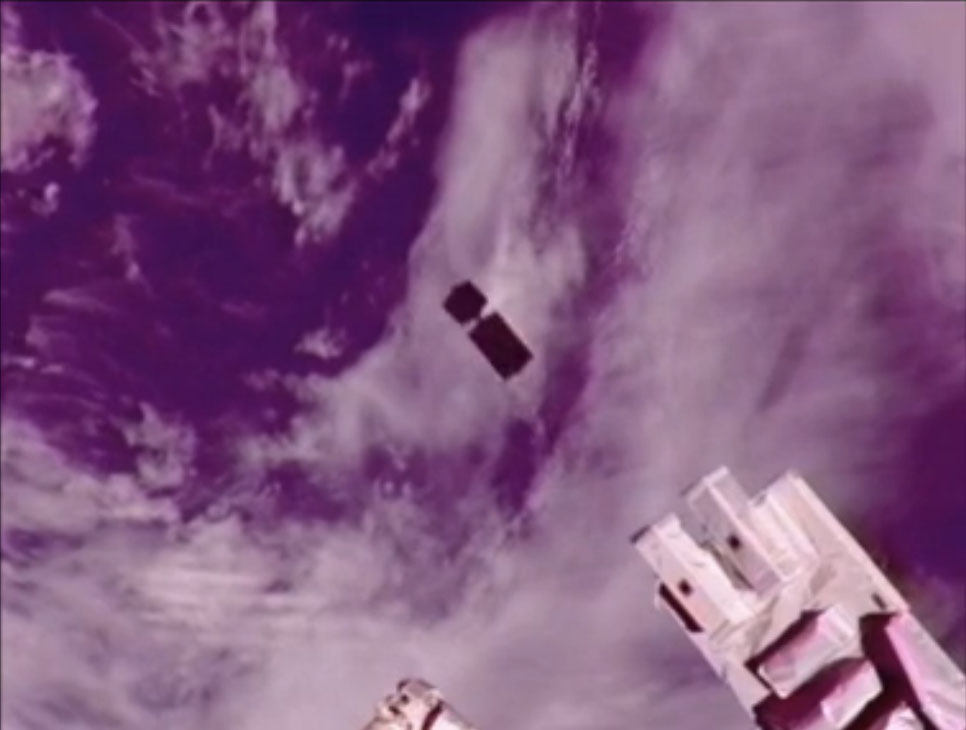
Deployment of CubeSats WE-WISH and RAIKO from the ISS – Image NASA
Built by members of the Meisei Amateur Radio Club WE-WISH carried an infrared camera for environmental studies. The 320 by 256 pixels images of the Earth’s surface were transmitted in approx 110 secs using SSTV. The callsign was JQ1ZIJ and the 100mW downlink on 437.515 MHz operated on CW (A1A), AX.25 1200 bps packet radio (F2D) or SSTV (F3F).
Masahiro Arai JN1GKZ has produced a chart that shows the declining altitude of the five CubeSats since their deployment. RAIKO was the largest of the CubeSats at about 2 kg and 10 × 10 × 20 cm and the others being about 1 kg and 10 × 10 × 10 cm. The chart compares their orbital decay with that of ARISSat-1/Kedr (30 kg, 55 × 55 × 40 cm) which was deployed on August 3, 2011 and and re-entered Earth’s atmosphere on January 4, 2012, having spent 154 days in orbit.
Further information and some spectacular pictures of the CubeSats taken just after deployment can be seen at https://amsat-uk.org/satellites/techedsat-f-1-fitsat-1-we-wish/

Mike Rupprecht DK3WN
One of the most frequently asked questions from newcomers to amateur satellites must be “Which satellites can I receive?”
Mike Rupprecht DK3WN has produced a summary of all active amateur radio satellites with frequencies and links to more detailed information. It is available at http://www.dk3wn.info/p/?page_id=29535
 The 5th European CubeSat Symposium takes place on June 3-5, 2013 at the premises of Royal Military Academy in Brussels, Belgium.
Last year this event attracted more than 250 participants and industrial exhibits of 7 specialized companies. This year, they are expecting more participation. Applicants from all around the world are welcome.
The call for proposals and the online abstract submission system is available at http://www.CubeSatSymposium.eu/

Romit1 – Image Credit GomSpace ApS
In this video Palle Haastrup OZ1HIA, President of Euroluna (OZ9LUNA), describes their work towards a flight ready high tension power supply for the CubeSat Ion propulsion system.
Euroluna are a Danish amateur team participating in the $30 million Google Lunar X PRIZE contest to be the first privately funded team to land and drive a rover on the Moon.
Their first Amateur Radio CubeSat Romit-1 is a 2U CubeSat that will transmit on 437.505 MHz using 1200 bps AX.25 packet radio. It will be fitted with an Ion Motor and if everything goes well it should, after a year, be able to raise its orbit from 310 km to 700 km. It is planned to launch on an Interorbital Systems Neptune 30 rocket.


You must be logged in to post a comment.