15 Canadian CubeSats to launch from 2021

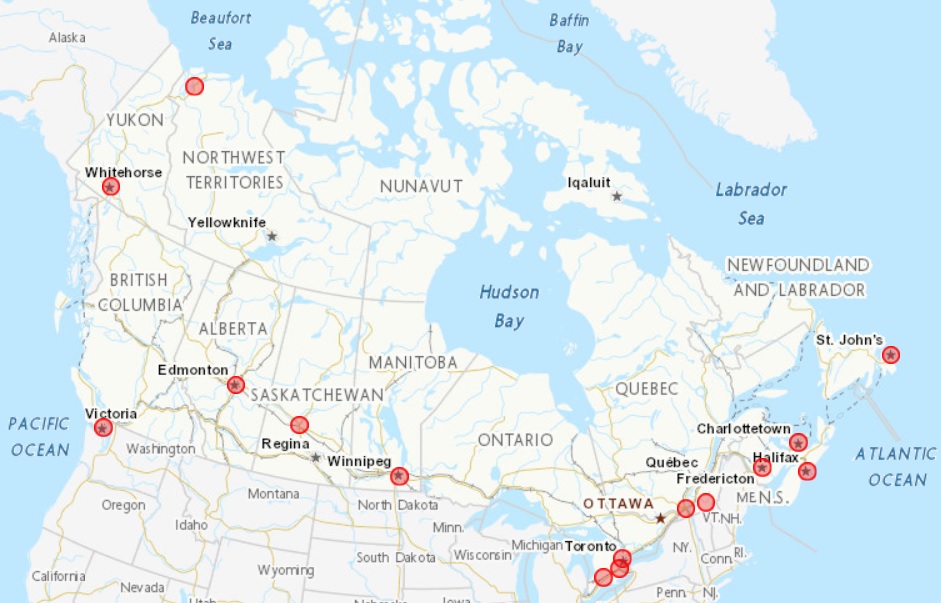
Canadian CubeSat Teams - credit Canadian Space Agency

Canadian CubeSat Teams – credit Canadian Space Agency

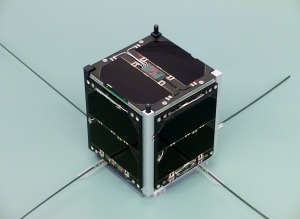
Radio Amateurs of Canada (RAC) report 15 CubeSat satellites are being built by students in Canada, all are expected to carry amateur radio payloads.

The RAC post says:

The Canadian Space Agency has been providing support and guidance to 15 teams of university and college students across Canada who are building satellites. These satellites are in the “CubeSat” format, based on a standardized architecture of 10 centimetre cubes. All 15 proposed satellites will be deployed from the International Space Station (ISS), possibly starting in 2021.

RAC is involved in explaining how, and under what conditions, Amateur Radio can be used for communications with these spacecraft, and a requirement of the frequency coordination process with the International Amateur Radio Union is an endorsement from RAC.

We were aware that the suspension of university classes due to the global pandemic could affect the teams’ progress, but I am pleased to report that all of the teams have chosen to use Amateur Radio communications and we continue to receive requests from them, although at a slower rate than in the past. About half of the teams have now received endorsements for their projects from RAC and have sent their proposals to the IARU for frequency coordination.

Designing and constructing CubeSats is a complicated, multi-year process. These projects will develop the students’ skills in many facets of engineering, science, technology, business and project management. Once in orbit, the satellites will also assist pure and applied scientific research and some may offer facilities that Amateurs across Canada and around the world can use.

Source RAC https://www.rac.ca/the-rac-report-june-2020/

Canadian CubeSat Project Teams https://asc-csa.gc.ca/eng/satellites/cubesat/selected-teams-map.asp

Tony Hutchison VK5ZAI in Queen’s Birthday honours list

Tony Hutchison VK5ZAI

Tony Hutchison VK5ZAI

Tony Hutchison VK5ZAI was awarded Member of the Order of Australia (AM) in the Queen’s Birthday Honours List released June 8, 2020.

The citation reads:

“For significant service to amateur radio, particularly to satellite and space communication.”

For full details see https://honours.pmc.gov.au/honours/awards/2006845

Queen’s Birthday 2020 Honours List, June 8, 2020
https://www.gg.gov.au/sites/default/files/2020-06/QB2020%20Gazette%20-%20O%20of%20A.PDF

Longjiang-2 / LO-94: Journey to the Moon

Longjiang-2 / LO-94 in Lunar Orbit

Longjiang-2 / LO-94 in Lunar Orbit

A cartoon movie has been made that tells the story of the student-built spacecraft Longjiang-2 / Lunar-OSCAR-94 which went into lunar orbit and transmitted SSDV images back to radio amateurs on Earth.

SSDV image of Moon and Earth taken by LO-94 (Longjiang-2) - Credit Cees Bassa

SSDV image of Moon and Earth taken by LO-94 (Longjiang-2) – Credit Cees Bassa

Longjiang-2 / LO-94, developed by students and researchers at the Harbin Institute of Technology, is the world’s smallest spacecraft to enter lunar orbit independently. It was launched on May 20, 2018 and radio amateurs tracked its progress as it traveled towards the Moon and successfully entered lunar orbit.

The spacecraft transmitted signals back to Earth on 435.400 and 436.400 MHz. The amateur radio mode SSDV (Slow Scan Digital Video) was used to send back pictures of the Moon and WSJT JT4G was used for messages.

Two VHF/UHF SDR transceivers onboard were used to provide the beacon, telemetry, telecommand, digital image downlink and a GMSK-JT4 repeater, transmitting power was about 2 watts.

Watch Longjiang-2: Journey to the Moon

Harbin Institute Of Technology Amateur Radio Club BY2HIT
Weibo: http://www.weibo.com/by2hit
QRZ: http://www.qrz.com/db/BY2HIT

Ofcom EMF Consultation: Your response needed by Friday, June 12

Ofcom are proposing to impose onerous new licence conditions and mandatory guidance on all licensees (not just amateurs) who are able to transmit >10W EIRP, prompted by recent but unjustified 5G concerns etc.

The RSGB EMF consultation response guide says:

However RSGB does not agree with Ofcom’s proposals to implement that principle by adding a major new enforceable condition to Amateur licences. We believe this would be:

1. In breach of statutory general duties
The Communications Act 2003 and the Wireless Telegraphy Act 2006 together require that regulations made by Ofcom:
• Must be proportionate, objectively justifiable, and targeted only at cases in which action is needed;
• Must not impose burdens which are unnecessary;
There would also be a danger of double regulation with what is normally a HSE/PHE matter.

2. Not objectively justifiable
• The Amateur licences include a long-standing requirement that safety precautions should be taken against “radio frequency radiation” which is accepted by Public Health England (PHE), and the NRPB before it, as being proportionate to the low levels of risk arising from Amateur Radio activities.

3. Inadequate with respect to the requirement for impact assessments
• The document contains no impact assessment of any kind.

4. Disproportionate and Discriminatory
We emphasise that all impacts upon Amateur Radio will be disproportionate to the related risks of harm.
• They will be extremely disruptive to the Amateur Service and Amateur Satellite Service
• They fall most heavily upon the very large numbers of non-commercial licensed spectrum users many of whom lack the resources to make the assessments demanded.

The RSGB recommends you acknowledge the need for ICNIRP guidelines but to state that the proposals from Ofcom are not proportionate for amateur licensees.

More details on the consultation and the Response Guide to help you with your response along with a copy of the RSGB’s response can be found at
https://www.rsgb.org/emf

Responses must be submitted to Ofcom before the consultations closes on June 12.

Ofcom Consultation PDF: Proposed measures to require compliance with international guidelines for limiting exposure to electromagnetic fields (EMF)
https://www.ofcom.org.uk/__data/assets/pdf_file/0013/190003/emf-condoc.pdf

Ofcom Consultation page
https://www.ofcom.org.uk/consultations-and-statements/category-1/limiting-exposure-to-emf

FUNcube-1 in continuous transponder mode

AO-73 (FUNcube-1) – Image credit Wouter Weggelaar PA3WEG

After some eight months in continuous sunlight, FUNcube-1 has now started to see some eclipses during each orbit.

The telemetry received has shown that the spacecraft continued to function perfectly during this period and the on board temperatures did not reach excessively high levels.

After this became clear, our next concern was the battery. Having been kept fully charged for this period, would it actually hold a charge and do its job when in eclipse?

After three weeks of increasing eclipse periods we can now see that indeed the Li battery appears to be ok and the bus voltage has not yet dropped below 8.1 volts.

So today we have changed the operating mode from high power telemetry educational mode to continuous amateur mode withe the transponder ON. The telemetry continues to be available, albeit at low power.

We will, of course, continue to carefully monitor the data but are planning to leave the spacecraft in this mode for at least the next week. Please enjoy using it!

Schedule released for E2STAYHOME satellite operation

Es'hail-2 Qatar-OSCAR-100Thailand’s regulator, the National Broadcasting and Telecommunications Commission (NBTC), has issued the special callsign, E2STAYHOME, to the Radio Amateur Society of Thailand under the Royal Patronage of His Majesty the King (RAST) for use during the outbreak of the COVID-19 virus.

This is because it is very important for people to boost their immune systems to fight off germs that can enter their bodies and to reduce the chance of getting infected by the COVID-19 virus. Now, it is very important to stay home and to keep a distance of at least one metre from others, if this is possible, which is one way to help prevent the spread of the disease on a global basis.

This is a rare opportunity for ham radio operators who are interested in satellite communications to legally communicate with Thai amateur radio stations by means of the Es’hail-2 or QO-100 geostationary satellite which licensed by the Thai regulator, the NBTC, in response to requests from RAST, and using the special callsign E2STAYHOME on the evenings of each working day in Thailand and on every weekend.

The operating schedule is as follows:
Monday to Friday, 1100 – 1500 UTC
Saturday and Sunday, 0800 – 1500 UTC
all days after 1600 UTC and up to 2200 UTC Thailand has an emergency curfew in place. Please STAY HOME!!

During these times, Thai hams will be operating using this callsign on all bands and in all modes, including all satellite modes under the supervision of the Radio Amateur Society of Thailand (RAST) in an effort to help prevent the spread of COVID-19 and they will be QRV from today until July 15, 2020. QSOs with E2STAYHOME can be confirmed via Tim W. Tadsri, HS6MYW and QSL cards will be sent to all via the bureau.

73 de HS1JAN
Tanan Rangseeprom

AMSAT Bulletin Board http://www.amsat.org/mailman/listinfo/amsat-bb

RAST https://www.qsl.net/rast/