ESA – CubeSats satellite operations update

Members of XaTcobeo team at ground station

Members of the XaTcobeo CubeSat team at the ground station

ESA have issued an update on the amateur radio CubeSats that were launched on February 13.

Since the launch ESA’s Education Office has maintained frequent contacts with the student teams to follow the progress of their satellite operations.

For each team, this is the first hands-on experience of operating an orbiting satellite, and some of them have had to deal with some challenging difficulties.

Read the ESA report at http://www.esa.int/SPECIALS/Education/SEM2KRGY50H_0.html

Student CubeSats BEESAT-2 and BEESAT-3

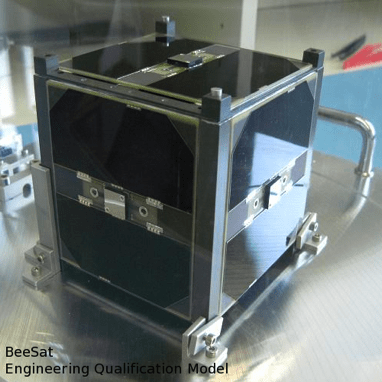
BEESAT-1 Engineering Qualification Model

BEESAT-1 Engineering Qualification Model

Two CubeSats, built by students at the Technical University of Berlin, are expected to launch in the 4th quarter of 2012 from Baikonour into a 575km circular 65 degree orbit.

BEESAT-2 is a 1U cubesat project intended to test a reaction wheel and an Attitude Determination and Control (ADC) system. Will also carry an experimental camera.

BEESAT-3 is a 1U cubesat project intended to test a transmitter using commercial S Band frequencies outside the amateur satellite service.

Up- and downlink of both of these CubeSats is established by half-duplex GMSK modulated narrow-band radio at 436.000 MHz. The standard data rate is 4800 bps but can be switched to 9800 bps for increased channel capacity at higher elevations. Each transmission at the higher data rate is announced by a small 4800 bps header to allow for adaptive receiver re-configuration. The modem device used is the CML CMX909b.

For more information see http://tinyurl.com/TUB-BEESAT

IARU Amateur Satellite Frequency Coordination pages hosted by AMSAT-UK http://www.amsat.org.uk/iaru/

HumSAT-D CubeSat

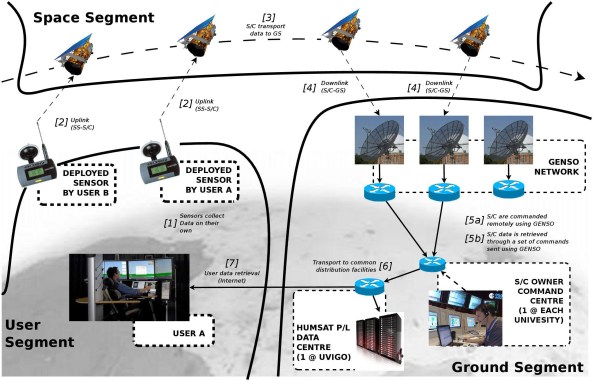
HumSAT Mission Concept

HumSAT Mission Concept

HumSAT-D is a 1U CubeSat mission developed by the University of Vigo. It is planning to use MSK telemetry and a CW beacon on UHF. The main mission is educational: to provide a hands-on experience to the students in the complete process of developing a space mission.

The other goal is to demonstrate the validity of the concept of HumSAT. A new subsystem to collect data from sensors located on the ground, store on-board and transmit it to ground stations will be developed and validated in orbit.

Universities and amateurs are invited to develop their own sensors compatible with HumSAT.

HumSAT-D is planning a launch from Russia into a Sun Synchronous Orbit (SSO) at 700km.

HumSAT System

The main purpose of the HumSAT system is the development of a satellite-based system for connecting a set of users with a network of worldwide distributed sensors which they have previously deployed.

Sensors will be responsible for acquiring user data and for transmitting it to the satellites through an standard radio interface (SSI interface, definition of this interface is published here). Users will be able to define their own sensors, for monitoring different types of parameters; for example, water temperature or wind speed.

For retrieving data from the satellites, the GENSO network of ground stations will be one of the core components of the data distribution system. Several universities from different ESA member states, Japan and USA are coperating in this project, whose second release (R2) is expected to provide the functionalities that the HumSAT system will require. For more information about the GENSO project, please visit the www.genso.org website.

Once data has been transported by HumSAT satellites, authorized users will be able to access it through an Internet connection. Several security restrictions shall be applied for guaranteeing a correct access to the data gathered.

HumSAT http://www.humsat.org/

HumSAT: example for international cooperation in small satellite missions
http://www.oosa.unvienna.org/pdf/bst/ISU-SSP2011/Small-Sats-_v1-Graz-26-07-2011-ISU.pdf

IARU Amateur Satellite Frequency Coordination pages hosted by AMSAT-UK http://www.amsat.org.uk/iaru/

UKube-1: 4 payloads

Rt Hon David Willetts MP learns about UKube-1 visiting Clyde space, seeing the clean rooms and talking to Craig Clark about CubeSat components. Courtesy http://www.clyde-space.com/news/305_uk-science-minister-visits-clyde-space


The UK Space Agency’s pilot programme has narrowed down from a total of 20 proposals to four payloads to fly on Ukube-1 from UK industry and academia.

Payloads chosen include a CMOS (complementary metal-oxide semiconductor) Imager Demonstrator, a specialist imaging device to measure radiation damage in space developed by the Open University and Essex-based e2v technologies.

Another, the United Kingdom Students for the Exploration and Development of Space (UKSEDS) payload, myPocketQub442, is an open source system comprising five experiments, one of which will allow school pupils, university students and hobbyists to run their own experiments in space for a day.

The other two payloads are the EADS Astrium , which will test random number generation crucial to secure communications systems in the radiation environment, and TOPCAT http://www.bath.ac.uk/elec-eng/invert/topcat.html, a system designed by the University of Bath to measure space weather conditions which can adversely affect global positioning systems (GPS).

UKube-1 will also take an educational subsystem called FUNcube, developed by the voluntary organisation AMSAT-UK, to encourage young people to learn about radio, space, physics and electronics.

The spacecraft is being developed through a knowledge transfer project with Scottish spacecraft system developer Glasgow based Clyde Space and the University of Strathclyde, which Clyde Space is also funding.

One of the world’s leading firms in the micro spacecraft sector, dubbed CubeSat , Clyde Space has made components for about 40% of the 600 CubeSats launched globally so far. It also makes components for larger satellites.

Ukube-1 is also being funded by the UK Space Agency, the Technology Strategy Board and The Science and Technology Facilities Council (STFC). The agency is currently in negotiations to find a launch vehicle to take the Ukube-1 satellite into space.

UKSEDS – Students for the Exploration and Development of Space http://www.uk.amsat.org/4369

Bath TOPCAT Project http://www.uk.amsat.org/1612

Thailand AMSAT High Altitude Balloon Videos

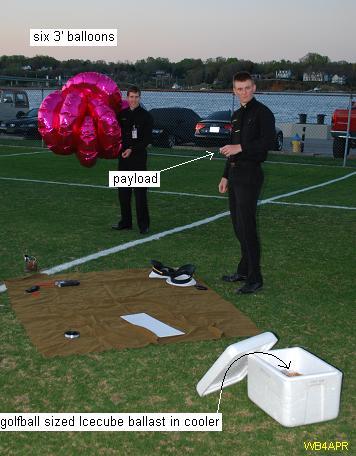
Videos have been released by the Thailand Amateur Satellite group TAMSAT showing their successful amateur radio balloon flight call sign HS1JAN-11 on March 18.

Watch the launch of MSBSAT-2

Watch MSBAT-2 at 30km and its descent to Earth

Watch a timelapse video of the balloon being assembled

The track of the balloon can be seen at http://aprs.fi/#!call=a%2FHS1JAN-11&timerange=3600

Apex students talk with space station

On Wednesday, March 21, students at Salem Elementary in Apex came together in the school’s multipurpose room for a once-in-a-lifetime event.

WRAL TV news reports that fourteen students, six of them winners of the school’s science fair a few weeks earlier, made their way onto the stage for their turn to ask a question of astronaut Don Pettit KD5MDT 241 miles (388 km) up and on the other side of the Earth aboard the International Space Station. Tony Hutchison VK5ZAI provided the telebridge link to the ISS amateur radio station NA1SS.

At 10:07 am EDT, the station came over the horizon of Southern Australia and ham radio volunteer Tony Huchison VK5ZAI called out to callsign NA1SS. Everyone relaxed a little bit when Pettit KD5MDT responded and students lined up to ask their questions one after another.

Watch the WRAL video

Read the full WRAL news report at http://www.wral.com/weather/blogpost/10904028/

ARISS ham radio space contact with Salem Elementary School, Apex, NC http://www.southgatearc.org/news/march2012/ariss_event_2103.htm

Amateur Radio on the International Space Station (ARISS) http://www.rac.ca/ariss/