ISS SSTV activation July 30-31

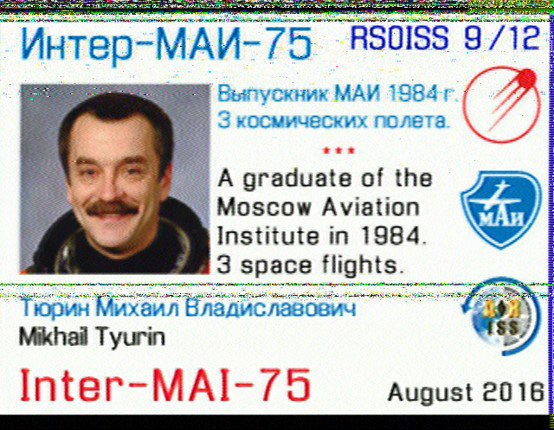
ISS SSTV MAI-75 image 9/12 received by Chertsey Radio Club on Baofeng handheld

ISS SSTV MAI-75 image 9/12 received by Chertsey Radio Club on Baofeng handheld

The Russian cosmonauts on the International Space Station are expected to activate amateur radio Slow Scan Television (SSTV) transmissions on 145.800 MHz FM during Monday and Tuesday, July 30-31.

The Inter-MAI-75 SSTV experiment should be active on:
• Monday, July 30 from 16:00-19:30 UT
• Tuesday, July 31 from 13:25-19:15 UT

The SSTV images will be transmitted on 145.800 MHz FM using the Kenwood TM-D710 transceiver located in the Russian ISS Service module. It is expected they will use the PD-120 SSTV format.

Note the ISS transmissions use the 5 kHz deviation FM standard rather than the narrow 2.5 kHz used in Europe. If your transceiver has selectable FM filters try using the wider filter. Handheld transceivers generally have a single wide filter fitted as standard and you should get good results outdoors using just a 1/4 wave whip antenna.

ISS SSTV links for tracking and decoding software
https://amsat-uk.org/beginners/iss-sstv/

You can receive the SSTV transmissions by using an Online Radio (WebSDR) and the MMSSTV software:
• Listen to the ISS when it is in range of London with the SUWS WebSDR http://farnham-sdr.com/
• Listen to the ISS when it is over Russia with the R4UAB WebSDR

Android Satellite Tracking Applications

AmsatDroidFree ScreenshotIn his blog Peter Goodhall 2M0SQL looks at satellite tracking Apps for Android devices

He says “Satellite tracking applications play an important part in using the transponders available to radio amateurs, of course, experiences of them all vary and are very subjective however we are going to explore what is available on the Android platform.”

Read his blog post at
https://www.2m0sql.com/2018/07/23/android-satellite-tracking-applications/

434 MHz balloon launch from Goonhilly

Goonhilly GHY-1 "Arthur"

Goonhilly GHY-1 “Arthur”

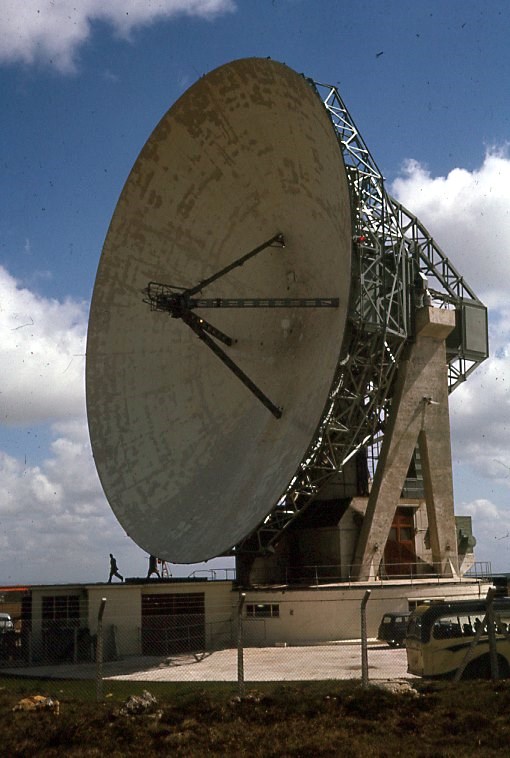
Phil M0DNY is planning to launch a high altitude balloon or two on Tuesday, July 10 from the Goonhilly Earth Station on the Lizard in Cornwall, nearby to the Marconi Wireless Testing Station.

Any help with tracking would be greatly appreciated!

We’re currently undecided between morning or late-afternoon. If we go for morning then we may also launch a second later near-identical balloon later in the day. 5m/s ascent, ~35km burst.

Two Trackers:

• Callsign: 1900 (year of construction of the Marconi Wireless Station)
– Calling Beacon: 433.650MHz.100 LoRa Mode 5
– Telemetry: 434.300 MHz LoRa 20.8K SF10 4/5 Explicit

• Callsign: 1901 (year of first over-the-horizon transmission received at the Wireless Station, from the Isle of Wight)
– 434.100 MHz USB RTTY 50bd 7n2 480Hz

I’ll post updates in #highaltitude on the day when I can.

For tuning in on the pi-in-the-sky LoRa gateway, the config you need is:

CallingTimeout=60
frequency_<x>=433.650
mode_<x>=5
AFC_<x>=y

Thanks, Phil M0DNY

The 434.100 MHz FSK RTTY balloon signal should be receivable across most of the British Isles using a radio capable of SSB reception in 434 MHz. Online tracking at https://tracker.habhub.org/

No radio? Use the SUWS online radio to receive signals from 434 MHz High Altitude Balloons when they are range of London (select USB mode) http://farnham-sdr.com/

Links to #highaltitude IRC chat, UKHAS mailing list, Online Radio and Tracking information at
https://amsat-uk.org/beginners/balloons/

CubeSats to deploy from ISS July 13

International Space Station – Image Credit NASA

Masa JN1GKZ reports JAXA has announced that nine CubeSats will deploy from the International Space Station on Friday, July 13.

The nine CubeSats are RainCube, Radix, CubeRRT, HaloSat, TEMPEST-D, EnduroSat AD, EQUISat, MemSat and RadSat-g.

EnduroSat AD, EQUISat and MemSat will operate in the amateur bands. The IARU Amateur Satellite Frequency Coordination Status pages show these frequencies:
• EnduroSat AD 437.050MHz CW, GFSK 9k6
• EQUISat 435.550MHz CW, FSK 9k6
• MemSat 437.350MHz BPSK 9k6

Happy chasing!
Masa JN1GKZ Tokyo Japan

Summer issue of OSCAR News now available

E-members of AMSAT-UK can now download the Summer 2018 edition of OSCAR News here.

The paper edition should be sent to postal members in 2-3 weeks.

In this issue:
• From the Secretary’s Keyboard
• 2018 Meetings & Events calendar
• My amateur Radio “Career” by Peter 2M0SQL
• Things that fall from the sky!
• AO73/FUNcube-1 Illumination update
• Greater Orbit, Larger Footprint: An Introduction to AMSAT-NA’s GOLF Program
• News Round-up June 2018
• Spacelink “Get Space V” day
• Presentations planned for the 2018 AMSAT-UK Colloquium
• Operating portable in the Mediterranean
• ESERO Germany opened in Bochum
• Debris Risks in GEO Orbits
• World Amateur Radio Day
• ATHENOXAT-1 Image received
• Pointing that Dish for Es’hail-2!
• Her Majesty’s Royal Mint – GB4RME
• My Satellite Story – G0ABI
• Beginners workshop on SDR programming
• 2018 AMSAT-NA Space Symposium
• Ham Radio at Friedrichshafen
• The AMSAT-UK Colloquium – 2018
• AMSAT-UK Data Privacy policy – May ‘18
• Lean Qualification of the AMSAT-UK Software Radio Payload
• Electromagnetic Field 2018 August 31 to September 2
• TLE confusion
• Young space entrepreneurs win backing from industry experts

AMSAT-UK FUNcube Mission Patch

AMSAT-UK FUNcube Mission Patch

Membership of AMSAT-UK is open to anyone who has an interest in amateur radio satellites or space activities, including the International Space Station (ISS).

E-members of AMSAT-UK are able to download OSCAR News as a convenient PDF that can be read on laptops, tablets or smartphones anytime, anyplace, anywhere. Join as an E-member at Electronic (PDF) E-membership

PDF sample copy of “Oscar News” here.

Join AMSAT-UK using PayPal, Debit or Credit card at
http://shop.amsat-uk.org/

E-members can download their copies of OSCAR News here.

Receive SSTV from Space in June and July

ISS SSTV image 2 received by Mike Rupprecht DK3WN April 12, 2016 at 1556 UT

ISS SSTV image received by Mike Rupprecht DK3WN April 12, 2016 at 1556 UT

ARISS Russia is planning a special Slow Scan Television (SSTV) event  from the International Space Station Station starting around 09:00 GMT on Friday, June 29.

It was originally planned to finish at 18:30 GMT on Sunday, July 1 but as of July 7 SSTV transmissions were continuing. The equipment will be required for a school contact on July 13 so SSTV transmission may continue until then.

Supporting this event is a computer on the ISS Russian Segment, which stores images that are then transmitted to Earth using amateur radio, specifically the onboard Kenwood TM-D710E transceiver.

These images will commemorate the various satellites that were hand-deployed from the ISS. These will include the first satellite deployment from ISS: Suitsat-1/Radioskaf-1 which was developed by ARISS and deployed in February 2006.

The transmissions will be made on 145.800 MHz FM using the PD-120 SSTV mode.

Note the ISS transmissions use the 5 kHz deviation FM standard rather than the narrow 2.5 kHz used in Europe. If your transceiver has selectable FM filters try using the wider filter. Handheld transceivers generally have a single wide filter fitted as standard and you should get good results outdoors using just a 1/4 wave whip antenna.

The ISS Fan Club site will show you when the space station is in range http://www.issfanclub.com/

ISS SSTV information and links at https://amsat-uk.org/beginners/iss-sstv/

Post your images on the ARISS-SSTV gallery at http://www.spaceflightsoftware.com/ARISS_SSTV/

If you don’t have an amateur radio receiver you can still listen to the ISS by using an Online Radio, also known as a WebSDR. Select a Frequency of 145800.0 kHz and Mode FM:
• Farnham WebSDR when ISS is in range of London http://farnham-sdr.com/
• R4UAB WebSDR when ISS is over Russia

Please note that the event is dependent on other activities, schedules and crew responsibilities on the ISS and subject to change at any time. You can check for updates regarding planned operation at:
ISS Ham https://twitter.com/RF2Space
ARISS Status https://twitter.com/ARISS_status
ARISS SSTV Blog https://ariss-sstv.blogspot.com/
AMSAT Bulletin Board http://www.amsat.org/mailman/listinfo/amsat-bb

If you receive a full or partial picture from the Space Station your Local Newspaper may like to know http://www.southgatearc.org/news/2016/july/now-is-a-great-time-to-get-ham-radio-publicity.htm

The RSGB produce a handy Media Guide and Template press release for anyone to download and adapt, see http://rsgb.org/main/clubs/media-guide-for-affiliated-societies/

An example of the publicity you can get for the hobby by telling your Local Newspaper
https://amsat-uk.org/2015/04/15/iss-sstv-in-the-press/