Getting ready for RadFxSat (Fox-1B)

RadFxSat (Fox-1B) CubeSat

RadFxSat (Fox-1B) CubeSat

RadFxSat (Fox-1B) is scheduled for launch on Saturday, November 18, 2017 at 09:47 GMT. RadFxSat is one of four CubeSats making up the NASA ELaNa XIV mission, riding as secondary payloads aboard the Joint Polar Satellite System (JPSS)-1 mission. JPSS-1 will launch on a Delta II from Vandenberg Air Force Base, California.

Watch launch coverage on NASA TV from 09:15 GMT at https://www.nasa.gov/multimedia/nasatv/

Paul Stoetzer N8HM has posted this update on the AMSAT Bulletin Board (AMSAT-BB):

Introduction

RadFxSat is a partnership with Vanderbilt University ISDE and hosts four payloads for the study of radiation effects on commercial off the shelf components. RadFxSat features the Fox-1 style FM U/v repeater with an uplink on 435.250 MHz (67.0 Hz CTCSS) and a downlink on 145.960 MHz. Satellite and experiment telemetry will be downlinked via the “DUV” subaudible telemetry stream and can be decoded with the FoxTelem software
https://www.amsat.org/foxtelem-software-for-windows-mac-linux/

Launch and Early Orbit Phase (LEOP)

RadFxSat will launch at 01:47 PST (09:47 UTC) on Saturday, November 18, 2017 from Vandenberg Air Force Base, California. At this time, pre-launch Keplerian elements are not expected to be available. However, based on the Local Time of the Ascending Node (LTAN) of the primary payload, 13:30, stations should expect to have their initial ascending passes starting around noon local time. The estimated time of “First Veronica,” the initial beacon after deployment, is 12:07 UTC. Due to the tight constraints on the primary payload deployment, the secondary payloads may be delayed slightly, so this should be considered the soonest the transmitter will be enabled. Orbital elements will be published as soon as they are available on the AMSAT website. Stations in Europe, South America, and North America should point your beams south and have FoxTelem running while awaiting the initial post-launch Keplerian elements.

Participation in telemetry collection by as many stations in as many parts of the world as possible is essential as AMSAT Engineering looks for successful startup and indications of the general health and function of the satellite as it begins to acclimate to space.

RadFxSat (Fox-1B) LogoIf you are capturing telemetry with FoxTelem please be sure that “Upload to Server” is checked in your settings, and that your “Ground Station Params” are filled in as well. You can help AMSAT and everyone waiting to get on the air with RadFxSat tremendously by capturing RadFxSat telemetry.

About 60 minutes after deployment, or 140 minutes after launch, the satellite will start up in Beacon Mode. In this initial mode, the transmitter is limited to 10 seconds on time and then will be off for
two minutes. For those of you capturing telemetry, that means that you will only see Current frames and no High or Low frames. The High and Low frames are truncated as it takes just over the 10 second limit to send two frames. Veronica may also be cut off before she gets to say her whole ID string as the full ID, “RadFxSat Fox-1B Safe Mode,” is a bit longer than the approximately 3.5 seconds she has in Beacon Mode. If the voice ID is cut off, the satellite is still in Beacon Mode.

If AMSAT Engineering is seeing nominal values from the telemetry you gather, the satellite will be commanded from Beacon Mode to Safe Mode on the first good pass over the United States. In Safe Mode, the satellite transmits a full two frames of telemetry (one Current frame followed by, and alternating each ID cycle, a High or a Low frame). Veronica now has time to make the whole ID announcement in Safe Mode.

The on-orbit checkout procedure for RadFxSat is similar to Fox-1A/AO-85 and could be completed in as little as a few days if users cooperate. It is very important, and good amateur operating practice, to refrain from using the transponder uplink so the on-orbit tests can be performed, including when the satellite is switched into Transponder Mode for testing.

AMSAT will make it broadly known when the tests are complete and the transponder is available for all to use. If you hear someone on the transponder, please do not assume that it is open for general use – check AMSAT’s website, Facebook, and Twitter before transmitting to be sure you do not interfere with testing.

AMSAT asks all satellite operators to contribute just a little bit of your time by gathering telemetry, not using the transponder uplink, to help complete the last few days of getting RadFxSat operating for the amateur radio community.

Lots of hams put thousands of volunteer hours of their time into making RadFxSat happen. Just like any ham radio project you might undertake, AMSAT builds satellites. AMSAT volunteers do it because they like to, and when they are done, AMSAT freely shares their project with hams everywhere as is the spirit of amateur radio.

Thank you very much and see you on the bird!

Radio Programming Chart

RadFxSat (Fox-1B) Doppler Shift Correction

Memory 1 (AOS) – Transmit 435.240 MHz (67.0 Hz Tone), Receive 145.960 MHz
Memory 2 (Approaching) – Transmit 435.245 MHz (67.0 Hz Tone), Receive 145.960 MHz
Memory 3 (TCA) – Transmit 435.250 MHz (67.0 Hz Tone), Receive 145.960 MHz
Memory 4 (Departing) – Transmit 435.255 MHz (67.0 Hz Tone), Receive 145.960 MHz
Memory 5 (LOS) – Transmit 435.260 MHz (67.0 Hz Tone), Receive 145.960 MHz

Frequencies are subject to change post-launch.

For the latest information on Fox-1B check the AMSAT Bulletin Board (AMSAT-BB)
http://www.amsat.org/mailman/listinfo/amsat-bb

Initial post-launch Keplerian Two Line Elements (TLEs) ‘Keps’
RadFxSat
1 00000U 17000A 17322.46057870 -.00000000 00000-0 00000-0 0 00004
2 00000 97.6996 257.5922 0258900 235.2917 178.7268 14.79536000 07

Online real-time satellite tracking http://www.n2yo.com/

Keplerian Two Line Elements (TLEs) ‘Keps’:
• New satellites launched in past 30 days http://celestrak.com/NORAD/elements/tle-new.txt
• CubeSats http://celestrak.com/NORAD/elements/cubesat.txt
• Experimental satellites http://celestrak.com/NORAD/elements/x-comm.txt
• Engineering satellites http://celestrak.com/NORAD/elements/engineering.txt
• Amateur radio satellites http://www.amsat.org/amsat/ftp/keps/current/nasa.all

New AMSAT-NA President Announces GOLF CubeSat Program

AMSAT-NA President Joe Spier K6WAO

AMSAT-NA President Joe Spier K6WAO

At the AMSAT-NA Annual General Meeting in Reno, NV, newly elected AMSAT-NA President Joe Spier, K6WAO, announced the next phase of AMSAT’s CubeSat program: GOLF.

Joe is a Life Member of AMSAT-NA and has previously served as Executive Vice President and Vice-President Educational Relations. He also has Life Memberships in the ARRL, SARA (Society of Amateur Radio Astronomers) and the AFA (Air Force Association). He holds an Extra Class license as well as commercial licenses.

GOLF, an acronym for “Greater Orbit, Larger Footprint,” is a crucial step towards fulfilling AMSAT’s strategic goals involving high altitude, wide access satellite missions.

As an initial step in the GOLF program, the AMSAT-NA Board of Directors approved the submission of a NASA CubeSat Launch Initiative proposal for the GOLF-T satellite project. The GOLF-T project will serve as a rapidly deployable Low Earth Orbit (LEO) testbed for technologies necessary for a successful CubeSat mission to a wide variety of orbits, including LEO, Medium Earth Orbit (MEO), Geosynchronous Orbit (GEO), Highly Elliptical Orbit (HEO), or beyond.

AMSAT-NA Vice-President Engineering Jerry Buxton, N0JY, said “The GOLF-T project tees off the next phase of our CubeSat program. GOLF-T provides AMSAT hardware and knowledge for Attitude Determination and Control (ADAC) capability and the opportunity to develop a 3U spaceframe with deployable solar panels that can be used in LEO or HEO missions, two of the major systems required in future GOLF and HEO missions.”

In addition, GOLF-T provides the opportunity for rapid deployment and on orbit testing of the AMSAT’s Advanced Satellite Communications and Exploration of New Technology (ASCENT )program’s technology, including radiation tolerant transponder and Integrated Housekeeping Unit (IHU) technologies that will lead the way for low cost commercial off-the-shelf (COTS) systems that can function in the MEO and HEO radiation environments. GOLF-T will also provide for the development of “Five and Dime” Field-Programmable Gate Array Software Defined Radio (FPGA SDR) transponders for use on a variety of missions and orbits.

GOLF CubeSat Program https://www.amsat.org/amsat-na-announces-golf-cubesat-program/

Joe Spier, K6WAO, Ascends to AMSAT-NA Presidency, Announces Next CubeSat Initiative
http://www.arrl.org/news/joe-spier-k6wao-ascends-to-amsat-na-presidency-announces-next-cubesat-initiative

Jordan’s first satellite – JY1-SAT

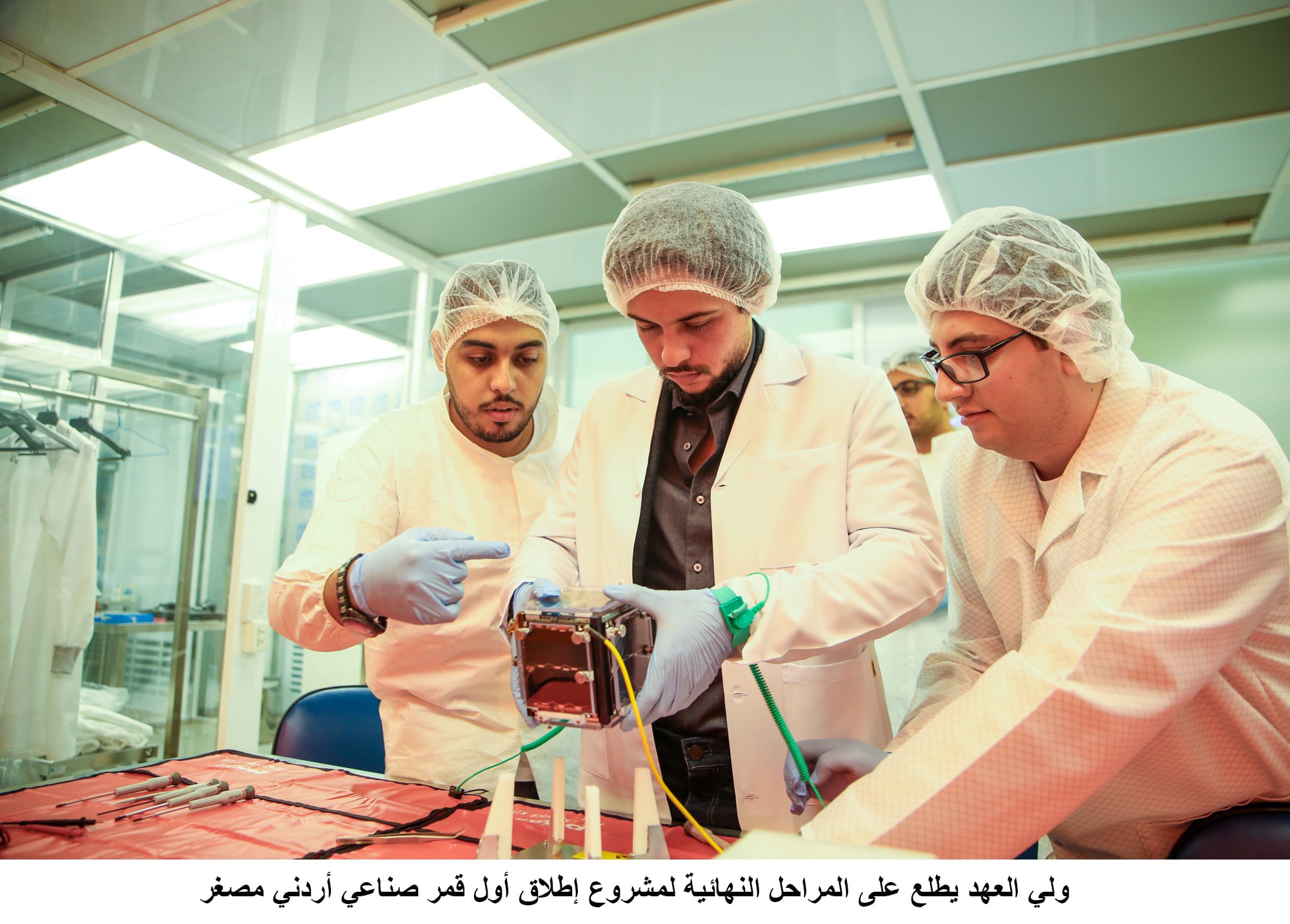
His Royal Highness Crown Prince Al Hussein bin Abdullah II with JY1-SAT CubeSat, October 23, 2017

His Royal Highness Crown Prince Al Hussein bin Abdullah II with JY1-SAT CubeSat, October 23, 2017

During the final satellite integration training for Jordan’s first satellite, JY1-SAT, the team was supported for the final stages of integration by His Royal Highness Crown Prince Al Hussein bin Abdullah II.

The spacecraft has been given to students of the Masar Initiative at the Jordan University of Science and Technology as part of the JY1-SAT mission support and training program under the Crown Prince Foundation given by ISIS – Innovative Solutions In Space and AMSAT-UK and AMSAT Netherlands.

JY1-SAT CubeSat

JY1-SAT CubeSat

The JY1-SAT mission was proposed by Jordanian students who participated in the first batch of the cooperation program with NASA, after which the interns had suggested the design and launch of the first Jordanian satellite CubeSat.

To build up the capability to design and develop such a first mission, the Crown Prince Foundation signed a support agreement with ISIS – Innovative Solutions In Space and the AMSAT Radio Amateur Societies of the UK and the Netherlands, for hardware and training support, building on ISIS’ and AMSAT’s experience with FUNcube radio amateur transponder missions.

As a special development for the JY1-SAT mission, AMSAT has expanded the capabilities of the FUNcube transponder to be able to transmit stored images reflecting the Jordanian culture and its historical heritage, along with a voice message recorded by the Crown Prince to be transmitted in space to receivers around the world.

The launch of the JY1-SAT, scheduled during the first half of next year, is in memory of His Majesty the late King Hussein, the first founder of the HAM Radio in Jordan and holder of call sign JY1.

JY1-SAT will have a linear, inverting, transponder downlinking between 145.855 & 145.875 MHz with the uplink between 435.100 & 435.120 MHz. The telemetry downlink will be on 145.840 MHz and be FUNcube compatible. A new Dashboard will be made available before the launch of JY1-SAT.

The Jordan Times – Crown Prince puts final touch on mini satellite project
http://www.jordantimes.com/news/local/crown-prince-puts-final-touch-mini-satellite-project

Caution Urged in Using High Duty Cycle Digital Modes via Satellite

Amateur Radio Satellite FO-29

Amateur Radio Satellite FO-29

A report in ANS-288 discussed an experiment operating with the WSJT-X FT8 digital mode via satellite. Satellite operators have gained more experience with this mode over this past week.

As a result of on-the-air observation other satellite users planning to try FT8 or MSK144 modes via satellite are encouraged use caution using these modes and possibly avoid their use completely in light of problems.

Dave, KG5CCI wrote, “He noticed a very hard time getting into the transponder. The pass was nearly overhead, and the 3w-4w that is normally sufficient was barely cutting it. I also noticed it was ‘up and down’ alot, whereas some moments it was easy to get in, then it would be nearly impossible. There were also pockets of ‘noise’ all over the transponder, that sounded somewhat digital, but I just couldn’t place them.” Further investigation revealed that an MSK144 signal in the transponder passband was causing the problems.

Matthew, NJ4Y noted, “Experimentation isn’t the problem, too much power is. It’s bad enough on SSB, worse with CW, and killer on constant duty cycle modes like FT8.”

To gain a full understanding of the situation readers are encouraged to follow the amsat-bb message thread which can be accessed at http://www.amsat.org/pipermail/amsat-bb/2017-October/064896.html

Source: AMSAT News Service http://www.amsat.org/mailman/listinfo/ans

CAS-4A and CAS-4B amateur radio linear transponders activated

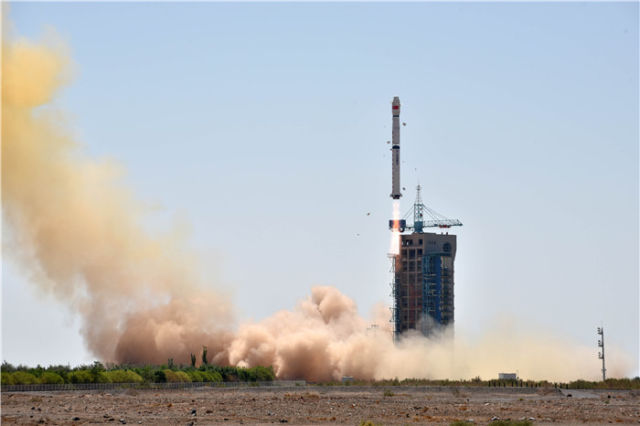
CAS-4A and CAS-4B launch on CZ-4B

CAS-4A and CAS-4B launch on CZ-4B

On Wednesday, October 18, 2017 the amateur radio linear (SSB/CW) transponders on the CAS-4A and CAS-4B satellites were activated.

CAMSAT’s amateur radio payloads piggybacked on the optical remote sensing micro-satellites ZHUHAI-1 01 (OVS-1A / CAS-4A) and ZHUHAI-1 02 (OVS-1B / CAS-4B) that were launched at 0300 GMT on Thursday, June 15, 2017 from the Jiuquan Satellite Launch Center, on the CZ-4B launch vehicle. The primary payload of the launch was a hard X-ray modulation telescope satellite (HXMT).

Satellite CAS-4A/OVS-1A/ZHUHAI-1 01:
● Architecture: Micro-satellite
● Dimensions: 494Lx499Wx630H mm
● Mass: 55 kg
● Stabilization: three-axis stabilization system with its +Y surface facing the earth
● Primary Payload: optical Camera with 1.98m resolution

CAS-4A Orbit:
● Orbit type : Sun synchronization orbit
● Apogee: 524 km
● Inclination: 43°
● Period: 95.1 minutes

CAS-4A Amateur Radio Payload:
● Call sign: BJ1SK
● VHF Antenna: one 1/4λ monopole antenna with max. 0 dBi gain located at +Z side
● UHF Antenna: one 1/4λ monopole antenna with max. 0 dBi gain located at -Z side
● CW Telemetry Beacon: 145.855 MHz 17 dBm
● AX.25 4.8k Baud GMSK Telemetry: 145.835 MHz 20 dBm
● U/V Linear Transponder Downlink: 145.870 MHz 20 dBm, 20 kHz bandwidth, Inverted
● U/V Linear Transponder Uplink: 435.220 MHz

CAS-4 Satellite

CAS-4 Satellite

Satellite Name: CAS-4B/OVS-1B/ZHUHAI-1 02:
● Architecture: Micro-satellite
● Dimensions: 494Lx499Wx630H mm
● Mass: 55 kg
● Stabilization: three-axis stabilization system with its +Y surface facing the earth
● Primary Payload: optical Camera with 1.98m resolution

CAS-4B Orbit:
● Orbit type : Sun synchronization orbit
● Apogee: 524 km
● Inclination: 43°
● Period: 95.1 minutes

CAS-4B Amateur Radio Payload:
● Call sign: BJ1SL
● VHF Antenna: one 1/4λ monopole antenna with max. 0 dBi gain located at +Z side
● UHF Antenna: one 1/4λ monopole antenna with max. 0 dBi gain located at -Z side
● CW Telemetry Beacon: 145.910 MHz 17 dBm
● AX.25 4.8k Baud GMSK Telemetry: 145.890 MHz 20 dBm
● U/V Linear Transponder Downlink: 145.925 MHz 20 dBm, 20 kHz bandwidth, Inverted
● U/V Linear Transponder Uplink: 435.280 MHz

73!
Alan Kung, BA1DU

CAMSAT Press Release PDF

N2YO online real-time tracking:
CAS-4A http://www.n2yo.com/satellite/?s=42761
CAS-4B http://www.n2yo.com/satellite/?s=42759

CAS-4A and CAS-4B

AMSAT-UK Colloquium Talks – Videos being added to YouTube

Working satellites with Arrow AntennasVideos of the presentations given at the AMSAT-UK International Space Colloquium, which was held as part of the RSGB Convention in Milton Keynes, October 14-15, are being made available on YouTube.

The first of the videos is ‘An introduction to Amateur satellites’ by David Johnson G4DPZ and Carlos Eavis G3VHF.

The PDF of the slides is here.

Other presentations are expected to be uploaded in the coming days.

Watch An introduction to Amateur satellites

PDF Slides of ‘An introduction to Amateur satellites’
https://amsat-uk.org/wp-content/uploads/2017/10/beginners-guide-to-amateur-satellites-by-dave-johnson-g4dpz.pdf

AMSAT-UK videos on YouTube https://www.youtube.com/user/AMSATUK/videos

Our thanks to the British Amateur Television Club and Wouter Weggelaar PA3WEG for their work in recording, editing and uploading these videos.