Syllabus consultation for UK amateur radio exams

A syllabus consultation is being held for the new Foundation, Intermediate and Advanced RSGB amateur radio exams.

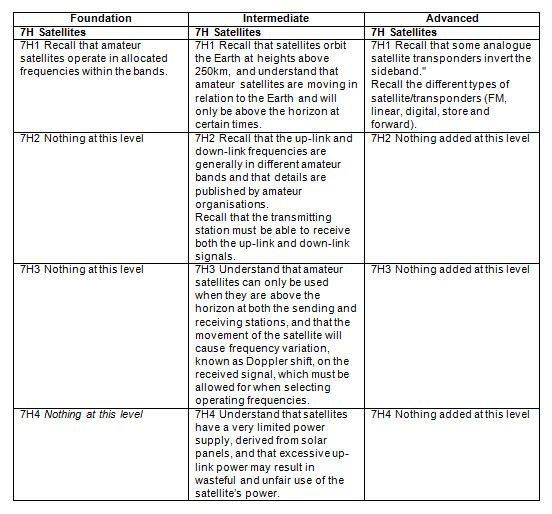
Surprisingly 7B1 Band Plans on page 56 of the consultation document proposes not teaching Foundation candidates that “transmissions on satellite frequencies should be avoided for terrestrial contacts.”

Instead it is suggested that teaching this Basic Information is delayed until Intermediate. Fewer that half of all Foundation licence holders ever do Intermediate and even those that do may take several years to get there.

The RSGB says:

A complete review of the syllabus for all three levels of the amateur radio examinations has been completed.

The draft of the new syllabus is now available for consultation together with a survey to capture any comments you may wish to make.

Please visit http://rsgb.org/syllabus_review to access the syllabus draft document and how to make your comments.

The section of syllabus relating to the Amateur Satellite Service can be seen on page 60 of the consultation document.

CAS-4A and CAS-4B Satellites from CAMSAT Launched

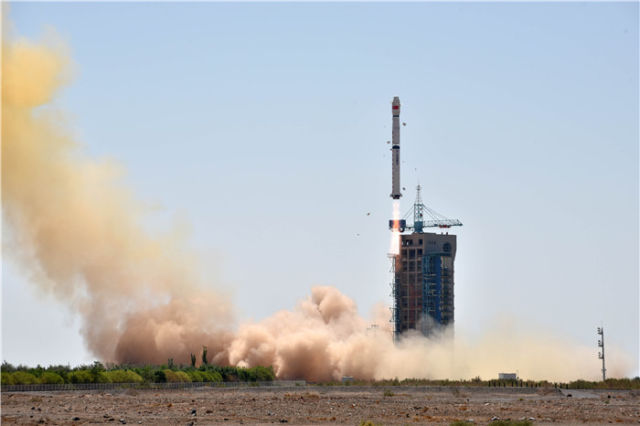
CAS-4A and CAS-4B launch on CZ-4B

CAS-4A and CAS-4B launch on CZ-4B

Two of CAMSAT’s amateur radio payloads piggybacked on the optical remote sensing micro-satellites OVS-1A and OVS-1B were launched at 0300 GMT on Thursday, June 15, 2017 from the Jiuquan Satellite Launch Center, on the CZ-4B launch vehicle. The primary payload of this launch is a hard X-ray modulation telescope satellite (HXMT).

Satellite CAS-4A/OVS-1A:
● Architecture: Micro-satellite
● Dimensions: 494Lx499Wx630H mm
● Mass: 55 kg
● Stabilization: three-axis stabilization system with its +Y surface facing the earth
● Primary Payload: optical Camera with 1.98m resolution

CAS-4A Orbit:
● Orbit type : Sun synchronization orbit
● Apogee: 524 km
● Inclination: 43°
● Period: 95.1 minutes

CAS-4A Amateur Radio Payload:
● Call sign: BJ1SK
● VHF Antenna: one 1/4λ monopole antenna with max. 0 dBi gain located at +Z side
● UHF Antenna: one 1/4λ monopole antenna with max. 0 dBi gain located at -Z side
● CW Telemetry Beacon: 145.855 MHz 17 dBm
● AX.25 4.8k Baud GMSK Telemetry: 145.835 MHz 20 dBm
● U/V Linear Transponder Downlink: 145.870 MHz 20 dBm, 20 kHz bandwidth, Inverted
● U/V Linear Transponder Uplink: 435.220 MHz

CAS-4 Satellite

CAS-4 Satellite

Satellite Name: CAS-4B/OVS-1B:
● Architecture: Micro-satellite
● Dimensions: 494Lx499Wx630H mm
● Mass: 55 kg
● Stabilization: three-axis stabilization system with its +Y surface facing the earth
● Primary Payload: optical Camera with 1.98m resolution

CAS-4B Orbit:
● Orbit type : Sun synchronization orbit
● Apogee: 524 km
● Inclination: 43°
● Period: 95.1 minutes

CAS-4B Amateur Radio Payload:
● Call sign: BJ1SL
● VHF Antenna: one 1/4λ monopole antenna with max. 0 dBi gain located at +Z side
● UHF Antenna: one 1/4λ monopole antenna with max. 0 dBi gain located at -Z side
● CW Telemetry Beacon: 145.910 MHz 17 dBm
● AX.25 4.8k Baud GMSK Telemetry: 145.890 MHz 20 dBm
● U/V Linear Transponder Downlink: 145.925 MHz 20 dBm, 20 kHz bandwidth, Inverted
● U/V Linear Transponder Uplink: 435.280 MHz

73!
Alan Kung, BA1DU

CAMSAT Press Release PDF

Keplerian Two Line Elements (TLEs) ‘Keps’ for new satellites launched in past 30 days
http://celestrak.com/NORAD/elements/tle-new.txt

CAS-4A and CAS-4B

2017 CubeSat Workshop presentations available

AO-73 (FUNcube-1) - Image credit Wouter Weggelaar PA3WEG

The 2017 CubeSat Developers Workshop, held in San Luis Obispo CA April 26-28, was the biggest event yet, with almost 550 attendees from 19 different countries!

All 2017 presentation slides are now available online at
http://mstl.atl.calpoly.edu/%7Eworkshop/archive/

You can also find all video footage from the workshop at
https://www.youtube.com/channel/UCENz0fNHsDR8Kz3jM6C_VWw

Stay tuned for the announcement of the dates for the 15th Annual Developers Workshop next year
http://www.cubesat.org/

February launch for Jordanian CubeSat

Aya Jaafari at IEEE Day 2016 event in Amman, Jordan

Aya Jaafari at IEEE Day 2016 event in Amman, Jordan

Fourth year electrical engineering student Aya Jaafari is a member of the JY1-SAT team. She says working on the CubeSat has allowed her to practically implement a lot of what she learns theoretically at university.

The Jordan Times reports on the country’s first CubeSat JY1-SAT which was built under the Masar initiative of the Crown Prince Foundation (CPF), by 16 young Jordanian men and women. The satellite is scheduled to be launched on a mission in February 2018, a date on which the team pins great hopes and ambitions.

These young Jordanians were supervised by a group of experts and academics through their weekly meetings held at the Royal Jordanian Radio Amateurs Society (RJRAS).

JY1-SAT was chosen as a tribute to His Majesty the Late King Hussein of Jordan whose amateur radio call sign was JY1.

JY1SAT LogoThe CubeSat will carry an Amateur Radio FUNcube 435/145 MHz SSB/CW transponder and a Slow Scan Digital Video (SSDV) system to transmit stored images reflecting the Jordanian culture and its historical heritage.

Read the full story at http://www.jordantimes.com/news/local/nasa-trained-young-jordanian-develops-team-nanosatellite-cubesat%E2%80%99

Royal Jordanian Radio Amateurs Society https://www.facebook.com/jy6zz/

JY6JY is a dedicated ground station to be used for communication with JY1-SAT. The call sign JY6JY is registered to the Office of Royal Highness Crown Prince Al Hussein Bin Abdullah II of Jordan
https://www.qrz.com/db/JY6JY

JY1SAT applies for frequency coordination
https://amsat-uk.org/2017/05/16/jy1sat-frequency-coordination/

Ham Radio Awareness Program at Science City Ahmedabad

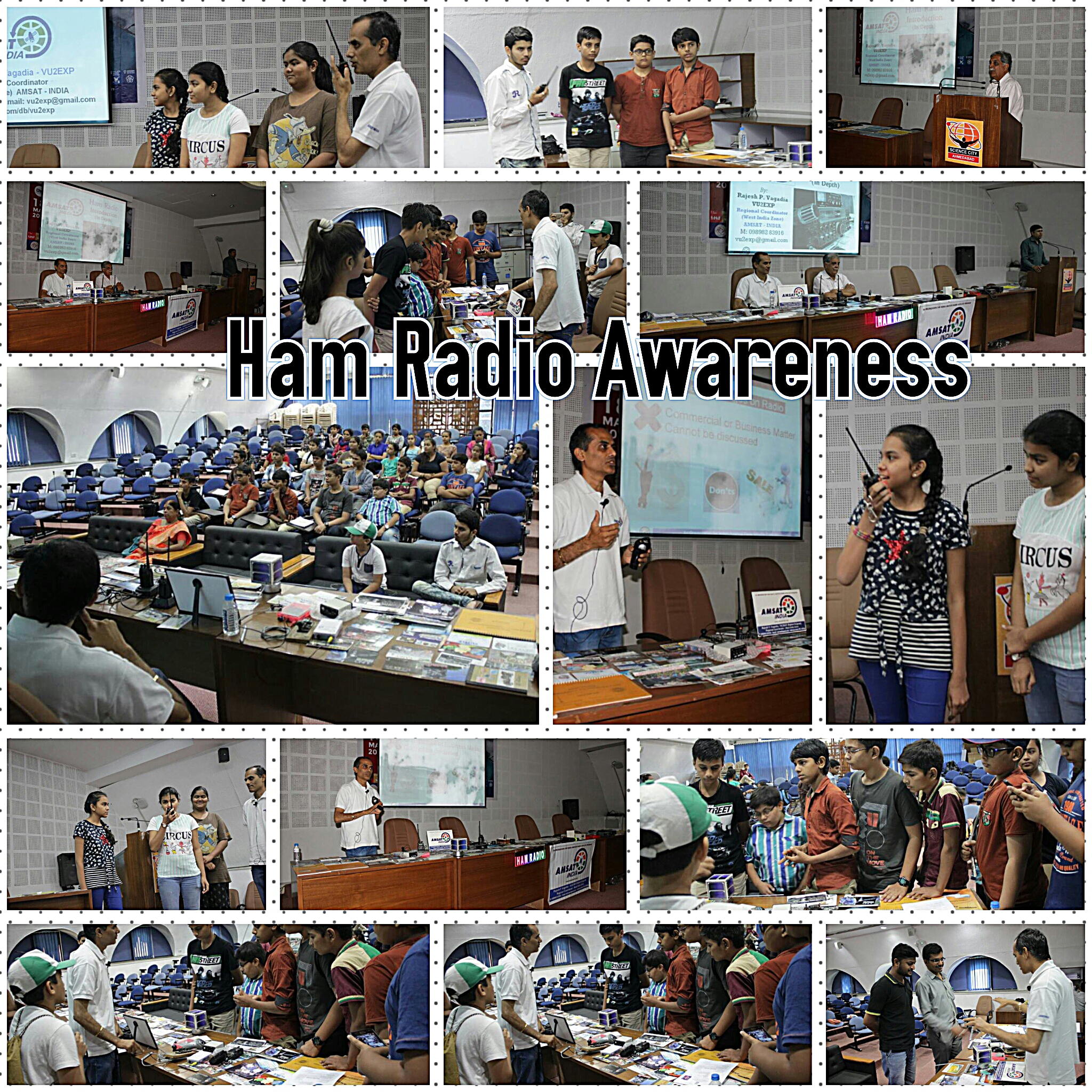
Ham Radio Awareness Program at Science City Ahmedabad May 20, 2017

Ham Radio Awareness Program at Science City Ahmedabad May 20, 2017

AMSAT-India Regional Coordinator Rajesh Vagadia VU2EXP conducted a Ham Radio Awareness program for summer camp students at Science City Ahmedabad, Gujarat, India on May 20, 2017.

The event was knowledge gaining and full of fun for small group of young students.

Participants learnt basic concept of Radio, their setup, propagation, types of conversation allowed and some limitation, communication modes, features used by hams to send voice, text, images and data, Licencing procedure in India etc.

Students were surprised to realize potential of Amateur Radio to do Satellite Communications or to have contact with Astronauts aboard ISS ! Many queries were satisfied in Question and Answer Session.

Also small VHF Demo (Modulation test) was given by young radio amateur Priyesh Vagadia VU3GLY.

We are delighted to observe young students taking interest in Amateur Radio hobby in crowded network of 3G & 4G !

We thank Shri S. D. Vora (Executive Director) and Shri Pulkesh Prajapati from Science City Ahmedabad for coordinating and supporting this event..

Tnx & 73’s
VU2EXP
Rajesh P. Vagadia
Regional Coordinator (West India Zone) AMSAT-India http://amsatindia.org/

QB50 ISS CubeSat Deployments Phase 2

QB50 ISS LogoThe second phase of QB50 CubeSats deployments from the International Space Station is now expected to take place this Thursday and Friday, May 25-26 GMT.

Check QB50-CubeSat Mission for updates.

Download the QB50 ISS CubeSat Deployment and Radio Information v3 PDF

Built by university students and research organisations from 23 countries around the world, the QB50 constellation aims to study the lower thermosphere 200-380 km above the Earth.

11 QB50 CubeSats were deployed in the first phase and a further 17 will be deployed in the second phase. The beacons should be activated about 30 minutes after deployment.

The QB50 CubeSats have downlinks between 435.7 and 438 MHz and reports from radio amateurs are most welcome. Beacon data received can be uploaded to a dedicated QB50 webpage at
https://upload.qb50.eu/

LilacSat-1 (ON02CN), which deploys at 0815 GMT on Tuesday, May 23, is carrying a FM to Codec2-BPSK Digital Voice transponder, an APRS digipeater and camera. Further information at
https://amsat-uk.org/2017/05/19/lilacsat-1-cubesat-iss/

Two of the ISS QB50 CubeSats deployed in the first phase, ON01FR 437.020 MHz and ON05FR 436.880 MHz, carry V/U FM transponders. The uplink frequency for both is 145.860 MHz with 210.7 Hz CTCSS, see http://site.amsat-f.org/2017/05/12/qb50-document-de-description-des-telemesures-des-satellites-on01fr-on05fr/

List of QB50 CubeSats with Beacon format and frequency information
https://upload.qb50.eu/listCubeSat/

Keplerian Two Line Elements (TLEs) ‘Keps’ for new satellites launched in past 30 days
http://celestrak.com/NORAD/elements/tle-new.txt

QB50 project https://www.qb50.eu/
Twitter: https://twitter.com/QB50Mission

On the deployment days radio amateurs and QB50 teams will be on the #CubeSat IRC channel. Join the deployment chat at http://irc.lc/freenode/cubesat

Don’t have a suitable 435-438 MHz receiver? Try listening online with the SUWS WebSDR located near London http://websdr.suws.org.uk/

On June 19, 2014 two precursor QB50 CubeSats were launched, QB50p1 and QB50p2, which carried amateur radio transponders
https://amsat-uk.org/2014/06/19/successful-launch-of-amateur-radio-satellite-payloads/