
Amateur Radio Project Horus on Kids TV Show “Scope”

Earth from 35km, captured by Horus 7

Terry Baume VK5VZI and the amateur radio Project Horus Balloon 22 was filmed and featured on the Channel 10 Kids Science Program, Scope TV. This program aired on May 24, 2012. For more information on project Horus check out their website, http://projecthorus.org/.

Watch Amateur Radio Project Horus on Kids TV Show “Scope”

5th Grader’s Near Space Flight http://www.uk.amsat.org/?p=8184

5th Grader's Near Space Flight

The Virginian-Pilot reports that when fifth-grader Tristan Jolley of Mack Benn Jr. Elementary school wasn’t picked to attend this year’s NASA student symposium in Houston, he was disappointed – motivated, too.

If anything, he said, it made him want to work harder. So he sent a balloon up to near space and captured some great video.

He won’t get a grade for his work, his teacher Liz Petry said she wants students to take risks and to learn from the process.

Read the full Virginian-Pilot story at http://hamptonroads.com/2012/05/suffolk-fifthgraders-project-sky-not-limit

On hearing of his success engineers from the NASA Langley Research Center visited his school, read the story at http://www.suffolknewsherald.com/2012/06/08/nasa-ventures-to-mack-benn/

Watch 5th Grade Independent study project from Tristan Jolley

5th Grader’s Near Space Flight

The Virginian-Pilot reports that when fifth-grader Tristan Jolley of Mack Benn Jr. Elementary school wasn’t picked to attend this year’s NASA student symposium in Houston, he was disappointed – motivated, too.

If anything, he said, it made him want to work harder. So he sent a balloon up to near space and captured some great video.

He won’t get a grade for his work, his teacher Liz Petry said she wants students to take risks and to learn from the process.

Read the full Virginian-Pilot story at http://hamptonroads.com/2012/05/suffolk-fifthgraders-project-sky-not-limit

On hearing of his success engineers from the NASA Langley Research Center visited his school, read the story at http://www.suffolknewsherald.com/2012/06/08/nasa-ventures-to-mack-benn/

Watch 5th Grade Independent study project from Tristan Jolley

First Tent In Space

In May 2012, while the world’s eyes were on the Space X Dragon launch, another piece of history was made.

In the Scottish Highlands four intrepid Vangonauts attempted their first mission and managed to pitch a tent at 104,000ft (over three and a half times the height of Mt Everest).

Mission control was in the Scottish Highlands near Oban. The tent was launched in light winds, and initially headed South East, before catching the jetstream and heading North East.

The tent was tracked by GPS by the ground crew who were then able to plan a rendezvous with the campers post trip. The mission landed in wilderness near Loch Tay resulting in a 10km hike through snow, hail and bogs for the ground crew to rendezvous with the intrepid campers. It is hoped that in future Space Camping missions, less remote landings can be orchestrated for the convenience of the campers.

Watch First tent in Space – short version 3:25

Watch Vango Space Camping :: Whole Trip (30:23)
Stunning HD images show the curvature of the Earth high up in the stratosphere

Project AirBeam® “Space Camping” Technical Data:

Initial ascent rate: Approx 5.5 metres per second
Trip duration: 1hour 42 mins
Trip ground distance:
– By Air: 68.91 Kilometres
– By Road: 95.8 Kilometres
Trip peak altitude: 31.5 Kilometres
Trip monitoring: 2 x GPS trackers giving location updated every 4 minutes to mission control.
Ground pressure: 1020 millibar.
Destination pressure: 3-4 millibar.
Helium use: 8 cubic metres
Launch balloon diameter (ground level): 2.5 metres
Launch balloon diameter (peak altitude): 10+ metres
Descent rate:
– Stratospheric: Approx 70-80 metres per second
– Sub Tropopause: Approx 6 metres per second

Space Camping http://www.spacecamping.org/

Around the World 28 MHz Balloon Launched

A long duration balloon mission that is using 6 Party Balloons to carry a 50 gram amateur radio 28.223 MHz CW beacon is hoping to go around the world.

The ballon was released at 2330 UT (1930 EDT) March 29, from Annapolis in Maryland and started its journey heading SE at 6 knots. By 0300 UT, March 30, it had reached a speed of 60 MPH (96 km/h).

It has no APRS, just the 28.223 MHz 100 milliwatt CW telemetry system and it is hoped to locate it by signal strength and beam headings only.

The mission is to give an insight into constant-pressure balloons and especially the use of common mylar party balloons as a fixed volume envelope. Unfortunately, these balloons have a high mass and so the theoretical maximum altitude no matter how many balloons are used is only about 26,000 feet and that is with no payload other than the fixed balloon mass.

The payload weighs about 50 grams. The team are targeting 6 party balloons 3′ in diameter which should give a float altitude around 16,000 feet.
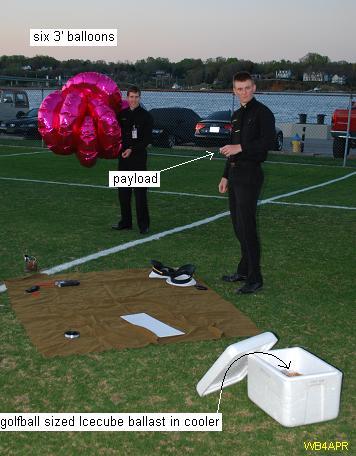
The Telemetry will be in CW on 28.223 MHz (USB DIAL) and will contain Battery voltage, inside and outside temperatures, and surface luminosity of the ocean/clouds. It has no GPS. The team will rely entirely on DF bearings and signal reports.

EMAIL DF reports to W3ADO@homeside.to Be sure to include:
Your LAT/LONG
Time of observation
Quality of heading (subjective 1 to 10)
The CW string copied

If you have APRS you can uplink your beam heading via APRS.

Since the balloon is only flying at 16,000 feet or so it will be vulnerable to weather. The battery is expected to have a lifetime of about 10 days.

Further information including details of CW telemetry at http://aprs.org/balloons.html

Thailand AMSAT High Altitude Balloon Videos

Videos have been released by the Thailand Amateur Satellite group TAMSAT showing their successful amateur radio balloon flight call sign HS1JAN-11 on March 18.

Watch the launch of MSBSAT-2

Watch MSBAT-2 at 30km and its descent to Earth

Watch a timelapse video of the balloon being assembled

The track of the balloon can be seen at http://aprs.fi/#!call=a%2FHS1JAN-11&timerange=3600