UK Scouts to talk to Space Station

1st Radford Semele Scout Group ISS ContactThe amateur radio scouting event Jamboree On The Air (JOTA) is taking place this weekend October 18-19.

Scouts from the 1st Radford Semele Scout Group at Radford Semele, UK, are planned to talk to astronaut Jonny Kim KJ5HKP on the International Space Station on Saturday, October 18 at 10:49 AM BST (09:49:40 GMT).

Jonny Kim will answer questions from Scouts in United Kingdom during this live amateur radio contact.

Astronaut Jonny Kim will operate the amateur radio station call sign NA1SS aboard the ISS and will call the radio amateur ground station call sign GB4RSS in United Kingdom. This is a live ARISS radio contact from the 1st Radford Semele Scout Group in Radford Semele, UK. You can listen live to astronaut Jonny Kim aboard the ISS on 145.800 MHz FM (plus/minus 3 kHz Doppler shift).

1st Radford Semele Scout Group ISS HamTVThe Space Station amateur radio transmission should be receiveable across the British Isles and Europe using just a handheld radio with a 1/4 wave whip.

Many FM rigs can be switched been wide and narrow deviation FM filters. For best results you should select the filter for wider deviation FM. Handhelds generally have a single wide filter fitted as standard.

The space and ground teams will attempt to use the recently reinstalled HamTV transmitter during this contact. HamTV DATV frequency is 2395 MHz.

In preparation for this ARISS contact, the HamTV transmitter will be tested with a color bar screen during the preceding pass. The pre-contact pass over Europe is at 8:15 UTC.

The event will be streamed live:
https://www.youtube.com/watch?v=LFBgDKPg4Mk

The HamTV downlink will be streamed:
https://live.ariss.org/hamtv/

English is the expected language of communication for this amateur radio contact.

Questions:
1. Is being on the ISS like living on Mars
2. Can you see the Milky Way from there?
3. Do plants still grow towards the sun on the ISS?
4. What’s the funniest thing that’ has happened to you in space
5. What happens if you drop something in space, does it float forever?
6. Have you ever seen a space storm or shooting star from the ISS
7. Have you ever had to fix something important in space, and what happened?
8. Do you ever play tricks or jokes on each other
9. What do you eat for breakfast in space? Cereal would float away
10. How does a space walk feel?
11. Does food taste different in space? Better or worse?
12. What’s the coolest experiment you’ve done in space?
13. Do you feel Dizzy when you get back to earth
14. With Halloween coming up, do you hear creepy sounds on the ISS?
15. Do you play Board Games on the ISS? Which ones?
16. What’s the most difficult challenge you’ve faced while living on the space station?

The ARISS program is aimed at students and enthusiasts and aims to inspire them in the study of sciences with this amateur radio activity. The demonstration of amateur radio communication from space invites schools and universities to make use of these educational technical resources. We invite radio amateurs and space enthusiasts to tune in to this exciting moment.

Check out the ARISS website and follow ARISS on the official social media channels for more updates.
https://www.ariss.org/contact-the-iss.html

ARISS-Europe News Bulletins are distributed by AMSAT Belgium.

Follow @ARISS_intl on X for official updates, since schedule changes can occur.

Follow AMSAT-UK on X

SSTV from the ISS in July

ISS SSTV Series 28An ARISS SSTV event from the International Space Station will begin no earlier than July 14 with the expectation that the event will run through the weekend into the beginning of the following week.

This is all subject to Axiom Mission AX-4 schedule and other operational considerations. AX-4 is expected to depart from ISS on Monday, July 14 at 11:05 GMT (12:05pm BST)

The subject will be the 50th anniversary of the Apollo-Soyuz Test Project (ASTP) and the 40th anniversary of STS-51F.

STS-51F was the second SAREX flight and had the first use of SSTV in human spaceflight.

Start: Monday, July 14 1605 GMT (10:45am BST)
End: Sunday, July 20 1800 GMT (7pm BST)

Frequency: 145.800 MHz FM (+/-3.5 kHz Doppler Shift)
SSTV Mode: PD120 (Transmission cycle 2 minutes on, 2 minutes off)

You are invited to upload decoded images in the ARISS gallery, area “ARISS Series 28 Apollo Soyuz and STS-51F” at: https://ariss-usa.org/ARISS_SSTV/

Once you’ve submitted, just clicking on the dedicated button you can apply for the official ARISS SSTV award.

Also, you can request the ARISS QSL by contacting the European QSL bureau: https://www.ariss-eu.org/index.php/ariss-station/european-qsl-bureau

To support everyone interested in such events, the European Space Agency released tutorials about how to receive pictures transmitted over amateur radio by the International Space Station: you can find them on https://issfanclub.eu/2024/11/08/esa-tips-how-to-get-pictures-from-the-international-space-station-via-amateur-radio-2/

It’s always possible to receive the ISS SSTV signal by using the WebSDR at the Goonhilly Earth Station, the audio can then be fed into your PC or Smartphone SSTV App  https://vhf-goonhilly.batc.org.uk/

Follow @ARISS_intl on X for official updates, since changes can occur.

Reminder, the images are sent on a (roughly) 2 minutes on, 2 minutes off schedule. So if you don’t hear anything, give it 2 minutes!

Many FM rigs can be switched been wide and narrow deviation FM filters. For best results you should select the filter for wider deviation FM. Handhelds generally have a single wide filter fitted as standard.

You can get predictions for the ISS pass times at https://www.amsat.org/track/

Useful information on receiving the pictures and links for Apps to display the pictures can be found here:
https://amsat-uk.org/beginners/iss-sstv/

You may be able to get publicity for the amateur radio hobby if you contact your local newspaper and tell them you’ve received a picture (doesn’t have to be perfect) from the International Space Station, see
https://amsat-uk.org/2015/02/04/iss-sstv-in-uk-press/

Follow AMSAT-UK on X

ISS SSTV Dec 1 145.800 MHz FM

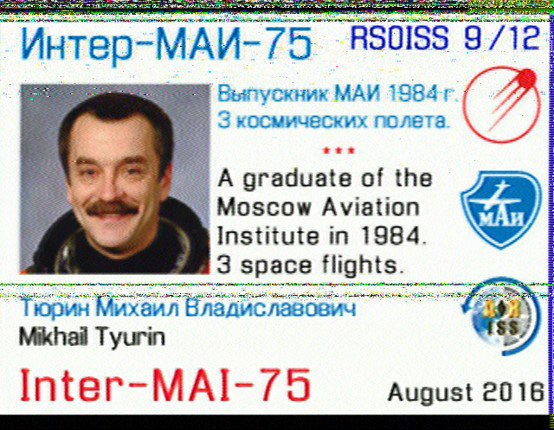
ISS SSTV MAI-75 image 9/12 received by Chertsey Radio Club on Baofeng handheld

ISS SSTV MAI-75 image 9/12 received by Chertsey Radio Club on Baofeng handheld

Russian cosmonauts on the International Space Station (ISS) are planning to transmit Slow Scan TV images on 145.800 MHz FM using the SSTV mode PD-120.

The transmissions are part of the Moscow Aviation Institute SSTV experiment (MAI-75) and will be made from the amateur radio station RS0ISS in the Russian ISS Service module (Zvezda) using a Kenwood TM-D710 transceiver.

December 1, 2021 (Wednesday) from 12:25 GMT until 18:45 GMT*

*Dates and times subject to change.

The signal should be receivable on a handheld with a 1/4 wave whip. If your rig has selectable FM filters try the wider filter for 25 kHz channel spacing.

You can get predictions for the ISS pass times at https://www.amsat.org/track/

ARISS SSTV Blog https://ariss-sstv.blogspot.com/

Useful SSTV info and links https://amsat-uk.org/beginners/iss-sstv/

ESA promote amateur radio in ISS SSTV video

The space agency ESA has released a video ‘How to get pictures from the International Space Station via Amateur Radio’ along with a collection of Tutorial videos explaining how to receive ISS Slow Scan TV (SSTV) pictures for different computers and mobile devices.

Did you know that astronauts on the International Space Station send pictures from space to ground over amateur radio that you yourself can get at home using your computer? ESA show you how to get them, step by step.

The video features radio amateur David Honess 2E0XDO (ex-M6DNT).

Watch How to get pictures from the International Space Station via amateur radio

See these Tutorials on how to receive SSTV pictures from the ISS for specific operating systems such as Windows 10, Apple iOS & Mac OSX, Android, Raspberry Pi, etc
https://www.esa.int/ESA_Multimedia/Sets/Radio_ISS/(result_type)/videos

YouTube Tutorials Playlist https://www.youtube.com/watch?v=HtC-BPcMruA&list=PLbyvawxScNbt5Mjfty4Ik-Tt6du-6N5jD

Read the Raspberry Pi article Pictures from space via ham radio
https://www.raspberrypi.org/magpi/pictures-from-space-via-ham-radio/

ISS SSTV info and links https://amsat-uk.org/beginners/iss-sstv/

What is Amateur Radio? http://www.essexham.co.uk/what-is-amateur-radio

Free UK amateur radio online training course https://www.essexham.co.uk/train/foundation-online/

Sarah Brightman to start space flight training in January

Private Spacefarer Sarah Brightman Undergoes Medical Tests

Private Spacefarer Sarah Brightman Undergoes Medical Tests

Sarah Brightman hopes to launch to the International Space Station (ISS) for a 10 day mission in September 2015. If the launch were to take place as expected she would become the UK’s second astronaut, the first was Helen Sharman GB1MIR on May 18, 1991. Tim Peake KG5BVI is expected to launch in November 2015.

TASS reports the soprano singer Sarah Brightman would begin pre-flight training for her journey to the International Space Station (ISS) as a private spacefarer early next year, instead of this autumn, Yuri Lonchakov, the head of the Russia’s Gagarin Cosmonaut Training Centre, said on Wednesday. “She will begin training in the Star City in January of 2015 and therefore we are all waiting for her,” Lonchakov said adding that he believed “her training will be a success.”

She is paying $52 million for the flight considerably more than the $20 million that Iranian-American engineer Anousheh Ansari paid for her mission to the ISS in 2006, highlighting the dramatic escalation in launch charges in recent years.

Sarah Brightman - DreamchaserSarah started her singing career in the 1970’s and had hits such as “I Lost My Heart to a Starship Trooper” and “Love in a UFO”. She is now a classical crossover artist.

In 2012 in conjunction with Virgin Galactic, The Brightman STEM Scholarship program (science, technology, engineering, and mathematics) was launched to help young women in the US pursue STEM education across their four year college careers.

Her album, “Dreamchaser” was released on January 22, 2013. She said “I don’t think of myself as a dreamer. Rather, I am a dream chaser, I hope that I can encourage others to take inspiration from my journey both to chase down their own dreams and to help fulfill the important UNESCO mandate to promote peace and sustainable development on Earth and from space. I am determined that this journey can reach out to be a force for good, a catalyst for some of the dreams and aims of others that resonate with me.” She intends to become the first professional musician to sing from space.

It is not yet known if she will make any amateur radio contacts while on the ISS. In 1991 the first UK astronaut Helen Sharman was issued with a special callsign GB1MIR by the Radiocommunications Division of the Department of Trade and Industry (DTI). She was then able to contact radio amateurs on Earth during her stay on the MIR space station.

Read the TASS story at http://en.itar-tass.com/non-political/747859

You can sign up to receive updates on Sarah’s mission at  http://www.sarahbrightman.com/

Wiki – Sarah Brightman http://en.wikipedia.org/wiki/Sarah_Brightman

Space Adventures http://www.spaceadventures.com/

International Space Station - Image Credit NASA

International Space Station – Image Credit NASA

Amateur radio CubeSats prepared for deployment

Koichi Wakata KC5ZTA installing CubeSat deployers on the Multipurpose Experiment Platform inside the Kibo laboratory of the ISS

Koichi Wakata KC5ZTA installing CubeSat deployers on the Multipurpose Experiment Platform inside the Kibo laboratory of the ISS

NASA reports that on Thursday, February 20, 2014, International Space Station (ISS) astronaut Koichi Wakata KC5ZTA worked in the Japanese Kibo laboratory to prepare the second batch of NanoRacks CubeSats for their deployment beginning next Tuesday.

He opened the inner hatch to the airlock and replaced the empty deployers on the Multipurpose Experiment Platform with loaded deployers. The platform and its deployers will be passed outside through the airlock to the Exposed Facility where Kibo’s robotic arm can grapple the platform and position the nanosatellites for launch. NanoRacks provides customers with CubeSat deployment services through a Space Act Agreement with NASA.

The deployment of the 12 commercial Planet Labs CubeSats is expected to take place at 1700 UT on Tuesday, February 25. The four amateur radio CubeSats LituanicaSat-1, LitSat-1, ArduSat-2, UAPSat-1 along with the 915 MHz SkyCube are expected to be deployed on Friday, February 28 at 07:30 UT.

Another amateur radio CubeSat the Peruvian Chasqui-1 was sent to the ISS on February 5, 2014. It is understood that Chasqui 1 is scheduled to be hand-deployed during a future Russian Extravehicular Activity (EVA).

CubeSats deployments are streamed live at http://m.ustream.tv/channel/live-iss-stream

For frequencies of the amateur radio CubeSats and pictures of previous deployments see
https://amsat-uk.org/2014/02/20/iss-cubesat-deployments-to-resume-february-25/