ISS Symposium 2012 “Research in space for the benefit of humankind”

Radio amateur Andy Thomas G0SFJ has been invited to the ESA ISS Symposium 2012 to be held in Berlin, May 2-4.

The Symposium aims to review and discuss the key accomplishments in research made to date, looking at case-studies in fundamental and applied research and the actual or potential spin-offs for the benefit of humankind, as well as to discuss the future path and priorities for research on ISS.

The Symposium will take place at the Hilton Hotel in Berlin, Germany, starting at 13h00 (after lunch) on Wednesday, May 2, and will run until around 13h00 on Friday, May 4, 2012. Attendance will be free of charge for all invited and registered guests.

ESA ISS Symposium http://www.isssymposium2012.com/

Astronaut’s Flashing Success

Blue Laser Flash seen from ISS

Light (top center) flashed from the Lozano Observatory, about 40 miles north of San Antonio, was easily visible from orbit. Click on the image to see it full-sized.

Radio amateur and ISS astronaut Don Pettit KD5MDT describes how he succeeded in receiving signals on a frequency of 650 THz.

Flashing the International Space Station with beams of light as it passes overhead had never been successfully done—until now.

It sounds deceptively easy. In an earlier post I wrote about the technical requirements. But like so many other tasks, it becomes much more involved in the execution than in the planning.

Early Sunday morning, at 01:27 our time, the San Antonio Astronomical Association, an amateur astronomy group, succeeded in flashing space station with a one-watt blue laser and a white spot light as we passed overhead. This took a number of engineering calculations. Projected beam diameters (assuming the propagation of a Gaussian wave for the laser) and intensity at the target had to be calculated. Tracking space station’s path as it streaked across the sky was another challenge. I used email to communicate with Robert Reeves, one of the association’s members. Considering that it takes a day, maybe more, for a simple exchange of messages (on space station we receive email drops two to three times a day), the whole event took weeks to plan.

I was ready with cameras for the early morning San Antonio pass and can report that it was a flashing success. Here’s one of the pictures to prove it.

Don Pettit KD5MDT

Astronaut's Flashing Success

Blue Laser Flash seen from ISS

Light (top center) flashed from the Lozano Observatory, about 40 miles north of San Antonio, was easily visible from orbit. Click on the image to see it full-sized.

Radio amateur and ISS astronaut Don Pettit KD5MDT describes how he succeeded in receiving signals on a frequency of 650 THz.

Flashing the International Space Station with beams of light as it passes overhead had never been successfully done—until now.

It sounds deceptively easy. In an earlier post I wrote about the technical requirements. But like so many other tasks, it becomes much more involved in the execution than in the planning.

Early Sunday morning, at 01:27 our time, the San Antonio Astronomical Association, an amateur astronomy group, succeeded in flashing space station with a one-watt blue laser and a white spot light as we passed overhead. This took a number of engineering calculations. Projected beam diameters (assuming the propagation of a Gaussian wave for the laser) and intensity at the target had to be calculated. Tracking space station’s path as it streaked across the sky was another challenge. I used email to communicate with Robert Reeves, one of the association’s members. Considering that it takes a day, maybe more, for a simple exchange of messages (on space station we receive email drops two to three times a day), the whole event took weeks to plan.

I was ready with cameras for the early morning San Antonio pass and can report that it was a flashing success. Here’s one of the pictures to prove it.

Don Pettit KD5MDT

Radio Hams send photo via satellite

ARISSat-1 Deployment

ARISSat-1 Deployment

The Cincinnati press reports that two Anderson Township amateur radio operators recently sent and received a photo from a satellite that was manually deployed from the International Space Station (ISS).

Farrell Winder W8ZCF and his son Jeff Winder KB8VCO achieved this despite the fact that an antenna on the satellite had snapped off prior to launch.

Read the Cincinnati press article at http://communitypress.cincinnati.com/apps/pbcs.dll/article?AID=/C2/20120301/NEWS/303010057/

HamRadioNow – AMSAT Edition

In this HamRadioNow video Lou McFadin W5DID describes the ARISSat-1 satellite, using the operational model at the AMSAT booth at the Orlando HamCation. HamRadioNow says Gary KN4AQ feels inadequate in the presence of such accomplished hams, and he insults the astronauts. That makes Lou uncomfortable, so he goes on to talk about the future of AMSAT and ARISSat.

Lou says that the reason for the ARISSat-1 435 MHz antenna snapping off was due to damage in transit up to the Internatonal Space Station (ISS). He mentions that he hopes NASA can be persuaded to take ARISSat-2 to the ISS. Lou also describes the problems caused by the US Federal Government ITAR restrictions.

Watch HamRadioNow Episode 2, Part 2 – AMSAT

The grab handles shown on ARISSat were supplied by a member of AMSAT-UK.

HamRadioNow http://HamRadioNow.TV/

YouTube Channel http://www.youtube.com/user/HamRadioNow

ISS Astronaut Active on 145.800 MHz

André Kuipers PI9ISS on ISS

André Kuipers PI9ISS on the ISS

Astronaut André Kuipers PI9ISS was calling CQ from the International Space Station on 145.800 MHz FM on both Saturday and Sunday afternoon, Feb. 25-26.

Paul Waddington M6WAD

Paul Waddington M6WAD and son Ethan

André worked mainly Dutch stations although one UK Foundation holder Paul Waddington M6WAD was lucky enough to have a contact with him on Sunday.

Paul says “I am absolutely thrilled to have had a QSO with the ISS. I just thought I would put out a random call, as I have done so many times in the past, and he answered me. I must say, when he did reply, I became a little tongue tied in disbelief!!! I use a Yaesu FT7900 to a Comet GP-15N Triband antenna.”

When the astronauts work other radio amateurs back on Earth they transmit on 145.800 MHz FM but operate “split” listening for replies 600 kHz lower on 145.200 MHz. If you are lucky and hear them calling CQ just remember to activate your rigs repeater shift to ensure you reply on the correct frequency. You should never transmit on 145.800 MHz.

The amateur rado station on the ISS runs QRP, just 5 watts of FM to an omni-directional antenna. Despite the low power it is a strong signal and can easily be received on a handheld radio with quarter wave whip.

Get the latest status of the space station at the ISS Fan Club http://www.issfanclub.com/

Read ‘Listening to the International Space Station’ http://www.uk.amsat.org/3491

M6WAD http://www.qrz.com/db/M6WAD
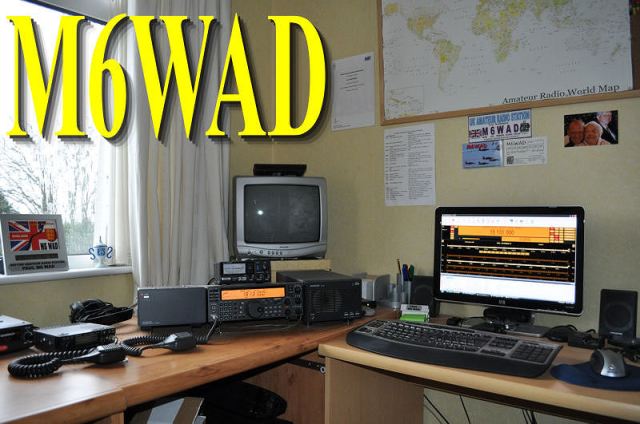
M6WAD Station

M6WAD Station